



A code of honor is defined as an explicit set of principles that governs personal or collective behavior by establishing clear boundaries of acceptable conduct, backed by accountability. This definition matters because it separates a true code from a vague list of good intentions. In 2026, understanding what is a code of honor means recognizing it as a living framework, not a relic of rank or birthright. Moderndayknightco was built on exactly this foundation: the belief that honor is something you practice daily, not something you inherit. The modern knight concept reflects this shift from tradition to intentional, testable commitment.
What is a code of honor in 2026, and how is it structured?
A code of honor is an implicit or explicit set of systematic personal or collective principles that guide integrity rather than legal conduct. That distinction is critical. Laws tell you what you cannot do. A code of honor tells you who you refuse to become. It functions as a compass for behavior, making certain acts like deception or betrayal socially and personally unacceptable, regardless of whether they are illegal.
The structure of a functioning code has three essential components. First, core principles define what you stand for. These are your non-negotiable values: loyalty, truth, accountability, and respect. Second, explicit behavioral boundaries specify what you will and will not do. Third, an accountability mechanism gives the code real teeth.

CoachVersity identifies this clearly: without defined principles, explicit boundaries, and accountability mechanisms including a permitted challenger, a code remains a list of aspirations rather than an active operating framework. That gap between aspiration and operation is where most personal ethics codes fail.
Pro Tip: Draft your code using observable, testable behavior standards. Instead of writing “be honest,” write “I will not misrepresent facts to gain advantage, even under pressure.” A stranger should be able to read your code and immediately recognize a breach.
Why is a code of honor important in 2026?
A code of honor bridges personal integrity with external social reputation. If a code is not observable externally, it loses its social utility and weakens group cohesion. This is not a philosophical point. It is a practical one. Communities, teams, and families function on trust. A code of honor makes that trust visible and testable.
The importance of a code of honor in 2026 shows up in several concrete ways:
- Trust building: A clear code signals to others what they can expect from you, reducing the friction of uncertainty in relationships.
- Pressure resistance: Effective honor codes create friction in decision-making under pressure by establishing non-negotiable commitments that prevent ethical shortcuts.
- Group cohesion: Shared codes align behavior across teams, military units, and communities, creating a common standard everyone can hold each other to.
- Professional credibility: Leaders who operate by a visible code earn a reputation that outlasts any single decision or mistake.
- Personal clarity: A code removes the need to renegotiate your values every time a difficult situation arises.
Military ethics offer the clearest example of this in action. The U.S. Armed Forces have long used honor codes to define conduct under extreme pressure. Those codes do not just prohibit bad behavior. They define what a soldier stands for when no one is watching.
“Honor codes historically function as mechanisms for social cohesion and trust. A code that exists only in the mind of its author is not a code at all. It is a preference.”
How does the concept of honor evolve to meet contemporary standards?
Honor is not static. Modern honor is evolving to emphasize interpretive attitudes aligned with contemporary justice, accountability, and equality rather than fixed traditional values. Military ethics exemplify this shift by incorporating respect for civilians and human rights as core to honor, not just battlefield courage or rank-based deference.
Traditional codes of honor were often tied to social class, gender roles, and institutional loyalty above all else. A knight’s code in medieval Europe prioritized fealty to a lord. A 19th-century officer’s code prioritized the regiment. These frameworks served their time. They do not serve 2026.
The table below shows how the core features of honor codes have shifted:
| Feature | Traditional code | 2026 code of honor |
|---|---|---|
| Source of authority | Rank, birthright, institution | Personal choice and commitment |
| Accountability | Peers within the same class | Designated witness, any trusted party |
| Flexibility | Rigid and static | Interpretive, reviewed under new contexts |
| Core values | Loyalty to hierarchy | Integrity, equality, and restraint |
| Breach consequence | Social exile or duel | Loss of personal and professional trust |
| Scope | Collective and class-based | Individual and community-facing |
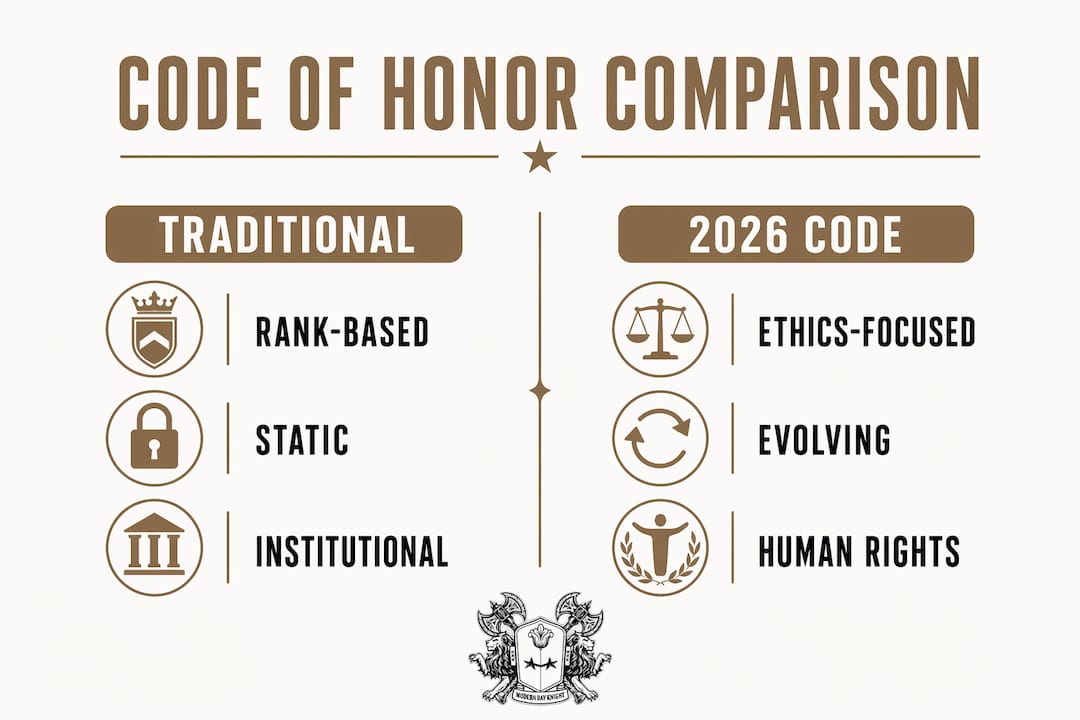
The 2026 ethics code integrates professionalism, restraint, and respect for human rights as non-negotiable pillars. This is not softening the concept of honor. It is sharpening it. A code that excludes accountability to those outside your group is not honor. It is tribalism.
How can you create and maintain an effective personal code of honor?
Building a personal code of honor is a deliberate process. It requires specificity, honesty, and a willingness to be held accountable by someone other than yourself.
- Define your core principles. Choose three to five values that represent who you are at your best. Loyalty, integrity, and courage are common starting points. Be specific about what each means to you in practice.
- Set explicit behavioral boundaries. For each principle, write one or two behaviors you commit to and one or two you refuse to engage in. These must be observable. Vague aspirational language such as “be honest” is less effective than clear, observable behavioral standards that specify what would immediately signal a breach.
- Designate a witness. A functional code of honor requires a designated witness with standing to challenge the author’s actions. Without this, the code drifts under pressure through subconscious reinterpretation.
- Audit regularly. Review your code quarterly. Ask your witness whether your behavior matches your stated commitments. Adjust language, not values, when context changes.
- Distinguish compromise from erosion. A strong code distinguishes legitimate compromises that serve real goals from erosion justified by convenient reasoning. Define this distinction in advance.
The most common pitfall is writing a code that sounds good but cannot be tested. If your code says “I value integrity,” that tells no one anything. If it says “I will not misrepresent my qualifications, even when the truth costs me an opportunity,” that is a code you can live by and be held to.
Pro Tip: Use a physical reminder to anchor your code. A purposeful lifestyle piece worn daily, a written card in your wallet, or a symbolic object on your desk keeps your commitments visible and present. What you see daily, you remember under pressure.
Key Takeaways
A code of honor in 2026 is a practical, testable framework of explicit principles and accountability mechanisms, not a vague statement of good intentions.
| Point | Details |
|---|---|
| Definition matters | A code of honor governs behavior through explicit principles, not aspirational language. |
| Three core components | Every effective code needs core principles, behavioral boundaries, and an accountability witness. |
| Social function is real | A code that cannot be observed externally loses its power to build trust and group cohesion. |
| Honor evolves | Modern codes prioritize equality, restraint, and accountability over rank or tradition. |
| Specificity is the standard | Observable, testable behavior standards make a code enforceable and meaningful under pressure. |
What living by a code actually costs you
Most people treat a code of honor as a reputation tool. That is the wrong frame. A working code of honor acts as an operating manual that limits personal freedom under pressure to prevent ethical shortcuts. That is not comfortable. It is not supposed to be.
We have seen this play out in veteran communities, in leadership roles, and in everyday life. The moment a code gets tested is the moment it either holds or reveals itself as decoration. The people who maintain their codes under pressure are not the ones with the most willpower. They are the ones who built the right structure in advance: clear principles, specific boundaries, and a witness who will call them out.
The hardest part of maintaining a code is not the big decisions. It is the small ones. The half-truth that saves you embarrassment. The shortcut that no one would notice. A code of honor is most valuable precisely in those moments, because it removes the negotiation. You already decided. You just have to follow through.
Balancing flexibility with commitment is real work. Codes should be reviewed and refined. But there is a difference between refining a code and abandoning it when it becomes inconvenient. That distinction must be built into the code itself, specified in advance, not decided in the moment when pressure is highest.
Living by a code is not about perfection. It is about having a standard you return to, every time, without exception.
— Modern Day Knight
Apparel that carries the weight of your commitments

At Moderndayknightco, we believe what you wear can reinforce what you stand for. Our accountability-focused apparel is designed for people who take their code seriously, not as a fashion statement, but as a daily reminder of the commitments they have made. Every piece carries a message rooted in integrity, loyalty, and strength. The Accountability Tee and the full line of warrior-inspired hats are built for those who want their values visible, not just internal. Veteran-owned and operated, Moderndayknightco exists for the community that lives by a code, not just talks about one.
FAQ
What is a code of honor, simply defined?
A code of honor is an explicit set of personal or collective principles that governs behavior and integrity, backed by accountability mechanisms. It goes beyond legal rules to define who you commit to being under pressure.
How is a 2026 code of honor different from traditional ones?
Modern codes prioritize equality, accountability to any trusted witness, and interpretive flexibility over rank-based or class-based loyalty. They are personal commitments, not institutional obligations.
Why does a code of honor need a witness?
A designated witness with standing prevents the code from drifting through subconscious reinterpretation. Without external accountability, a code becomes whatever is convenient in the moment.
What makes a code of honor effective vs. ineffective?
Effective codes use observable, testable behavioral standards. Ineffective codes rely on vague aspirational language like “be honest” that no one can objectively measure or enforce.
Can a code of honor apply to professional life?
A code of honor applies directly to professional conduct by establishing non-negotiable commitments that prevent ethical shortcuts under career pressure, protecting both personal integrity and professional reputation.


