



Courage is the consistent choice to act in alignment with your values despite fear or discomfort. That definition sits at the heart of the role of courage in everyday warrior living. Most people wait for a crisis to test their bravery. Warriors do not wait. They build it daily, through small decisions that most people overlook. Psychological frameworks from Psychology Today, insights from Gregory Crawford, and practical tools like the 6-step courage decision framework all confirm the same truth: the warrior ethos is built one ordinary moment at a time.
What kinds of courage build the everyday warrior mindset?
Six distinct types of everyday courage form the foundation of daily resilience and mental strength. Recognizing each type helps you spot the moments when courage is actually being called on, even when they feel routine.
| Courage Type | Daily Example | Outcome |
|---|---|---|
| Moral courage | Speaking truth when it costs you | Builds integrity and trust |
| Social courage | Setting boundaries with people you respect | Strengthens self-respect |
| Emotional courage | Admitting fear or grief openly | Deepens connection and self-awareness |
| Physical courage | Pushing through discomfort in training | Builds endurance and discipline |
| Intellectual courage | Challenging your own assumptions | Sharpens thinking and adaptability |
| Vital courage | Facing illness or mortality with resolve | Cultivates peace and purpose |
Most people only count physical courage as “real” bravery. That is a mistake. Moral courage, the willingness to say the hard thing in a meeting or stand by a principle when it costs you socially, is often harder than any physical test. Emotional courage, the act of naming your fear out loud, is one of the most underrated forms of strength a person can develop.
Everyday courage is built on choices that align your behavior with your values, including the willingness to communicate honestly and rise in uncertainty. That alignment is what separates a warrior from someone who simply endures.

Pro Tip: When you feel resistance before a conversation or decision, pause and name which type of courage is being asked of you. Labeling it makes it real and makes acting on it easier.
How do you cultivate courage daily?
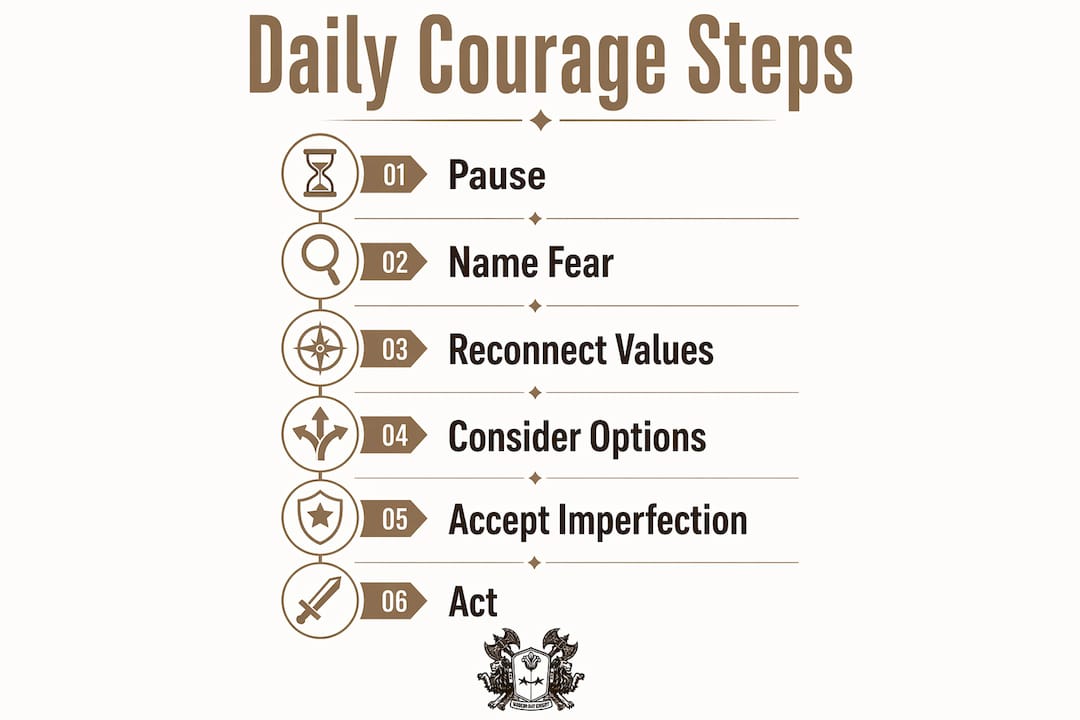
The most effective process for building courage is a 6-step decision-making framework designed for consistent daily use. It does not require dramatic circumstances. It works in the middle of an ordinary Tuesday.
- Pause. Stop before reacting. Create space between the trigger and your response.
- Name the Fear. Say it plainly. “I am afraid of being wrong.” “I am afraid of rejection.” Naming it reduces its power.
- Reconnect with Values. Ask what your code demands here. Honor, loyalty, integrity. Let those guide the next move.
- Consider Options. Look at what is actually available to you. Most fear narrows your thinking. Expanding options restores clarity.
- Accept Imperfection. You will not get it perfectly right. Courage includes willingness to start and adapt, not waiting until you feel fully ready.
- Decide and Act. Move. Imperfect action beats perfect hesitation every time.
This framework works because it interrupts the automatic fear response and replaces it with a values-driven process. Experts in 2026 emphasize that incremental exposure to manageable discomfort builds long-term mental toughness more effectively than rare, massive risks. That means applying this framework to small daily decisions matters more than saving it for emergencies.
The warrior does not train only for battle. The warrior trains every day so that when the moment arrives, the response is already built in. Courage works the same way. Small reps, done consistently, create a person who acts with strength when it counts.
Pro Tip: Run through this 6-step process once a day on a low-stakes decision. A difficult email, a hard conversation, a commitment you have been avoiding. The repetition builds the habit before the high-pressure moments arrive.
Myths about courage versus the reality of warrior living
The biggest myth about courage is that it belongs to extraordinary moments. It does not. The warrior ethos lives in the ordinary.
- Myth: Courage means you are not afraid. Reality: Courage is acting despite fear. Fear is the signal, not the stop sign.
- Myth: You need a crisis to prove your courage. Reality: Small courageous acts build psychological resilience that prepares you for larger challenges.
- Myth: Waiting until you feel ready is responsible. Reality: You will never feel fully ready. Courage includes the willingness to start and adjust as you go.
- Myth: Failure means you lacked courage. Reality: High failure-to-success ratios are normal in courageous attempts. Failure is time spent learning, not wasted effort.
- Myth: Courage is recklessness. Reality: Gregory Crawford defines courage as a directive action grounded in clarity and balanced risk assessment, not impulsive behavior.
Mark Ormrod makes the point directly: the modern battlefield is internal. Comfort, distraction, mediocrity, and self-doubt are the real enemies. The warrior mind for daily life involves deliberate discomfort and mission clarity, not waiting for an external threat to show up.
This reframe matters. When you stop waiting for a dramatic test and start treating every day as the training ground, your relationship with courage changes completely. You stop asking “Am I brave enough?” and start asking “What does my code require of me right now?”
How does the warrior ethos shape meaningful daily living?
True warrior spirit is maintaining commitment in ordinary daily tasks without external recognition. Psychologist Viktoriya Magid puts it plainly: the highest form of strength is consistency in the mundane, holding your vision without applause.
That is a harder standard than most people realize. Anyone can show up when the crowd is watching. The warrior shows up when no one is watching. Rising early, doing the work that no one will praise, holding the line on your values when it would be easier to let it slide. That is the warrior spirit of ordinary days.
Embracing warrior spirit in daily life means treating routine as training. Your morning discipline is not just a habit. It is a rep. Your decision to have the hard conversation instead of avoiding it is not just communication. It is a courage rep. Every time you choose effort over comfort, you are forging strength through intentional hardship, which is exactly what Mark Ormrod describes as the warrior mindset in modern life.
Mission clarity is the anchor. Warriors throughout history carried a purpose larger than personal comfort. The samurai code, the knight’s oath, the soldier’s commitment. These were not just rules. They were identity. For the modern warrior, that mission might be raising children with integrity, building a business that serves others, or simply becoming someone your community can count on. The mission does not have to be grand. It has to be real.
Consistent daily effort without external validation is not just admirable. It is the proof of character. The absence of applause is not the absence of progress. It is the clearest sign that you are doing it for the right reasons.
Developing personal courage through daily practice also means accepting that the process is never finished. The warrior does not arrive at a destination called “courageous.” The warrior keeps choosing courage, day after day, because that is what the code demands. That is what living with courage actually looks like.
Key takeaways
Courage is a daily practice, not a single moment, and the warrior ethos is built through consistent small acts that align behavior with values, mission, and mental strength.
| Point | Details |
|---|---|
| Courage is action despite fear | Acting in alignment with your values, even when afraid, is the core definition of everyday courage. |
| Six courage types matter daily | Moral, social, emotional, physical, intellectual, and vital courage all show up in ordinary situations. |
| The 6-step framework builds habit | Pause, Name the Fear, Reconnect with Values, Consider Options, Accept Imperfection, and Act creates a repeatable courage practice. |
| Small reps beat rare leaps | Incremental exposure to discomfort builds long-term mental toughness more effectively than waiting for big moments. |
| Consistency without applause is strength | Warrior spirit is found in daily effort performed without external recognition or reward. |
My honest take on living the warrior code every day
I have watched people wait their whole lives for the moment that will prove they are brave. It never comes the way they expect. The real test is not the dramatic one. It is the Tuesday morning when you are tired, no one is watching, and you still choose to do the hard thing.
The shift that changed everything for me was treating discomfort as a signal, not a stop sign. When I feel resistance before a difficult conversation or a commitment that stretches me, I now recognize that as the exact moment the code is being tested. That is where character is built or lost.
The warrior ethos is not about being fearless. It is about being faithful to your values when fear shows up. Start small. Have the conversation you have been avoiding. Wake up when you said you would. Keep the commitment no one else knows about. Those small acts compound. They build a person who, when a real test arrives, already knows how to respond.
The modern warrior concept is not nostalgia. It is a living standard. Honor, loyalty, and strength are not relics. They are the most relevant values a person can carry right now. Wear them. Live them. Build them daily.
— Modern Day Knight
Gear that carries the warrior code
Moderndayknightco was built by veterans who understand that values are not just spoken. They are worn, carried, and lived. Every piece in our collection is a statement of the code you hold, not just a garment.

The warrior culture behind our apparel is rooted in the same principles this article covers: courage, discipline, mission, and honor. When you put on gear that reflects your values, it reinforces your commitment every time you look in the mirror. Browse the full Moderndayknightco apparel collection and find pieces designed for people who live the code, not just talk about it. Join the movement.
FAQ
What is the role of courage in everyday warrior living?
Courage is the daily practice of acting in alignment with your values despite fear or discomfort. The warrior ethos depends on consistent small courageous choices, not occasional dramatic acts.
What are the six types of everyday courage?
The six types are moral, social, emotional, physical, intellectual, and vital courage. Psychological frameworks identify these as the core domains that build daily resilience and mental strength.
How do you build courage as a daily habit?
Apply the 6-step framework: Pause, Name the Fear, Reconnect with Values, Consider Options, Accept Imperfection, and Act. Practicing this on small daily decisions builds the habit before high-pressure moments arrive.
Is courage the same as fearlessness?
Courage is not fearlessness. Courage is the willingness to act despite fear, using fear as a signal rather than a reason to stop.
Why does warrior spirit matter in ordinary life?
Psychologist Viktoriya Magid identifies consistency in mundane tasks, without external recognition, as the highest form of strength. The warrior spirit is proven in daily effort, not just exceptional moments.


