



An identity-driven capsule wardrobe is a small, compatible collection built around 3–4 style anchors that express your values and daily life. Every piece earns its place. Every outfit communicates who you are. The first step is not a shopping list. It is a calendar audit: open your planner, look at one typical week, and map what you actually need to wear.
Three quick wins you can complete in 30–90 minutes right now:
- Calendar audit: Block 20 minutes and list every context you dressed for last week — office, gym, errands, social, outdoor work. Note the dress code and frequency for each.
- Pull 10 worn items: Go to your closet and pull the 10 pieces you reached for most in the last 30 days. These are your evidence base, not your aspirations.
- Pick one signature anchor: From those 10 items, identify one recurring element — a silhouette, a fabric weight, a color, a detail — that shows up again and again. That is your first anchor.
That is the foundation. Everything else builds from it.
Table of Contents
- What does a 7-step identity-driven capsule process look like?
- How do you audit your lifestyle before building a capsule?
- How do you define your signature style and style anchors?
- How do you choose a color palette that lets you mix everything?
- What core pieces does every identity-driven capsule need?
- How do you shop your closet before buying anything new?
- How do you identify gaps and buy intentionally?
- How do you build outfit formulas that work every day?
- How do you size a capsule for year-round use across U.S. climates?
- What mistakes turn a capsule into a boring uniform?
- Why does the identity-driven method actually work?
- Key Takeaways
- Why Modern Day Knight champions identity-driven capsules
- Moderndayknightco apparel fits your identity-driven capsule
- Sources and further reading
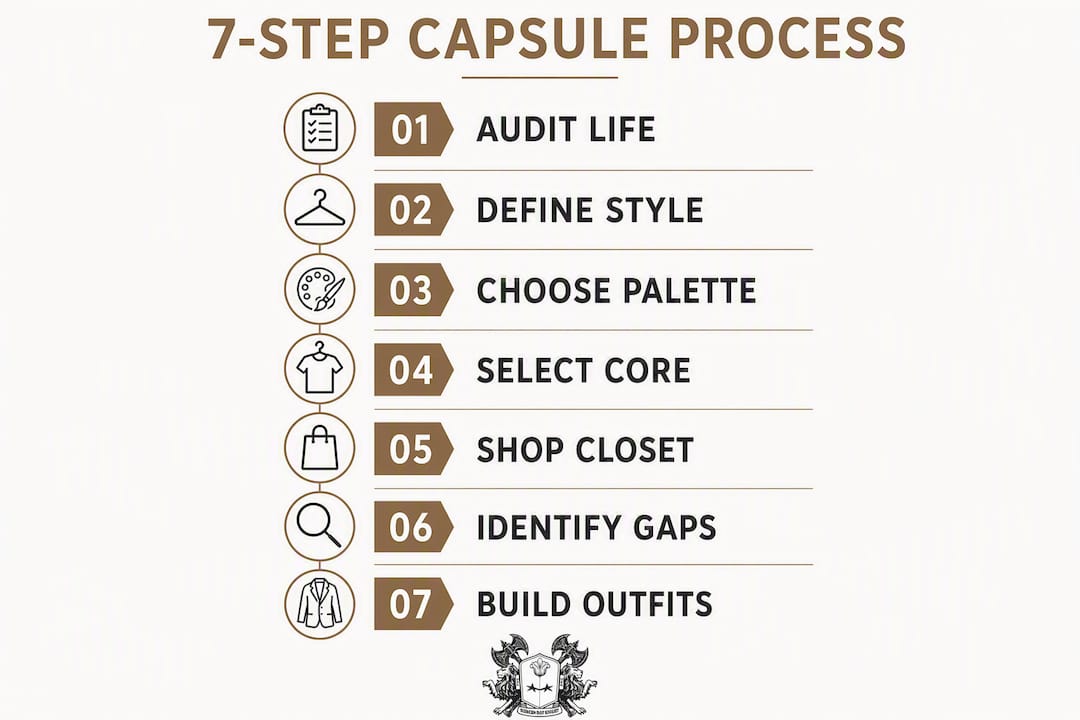
What does a 7-step identity-driven capsule process look like?
The 7-step method moves from evidence to expression, not the other way around. Here is the sequence and what completion looks like at each stage:
| Step | Action | Time | Done When… |
|---|---|---|---|
| 1 | Audit your lifestyle | 20–30 min | You have a written list of weekly contexts and dress codes |
| 2 | Define signature style anchors | 30–60 min | You have named 3–4 repeatable style elements |
| 3 | Choose a color palette | 20–30 min | You have 2–3 neutrals and 1–2 accents written down |
| 4 | Build your core-piece list | 30–45 min | You have a category checklist with target counts |
| 5 | Shop your closet | 1–3 hours | Every item is sorted: keep, mend, donate, or store |
| 6 | Identify gaps and buy intentionally | Days to weeks | Your shopping list has fewer than 10 prioritized items |
| 7 | Build outfit formulas | 30–60 min | You have at least 10 written outfit combinations |
The whole process can run over a single weekend. Most people find Steps 1 and 5 take the longest because they require honesty, not creativity.
How do you audit your lifestyle before building a capsule?
Your capsule should reflect your actual life, not the life you imagine living. Auditing your calendar first prevents the most common failure mode: building a wardrobe for someone else’s routine.
Run this audit template for one typical week:
- Contexts: List every environment you dressed for (office, commute, outdoor work, gym, casual social, formal events).
- Dress codes: Note the code for each — business formal, smart casual, athletic, rugged outdoor.
- Frequency: How many days per week does each context occur?
- Environment: Indoors or outdoors? Climate-controlled or weather-exposed?
- Activity level: Sedentary, moderate movement, or physically demanding?
- Laundering rhythm: How often do you do laundry? Every 3 days? Weekly?
That last point drives your item count more than any style rule. If you wash every 7 days and need a top for 5 workdays, you need at least 6 tops to rotate without stress. That is the math, not a trend.
Pro Tip: Uniforms, gym kit, and sentimental pieces serve a fixed purpose. Track them separately and exclude them from your capsule count. They are not remixable, so counting them inflates your number without adding versatility.
How do you define your signature style and style anchors?
A style anchor is a repeatable design element that stays consistent across seasons and trends. It could be a silhouette (relaxed straight-leg trousers), a fabric (midweight cotton), a jewelry mood (matte metal, minimal), a color, or a symbolic detail like a graphic that carries meaning. The Identity Closet Method recommends establishing 3–4 anchors as the skeleton of a trend-proof personal style.
To find yours, work through these prompts:
Identity prompts:
- What three words do you want people to use when they describe how you carry yourself?
- Which values do you hold that you want visible in how you show up?
- What role do you play most often — leader, protector, creator, builder?
From those answers, map to garments. Three examples:
- “Resilient professional” → Structured blazer, midweight chinos, matte leather boots. Clean lines, no excess.
- “Active outdoorsman” → Technical quarter-zip, durable cargo pants, trail-ready boots. Function-forward, earth tones.
- “Values-driven veteran” → Graphic tee with a meaningful message, straight-leg denim, clean white sneakers or boots. Strength in simplicity.
Clothing that reflects personal principles works because garments function as non-verbal language. When the artifact matches the identity, you wear it more, care for it better, and feel more aligned in it. That internal alignment is what makes a capsule sustainable long-term.
How do you choose a color palette that lets you mix everything?
The ratio that works for most people: 2–3 neutrals + 1–2 accents. Neutrals carry the structural load — they pair with everything. Accents give the capsule personality without limiting compatibility.
Four sample palettes to consider:
- Neutral-driven: Charcoal, off-white, navy. Accent: burgundy. Every piece pairs with every other. Formal-leaning, authoritative.
- Color-forward: Olive, tan, cream. Accents: rust and forest green. Warm, grounded, works well for outdoor and casual contexts.
- Warm-earth: Camel, chocolate brown, ivory. Accent: terracotta. Rich and cohesive; strong in fall and transitional seasons.
- Cool-contrast: Black, white, gray. Accent: cobalt or slate blue. High-contrast, modern, works across professional and casual settings.
Before committing, run this fast palette test:
- Wear test: Put on three pieces from your proposed palette together. Do they feel like you, or like a costume?
- Photo test: Photograph the combination in natural light. Colors that clash on camera will clash in real life.
- 7-day repeat test: Wear only your palette colors for one week. If you feel restricted by day three, add a second accent or swap a neutral.
The goal is a palette where every item can touch every other item. If you need to think hard about whether two pieces work together, the palette is not tight enough.
What core pieces does every identity-driven capsule need?
The core-piece list is a category framework, not a prescription. Adjust counts to your lifestyle audit.
Tops
Aim for 5–8. Prioritize midweight cotton, fine merino, or cotton twill. These fabrics layer well, hold shape, and work across seasons. A graphic tee with a meaningful message counts as a core piece when it aligns with your anchors — it is not decoration, it is a statement.
Bottoms
3–5 pieces. Straight-leg or slim-straight denim is the most remixable cut across casual and smart-casual contexts. Add one pair of chinos or structured trousers if your lifestyle includes professional settings.
Outer layers
2–3 pieces. A midweight jacket or structured hoodie handles 70% of U.S. weather transitions. One heavier coat for cold anchors. One lighter layer (bomber, denim jacket) for warm-weather overlap.
Footwear
2–3 pairs. One clean sneaker or casual leather shoe, one boot or more rugged option, one athletic or trail shoe if your lifestyle demands it. Footwear is where fit matters most — a shoe that does not fit your gait will not get worn.
Accessories
2–4 pieces. A belt, a watch or bracelet, a hat or cap. Keep accessories within your anchor palette. They finish an outfit without requiring a new piece.
Fit priorities: Shoulders must sit correctly on tops and jackets — this is the one measurement that cannot be tailored cheaply. Hem length and waist can be adjusted. Buy for the shoulder, tailor the rest.
How do you shop your closet before buying anything new?
The most effective capsule is an editing project, not a shopping spree. Pull everything out. Every item gets a decision.
- Keep: Worn in the last 90 days, fits well, aligns with at least one anchor, pairs with three or more other pieces.
- Mend: Good bones, right identity, but needs a repair — loose button, frayed hem, broken zipper. Set a two-week deadline to fix it or move it to donate.
- Donate: Does not fit, does not align with any anchor, has not been worn in 12 months. No guilt. It served its time.
- Store: Seasonal extremes (heavy winter coat, summer-only linen) that do not belong in the active capsule but are worth keeping. Box and label them.
After sorting, photograph every keep item flat on a neutral surface or on a hanger against a plain wall. This photo library becomes your planning tool — you can build outfit formulas without physically pulling everything out again.
Repair vs. replace: If the repair costs less than 30% of what a replacement would cost and the item scores high on identity alignment, mend it. If it costs more, or if the item never felt quite right, replace it when the gap-fill phase begins.
How do you identify gaps and buy intentionally?
Gaps are the difference between what your lifestyle audit requires and what your closet audit produced. Not every gap is urgent.
Prioritize using this two-axis check: urgency (how soon do you need it?) × versatility (how many outfits does it unlock?). High urgency and high versatility go to the top of the list. Low urgency and low versatility get cut entirely.
Where to invest more:
- Outerwear: you wear it over everything, so quality shows
- Footwear: durability and fit directly affect how often you reach for it
- One tailored or structured piece (blazer, chinos) if your lifestyle includes professional contexts
Where to save:
- Basic tees and underlayers: midweight cotton at a moderate price point performs as well as premium for most people
- Casual accessories: a $20 canvas belt works as well as a $120 one if it matches your palette
Before any purchase, apply the compatibility test: the new item must pair with at least five pieces you already own. If it does not, it is a statement piece, not a capsule piece. Statement pieces have a place, but they are not the foundation.
For values-driven buyers, the purposeful lifestyle clothing checklist adds one more filter: does this piece align with what you stand for, or does it just look good in the store? Those are different questions with different answers.
When selecting brands, choosing mission-aligned apparel brands applies the same logic: the brand’s values should reinforce your own, not just fill a gap.
How do you build outfit formulas that work every day?
Outfit formulas remove the morning decision tax. Once you have them written, getting dressed becomes execution, not creativity.

Core formula structure
| Element | Role | Example |
|---|---|---|
| Base top | Foundation | Graphic tee or fitted merino |
| Layer | Warmth + structure | Structured hoodie or blazer |
| Bottom | Anchor | Straight-leg denim or chinos |
| Shoe | Tone-setter | Clean boot or leather sneaker |
| Accessory | Identity signal | Watch, cap, or meaningful graphic |
Three mini capsule examples
Commuter professional (28 pieces): 7 tops (3 graphic tees, 2 button-downs, 2 merino), 4 bottoms (2 chinos, 2 denim), 2 blazers, 2 outerwear, 3 footwear, 4 accessories, 6 underlayers and basics. Formula: button-down + blazer + chinos + leather boot + watch. Swap: graphic tee + structured hoodie + dark denim + clean sneaker.
Weekend-active (22 pieces): 6 tops (4 tees, 2 quarter-zips), 4 bottoms (2 cargo, 2 athletic), 2 outerwear, 3 footwear, 3 accessories, 4 underlayers. Formula: graphic tee + midweight jacket + cargo pants + trail boot. Swap: quarter-zip + athletic bottom + sneaker.
Hybrid-creative (25 pieces): 7 tops (mix of graphic, solid, and textured), 4 bottoms, 1 blazer, 2 outerwear, 3 footwear, 4 accessories, 4 basics. Formula: textured tee + denim jacket + straight-leg chino + clean sneaker + cap.
Mix-and-match math
A capsule with a moderate number of pieces across categories typically produces hundreds of base combinations before accessories. Add accessories and the number climbs further. Most people need several dozen reliable outfits. A well-built capsule covers that with room to spare.
How do you size a capsule for year-round use across U.S. climates?
Capsule size is not a style rule. It is a function of climate, lifestyle complexity, and laundry rhythm. Compatibility is the defining metric, not the raw count.
Three practical size ranges:
- Compact (20–25 pieces): Works for single-climate cities (Miami, Phoenix), remote workers, or anyone with a simple weekly routine. Requires tight palette discipline.
- Balanced (26–35 pieces): The most common range for U.S. adults with mixed professional and casual needs. Handles four-season climates with a layering strategy.
- Generous (36–45 pieces): Suits frequent travelers, people with formal event obligations, or those in extreme climates (Minneapolis winters, Houston summers).
Layering math for four-season climates
A year-round capsule works best when about 70% of your pieces are midweight fabrics, 20% are warm-weather pieces, and 10% are cold anchors. For example, in a 30-piece capsule, this is approximately 21 midweight, 6 warm-weather, and 3 cold anchor pieces. Adjust as needed for your climate and routine; compatibility matters more than exact numbers.
From 20°F to 95°F, that structure holds: cold anchor over midweight layer over base top for winter; midweight alone for spring and fall; warm-weather pieces for summer with one light layer for air-conditioned spaces.
Review schedule: Run a 30-day trial when you first build the capsule. After 30 days, identify anything you did not wear once and remove it. Conduct a 15-minute mini-audit each season to swap out-of-rotation pieces. Once a year, do a full deep edit using the same keep/mend/donate/store framework.
What mistakes turn a capsule into a boring uniform?
The most common failure is copying an influencer template without running the lifestyle audit first. A capsule built for someone else’s life will feel like a costume within two weeks.
Watch for these red flags:
- All neutrals, no anchors: A wardrobe of beige, gray, and white with no expressive element is not a capsule. It is a uniform. If you hate wearing neutrals, do not build your palette around them.
- Ignoring laundering reality: Buying dry-clean-only pieces when you do laundry once a week creates friction that kills the capsule.
- Trend-buying during the process: Seeing a sale mid-build and adding a piece that does not meet the compatibility test is how capsules bloat back to 80 pieces.
- Shame-deprivation cycle: Forcing identity into too few items that do not match real life creates resentment, not clarity. If the capsule feels punishing, it is too small or too aspirational.
The 30-day trial rule: Any item that you do not wear at least three times in its first 30 days in the capsule leaves the capsule. No exceptions. This is not failure. It is editing.
Corrective actions by mistake:
- Boring palette: Add one accent color via a single piece. Do not rebuild the whole palette.
- Wrong silhouette: Tailor one piece before replacing it. A $20 hem can save a $90 trouser.
- Identity misfire: Return to your anchor prompts. If the item does not map to any anchor, it does not belong, regardless of how good it looks on the hanger.
- Trend purchase regret: Apply the compatibility test retroactively. If it pairs with fewer than five pieces, it moves to donate at the next audit.
Why does the identity-driven method actually work?
The Identity Closet Method is grounded in a simple premise: style anchors create a stable framework that trends cannot disrupt. When your wardrobe is built around 3–4 repeatable elements that map to your values and roles, every purchase decision becomes easier and every outfit feels intentional.
Identity-based fashion treats garments as artifacts that communicate internal states. The design framework moves from Modes (how you show up) to Characters (the roles you play) to Artifacts (the specific garments that express both). That is not abstract theory. It is the same logic behind why a veteran reaches for a graphic tee with a meaningful message over a plain one, or why a builder chooses a structured work jacket over a fashion parka.
The 7-step sequence maps directly to this framework: audit (Modes) → anchors (Characters) → palette and core pieces (Artifacts) → outfit formulas (daily expression). Each step reinforces the next.
The sustainability case: The EPA estimates U.S. textile waste at approximately 17 million tons annually. A capsule wardrobe built on durability and identity alignment directly counters that pattern. When you buy fewer pieces with higher symbolic and functional value, you replace less and discard less.
The practical evidence supports the method too. Midweight cottons, denim, ponte, fine merino, and cotton twill are the workhorses of a durable capsule. They layer, they hold shape, and they signal quality without requiring a luxury budget. Prioritizing these fabrics over trend-driven synthetics is one of the highest-leverage decisions in the whole process.
Key Takeaways
A well-built identity-driven capsule wardrobe requires auditing your actual life first, anchoring every piece to 3–4 repeatable style elements, and applying a strict compatibility test before any new purchase.
| Point | Details |
|---|---|
| Audit before you shop | Map one week of real contexts and dress codes before pulling a single item from your closet. |
| Anchor to 3–4 style elements | Silhouettes, fabrics, or symbolic details that stay stable across trends form the capsule’s skeleton. |
| Use layering math | Aim for 70% midweight, 20% warm-weather, and 10% cold anchors to cover most U.S. climates without seasonal rebuilds. |
| Apply the compatibility test | Every new purchase must pair with at least five pieces you already own, or it does not belong in the capsule. |
| Moderndayknightco as a starting point | Values-driven graphic tees and midweight hoodies from Moderndayknightco can serve as identity-anchored core pieces in any capsule. |
Why Modern Day Knight champions identity-driven capsules
We believe what you wear is a declaration. Not a trend report. Not a mood board. A declaration of what you stand for.
At Moderndayknightco, we built our brand around a simple conviction: clothing should carry meaning. Every piece we design reflects a code — integrity, loyalty, strength. Those are not marketing words. They are the anchors our community lives by, and they are the same anchors that make an identity-driven wardrobe worth building.
The 7-step method in this article is not about minimalism for its own sake. It is about intentionality. It is about knowing why you reach for what you reach for, and making sure every item in your closet earns its place by reflecting who you are and what you stand for. That is the same standard we hold our apparel to. Lifestyle apparel builds community when it carries shared values, not just shared aesthetics.
Moderndayknightco apparel fits your identity-driven capsule
Values-driven apparel should do more than fill a gap. It should anchor one.
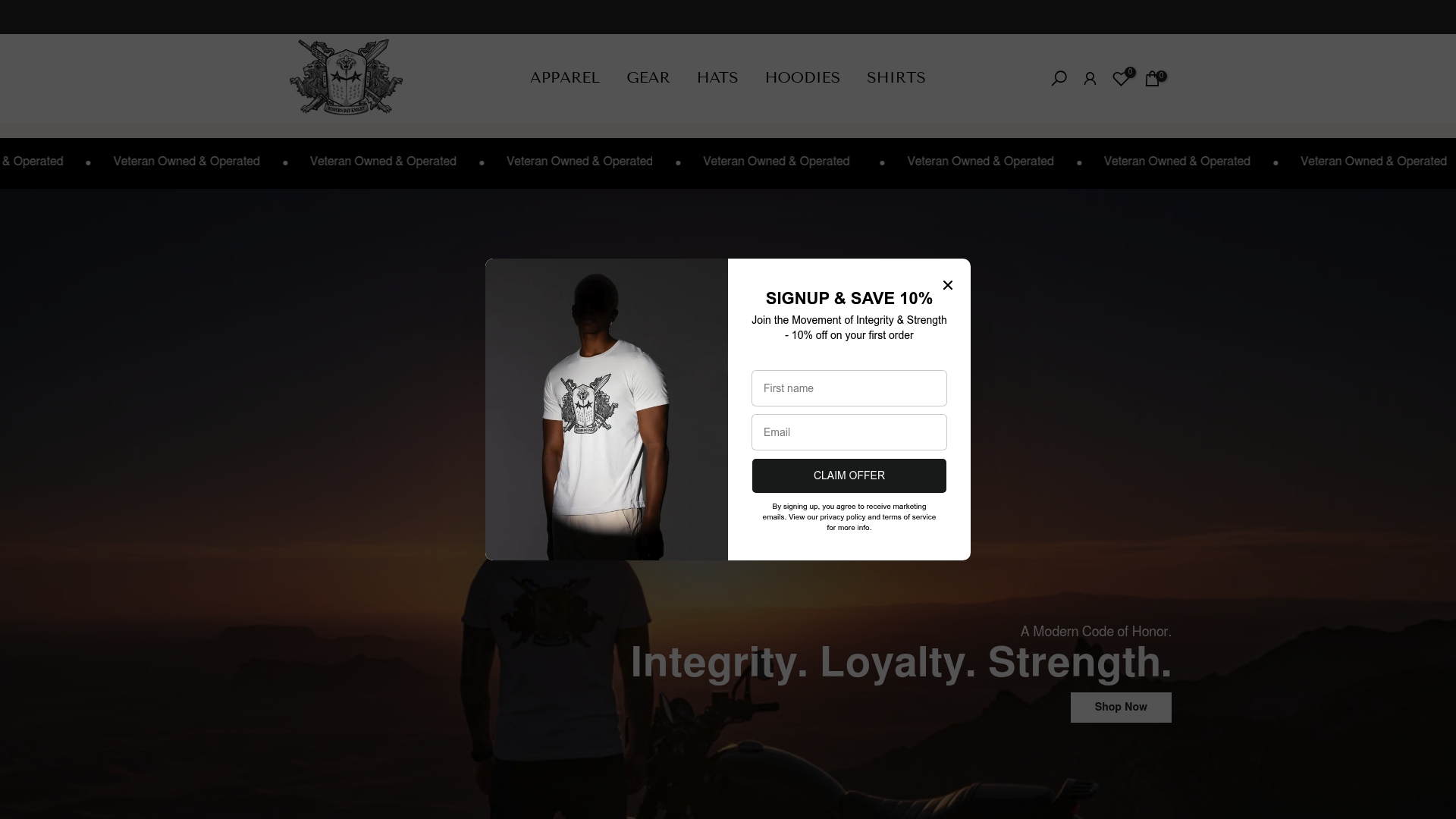
Moderndayknightco designs every piece around the same anchors this method asks you to define: integrity, loyalty, and strength. A graphic tee is not just a base layer here. It is a statement artifact. The Army Brat Tee is built for exactly the kind of core-piece role this method describes: midweight cotton, meaningful message, pairs with straight-leg denim, chinos, or a structured jacket without effort. Before you add it to your capsule, run the compatibility test. If it pairs with five or more pieces you already own, it earns its place.
For a midweight layer that works from fall through spring, the Army Brat Hoodie fits the 70% midweight rule and adds a values-forward identity signal to any formula. Browse the full apparel collection and apply the compatibility test to anything that catches your attention. One intentional piece at a time.
Sources and further reading
The research and internal resources behind this guide:
| Source | What it provides |
|---|---|
| The Identity Closet Method — careandselflove.com | The anchor-based framework and 7-step sequence; foundational for Steps 1, 2, and the EEAT rationale |
| Capsule Wardrobe Guide — capsulewardrobe.ai | Defines compatibility as the core metric; source of the 5-piece pairing rule and size ranges |
| Year-Round Capsule — capsulewardrobestyle.com | Layering math (70/20/10) and U.S. textile waste data; supports Steps 4 and 10 |
| Identity-Based Fashion — multiversitystore.com | Artifact framework and fabric guidance; supports Steps 2, 4, and the EEAT section |
| Gen Z Capsule Wardrobe — abfrl.com | Validates the 7-step sequence as a practical, acquisition-shifting method |
| How to Build a Capsule Wardrobe — daily.clothing | Calendar-first audit approach; supports Step 1 |
| Personal Identity Wardrobe — sustainability-directory.com | Sustainability framing for identity wardrobes; background for ethical sourcing guidance |
| Purposeful Lifestyle Clothing Checklist — Moderndayknightco | Internal checklist for values-aligned purchasing; recommended for Step 6 |
| Clothing That Reflects Personal Principles — Moderndayknightco | Brand philosophy on identity-driven apparel; supports Step 2 and the perspective section |


