



Five standout lifestyle apparel style examples signal honor, loyalty, and military heritage through a shared design language: earth-tone color palettes, structured cuts, heritage fabrics, purposeful hardware, and provenance storytelling. The looks that carry real weight are the field jacket layered over a values-graphic tee, the chore coat and selvedge denim combination, the military-inspired athleisure build, the smart-casual commemorative outfit, and the rugged-minimal weekend look. Moderndayknightco, a veteran-owned brand built around integrity and strength, is the benchmark for how standout apparel communicates values rather than just aesthetics. According to 3rd Rail Clothing, apparel becomes truly standout when design language — color, cut, and material — aligns with audience values. Printful’s research confirms that the most effective lifestyle statements pair versatile basics with one expressive detail rather than full themed costumes.
- Field jacket + values tee + straight trousers + leather boots
- Chore coat + white tee + selvedge denim + clean sneakers
- Military-inspired athleisure: track jacket + joggers + lapel pin
- Smart-casual commemorative: navy blazer + OCBD + chinos + lapel pin
- Rugged-minimal weekend: canvas overshirt + raw-hem denim + work boots
Table of Contents
- Six outfit breakdowns that show what values-driven style looks like
- 1. Field jacket over a values graphic tee
- 2. Chore coat and selvedge denim
- 3. Military-inspired athleisure
- 4. Smart-casual commemorative outfit
- 5. Rugged-minimal weekend
- 6. Values-graphic tee as the anchor piece
- What colors, fabrics, and cuts actually signal heritage
- How to match each look to the right occasion
- How to shop values-first and vet what you buy
- A styling checklist and five ready-to-copy outfit templates
- How to care for heritage pieces and use military motifs respectfully
- Key Takeaways
- Why what you wear is a declaration, not a decoration
- Moderndayknightco: apparel built on a code, not a trend
- Useful sources and further reading
Six outfit breakdowns that show what values-driven style looks like
1. Field jacket over a values graphic tee
Pieces: Olive M-65-style field jacket, short-sleeve graphic tee with a heritage or honor-code message, straight-leg dark chinos, leather lace-up boots, small enamel lapel pin.
The field jacket does the heavy lifting here. Its four-pocket utility silhouette and olive or OD green colorway carry decades of service association. The graphic tee underneath adds the personal statement — choose one with purposeful typography rather than decorative noise. Dark chinos keep the lower half clean so the jacket reads as intentional, not costume. Leather boots ground the look in durability.
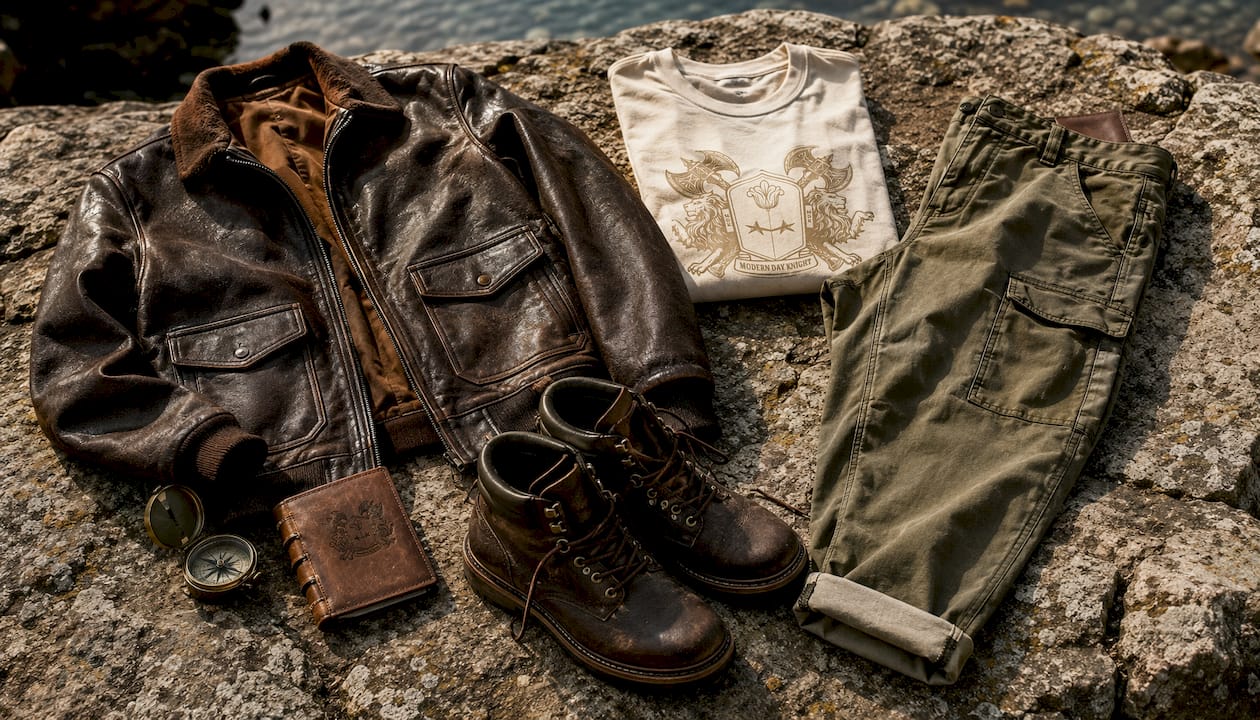
Seasonal swap: In summer, drop the jacket and let the tee stand alone with tan chinos and suede chukkas.
2. Chore coat and selvedge denim
Pieces: Washed canvas or duck-cloth chore coat, plain white or off-white tee, selvedge denim in a straight or relaxed cut, white leather low-top sneakers, woven leather belt.
This combination signals craftsmanship and restraint. The chore coat’s boxy cut and visible stitching read as workwear heritage without veering into costume territory. Selvedge denim adds a quiet proof of quality — the tightly woven edge visible at the cuff tells anyone who knows that you chose substance over speed. Keep footwear clean and simple.
Pro Tip: Roll the denim cuff once to expose the selvedge edge. It is a small detail that communicates intentionality to anyone who recognizes it.
3. Military-inspired athleisure
Pieces: Olive or charcoal track jacket with minimal branding, fitted graphic tee, tapered joggers in a matching or tonal color, clean athletic sneakers, small lapel pin or woven patch on the jacket chest.
Athleisure remains dominant in U.S. lifestyle apparel, and this build channels that energy through a heritage filter. The key is tonal dressing: keep jacket and joggers within the same color family so the look reads as deliberate. One patch or pin on the chest adds the values signal without overwhelming the athletic silhouette.
4. Smart-casual commemorative outfit
Pieces: Navy or charcoal unstructured blazer, Oxford cloth button-down in white or pale blue, flat-front chinos in khaki or stone, leather loafers or clean derby shoes, single lapel pin representing a personal or family service connection.
This is the look for memorial events, veterans’ gatherings, or any occasion where respect is the dress code. The unstructured blazer keeps it approachable rather than stiff. One lapel pin is the only insignia needed — and it should be earned or personally meaningful. Avoid decorative medals or unit patches you have no connection to.
5. Rugged-minimal weekend
Pieces: Heavy cotton canvas overshirt in tan or olive, plain crew-neck tee, raw-hem or lightly distressed straight denim, leather work boots, canvas tote or waxed-canvas bag.
This is the easiest entry point for fresh resort wear trends that signals values without effort. The canvas overshirt functions as both a light outer layer and a statement of material integrity. Work boots communicate durability and purpose. Keep the tee plain — the fabrics and silhouette carry the message.
6. Values-graphic tee as the anchor piece
Pieces: Heritage-message graphic tee from a veteran-owned brand, straight or relaxed chinos, clean white sneakers, minimal watch, no additional graphics.
When the tee carries the message, everything else steps back. This is the casual chic outfit example that works for daily errands, weekend coffee runs, or low-key social settings. One statement piece, clean supporting items. The honor-code brand concept lives in the graphic itself — choose pieces from brands whose provenance matches the message.
What colors, fabrics, and cuts actually signal heritage
Standout apparel builds a consistent visual identity tuned to its audience. For military-heritage and honor-driven looks, that identity rests on three pillars: palette, material, and silhouette.
Core color palettes:
- Olive drab, OD green, and field tan: direct service associations, read as functional and earned
- Navy and charcoal: restraint and authority without aggression
- Muted khaki and stone: workwear heritage, pairs with almost any accent
- Off-white and natural canvas: craftsmanship and simplicity
Materials that read as heritage:
- Medium-weight cotton twill and duck cloth: durable, ages with character
- Selvedge denim: signals quality construction and intentional choice
- Brushed wool and heavy cotton canvas: warmth and substance, not trend-chasing
- Solid brass and antique-finish hardware: longevity over flash
Silhouette cues:
- Structured shoulders on jackets: purposeful, not overstyled
- Straight or relaxed trousers: grounded, functional
- Chore and field-jacket proportions: workwear lineage without costume energy
- Clean, minimal tailoring: confidence without decoration
Pro Tip: A repeated narrow detail — a signature embroidery placement or a unique hardware finish — creates instant recognition across multiple pieces and builds long-term wardrobe coherence.
| Cue | What it communicates | Easy swap |
|---|---|---|
| Olive or OD green | Service, durability, restraint | Charcoal or navy for cooler seasons |
| Duck cloth or canvas | Craftsmanship, longevity | Brushed cotton twill in summer |
| Brass hardware | Quality, permanence | Antique silver for a lighter palette |
| Straight-leg cut | Grounded, functional | Relaxed taper for smart-casual occasions |
| Minimal graphics | Confidence, intentionality | One heritage embroidery instead of print |
How to match each look to the right occasion
Knowing when to wear each style keeps outfits respectful and appropriate. Here is a quick map and a set of coordination rules.
Occasion map:
- Daily errands: values-graphic tee anchor (Look 6) or rugged-minimal weekend (Look 5)
- Office smart-casual: chore coat and selvedge denim (Look 2) or smart-casual commemorative (Look 4)
- Memorial or commemorative events: smart-casual commemorative (Look 4) only
- Date night with restraint: field jacket look (Look 1) with clean boots, or Look 4 with loafers
- Travel and adventure: military-inspired athleisure (Look 3) or rugged-minimal (Look 5)
- Formal-leaning functions: Look 4 with a pressed OCBD and polished leather shoes
Coordination rules:
- Pair heavy canvas with clean, unscuffed footwear — worn boots plus a worn jacket reads sloppy, not rugged
- At commemorative events, wear only insignia you have a personal or family connection to
- One graphic or statement piece per outfit; let everything else support it
- Match hardware tones: brass belt buckle with brass boot eyelets, not mixed metals
- Dial formality up by swapping sneakers for leather shoes and adding a lapel pin
- Dial formality down by removing the outer layer and rolling sleeves once
- Avoid faux patches or decorative medals at any event where veterans are present
- Keep accessories restrained: one watch, one pin, one bag — not all three at maximum volume
How to shop values-first and vet what you buy
Quality heritage pieces are worth the investment. Here is how to shop with intention.
Vetting checklist:
- Provenance: does the brand state where pieces are made and by whom?
- Material specs: is fabric weight and content listed (e.g., 12 oz. duck cloth, 100% cotton)?
- Construction: look for double-needle hems and reinforced stress points — these separate durable pieces from fast-fashion imitations
- Veteran-owned verification: look for stated veteran ownership, not just military-themed graphics
- Small-batch or artisan signals: limited runs, named makers, or origin labels
- Storytelling: does the brand explain why each piece exists, not just what it looks like?
Price guidance by tier:
- Entry ($25–$60): Graphic tees and basic chinos. Prioritize fabric content over brand name. Cotton weight matters more than logo placement.
- Mid-range ($60–$150): Chore coats, selvedge denim, and quality overshirts. This is where construction details become the differentiator.
- Investment ($150+): Field jackets, wool blazers, and leather boots. Pieces at this tier should last years and develop patina.
Some brands integrate provenance traces — origin tags or artisan details — that link garments to a maker’s story and raise perceived authenticity. When in doubt, contact customer service and ask for fabric content and construction photos. A brand that cannot answer those questions quickly is not a heritage brand.
For a vetted starting point, the Moderndayknightco apparel collection includes provenance details and values-driven design on every product page. For deeper reading on choosing meaningful apparel, the brand’s blog covers the reasoning behind values-first shopping.
A styling checklist and five ready-to-copy outfit templates
Styling checklist (screenshot or save this):
- Fit: nothing too baggy or too tight; purposeful proportions
- Palette: stay within two to three tones per outfit
- Material: at least one heritage fabric per look
- Hardware: match tones; keep it minimal
- Provenance: know where your statement piece comes from
- Personalization: one earned or meaningful detail only
Five copyable outfit templates:
- Chore jacket + white tee + selvedge denim + leather boots + lapel pin
- Olive field jacket + heritage graphic tee + dark chinos + suede chukkas
- Track jacket + fitted tee + tapered joggers + clean sneakers + woven patch
- Navy blazer + white OCBD + stone chinos + leather loafers + single pin
- Canvas overshirt + crew-neck tee + straight denim + work boots
Mix one heritage cue with one modern simplicity cue in every look. A full head-to-toe military-inspired outfit reads as costume. One anchor piece with clean supporting items reads as conviction. The purposeful clothing checklist from Moderndayknightco expands on each of these points.
| Checklist point | Why it matters |
|---|---|
| Fit first | Ill-fitting heritage pieces lose their authority immediately |
| One statement piece | Prevents the costume effect; keeps the look wearable |
| Provenance check | Confirms the brand’s values match the message on the garment |
| Earned insignia only | Protects the meaning of military symbols for those who served |
| Heritage fabric | Signals quality and longevity over trend-chasing |
How to care for heritage pieces and use military motifs respectfully
Good pieces deserve good care. Heritage fabrics age well when maintained correctly.
Care by fabric:
- Canvas and duck cloth: brush off dry dirt before washing; condition with a wax or oil treatment twice a year to maintain water resistance and prevent cracking
- Selvedge denim: wash inside-out in cold water every 3–6 months of regular wear; air dry flat to preserve the weave
- Brushed wool: dry clean or hand wash in cold water; store folded with cedar blocks, never on a hanger that distorts the shoulder
- Leather boots and hardware: condition leather every 4–6 weeks; polish brass hardware with a dry cloth to maintain finish
Respectful use of military motifs:
- Avoid wearing unit patches, rank insignia, or service medals you did not earn
- Symbolic nods — muted colors, heritage cuts, honor-code typography — carry the message without impersonation
- Decorative patches inspired by military design are acceptable; direct replicas of active-duty insignia are not
- At commemorative events, restraint is respect: one meaningful pin, no decorative medals
Pro Tip: Custom embroidery works best when it references your own family’s service history or a personal unit-style identifier. A name, a date, or a family motto in clean block lettering is a powerful personal statement that respects the tradition it draws from.
Key Takeaways
Values-driven lifestyle apparel works when one heritage anchor piece — the right fabric, cut, or provenance detail — carries the message and everything else supports it cleanly.
| Point | Details |
|---|---|
| One anchor piece per outfit | Pair a single heritage item with clean basics to signal conviction, not costume. |
| Heritage cues that work | Olive and navy palettes, duck cloth or canvas, brass hardware, and straight cuts read as earned and durable. |
| Vetting before buying | Check fabric weight, construction details like double-needle hems, and verified veteran-owned status before purchasing. |
| Respectful symbolism | Wear only insignia with a personal or family connection; symbolic nods outperform direct military replicas at every occasion. |
| Moderndayknightco | A veteran-owned, values-driven brand whose apparel collection includes provenance and material details on every product page. |
Why what you wear is a declaration, not a decoration
Most style advice treats clothing as a visual problem. We see it differently. What you put on your back every morning is a statement about what you stand for. That is not a metaphor — it is the operating principle behind every piece Moderndayknightco builds.
The conventional wisdom says buy what looks good. We say buy what is true. A field jacket from a veteran-owned brand carries a different weight than the same silhouette from a fast-fashion shelf, even if they look identical in a photo. The difference lives in the provenance, the construction, and the community behind it. Lifestyle brands that build community around shared belief systems make garments feel personally meaningful in a way that trend-chasing never can.
Wear what you believe. The checklist and templates in this article are tools. The values are yours to bring.
Moderndayknightco: apparel built on a code, not a trend
Moderndayknightco is a veteran-owned apparel brand centered on integrity, loyalty, and strength. Every piece in the collection is designed to be a statement of personal values, not just a garment. Product pages include provenance details, fabric content, and the story behind each design — so you know exactly what you are wearing and why it was made.
If the outfit templates and vetting checklist in this article resonated with you, the Moderndayknightco apparel collection is the natural next step. Browse the full range, check the material specs, and find the piece that fits your code.
Useful sources and further reading
- 3 Essential Tips for Designing Standout Apparel — 3rd Rail Clothing: Covers how consistent design language — color, cut, and construction — creates apparel that stands out and communicates values.
- Gen Z Fashion 2026 Trends — Printful: Documents the shift toward versatile basics plus one expressive detail; supports the article’s styling templates and checklist.
- Understanding and Creating Lifestyle Brands — Limelight Marketing: Explains how brands that build community around shared beliefs make garments feel personally meaningful.
- JUNIQUE — Smart Fashion and Connected Garments: Shows how provenance traces and artisan details raise perceived authenticity in values-driven apparel.
- Reebok Angel Reese Range — Reebok: Context for the athleisure movement and how athletic silhouettes intersect with lifestyle and identity.
- 9 Ways Lifestyle Apparel Builds Community in 2026 — Moderndayknightco: Brand-authored piece on how apparel collections create shared identity and community among values-driven wearers.
- What Is a Honor-Code Lifestyle Brand? — Moderndayknightco: Defines the honor-code brand concept and the design principles behind values-driven apparel.
- Military-Inspired Apparel: A Lifestyle Statement of Honor — Moderndayknightco: Guidelines for wearing military-inspired apparel respectfully and with personal integrity.


