



Amor fati means “love of fate,” and it names an active embrace of whatever happens, not a passive shrug of resignation. The idea splits into two lineages that both matter: the Stoics, who treated fate as raw material to work with through reason and virtue, and Friedrich Nietzsche, who took the exact Latin phrase in the 19th century and turned it into a personal creed of affirmation. Understanding both sides is what separates a real grasp of amor fati from a tattoo caption.
TL;DR:
- Stoic exercises like negative visualization and journaling help cultivate rational acceptance but should be brief and focused on gaining perspective rather than inducing anxiety.
- Nietzsche’s amor fati emphasizes active affirmation of life’s hardships, demanding a desire for their repetition through the concept of eternal recurrence.
- Misusing amor fati as passive acceptance or toxic positivity can lead to tolerating injustice or avoiding necessary grief, which diverges from its original intent.
- The phrase’s popularity in pop culture often strips away its philosophical roots, reducing it to an aesthetic rather than a disciplined practice rooted in Stoicism and Nietzschean affirmation.
- Maintaining the philosophy requires consistent effort and real reminders, such as clothing with symbolic messages, to reinforce active love of one’s fate daily.
Table of Contents
- What Does Amor Fati Mean, Literally?
- Stoic Origins: Epictetus, Marcus Aurelius, and Rational Acceptance
- Nietzsche’s Version: Defiant Affirmation Over Rational Order
- How to Practice Amor Fati Day to Day
- What Amor Fati Isn’t: Passivity, Toxic Positivity, and Moral Complacency
- Beyond Stoicism and Nietzsche: How the Phrase Traveled
- Amor Fati vs. Acceptance, Fatalism, and Resilience
- The Psychological Upside and the Real Cost
- Amor Fati in Movies, Music, and Modern Self-Help
- A Veteran-Owned Perspective on Living the Philosophy
- Wearable Reminders for Practicing Amor Fati
- Sources
What Does Amor Fati Mean, Literally?
“Amor” is Latin for love. “Fati” is the genitive form of “fatum,” meaning fate or destiny. Put together, the phrase translates literally to “love of fate”, and that grammar carries weight. “Fati” as a genitive signals possession or relation, closer to “of fate” than a direct object, which is part of why the phrase resists a clean one-word English substitute.
You’ll see the phrase misspelled constantly. “Amore fati” tacks an Italian ending onto a Latin word. “Amour fati” borrows the French word for love. Neither is correct Latin, though both spread because they sound more familiar to modern ears. Wiktionary’s entry confirms the standard morphology: amor plus the genitive fati, no extra vowels attached.
The bigger nuance sits in the word “love” itself, not the spelling:
- Love implies active engagement, even gratitude, toward what happens to you.
- Accept implies tolerance, a grudging allowance that something exists.
- Endure implies suffering through something without changing your relationship to it.
Amor fati asks for the first, not the second or third. That distinction is the whole philosophy in miniature.
Stoic Origins: Epictetus, Marcus Aurelius, and Rational Acceptance
The Stoics never wrote the exact Latin phrase “amor fati.” They built the idea it describes, brick by brick, centuries before Nietzsche gave it a name. Their premise: the universe runs on rational order (logos), and a good life means aligning your will with that order rather than fighting it. Scholarly interpretation frames Stoic acceptance as aligning with rational nature and virtue, which is a very different aim from what Nietzsche was after.
Epictetus put it bluntly in the Enchiridion: don’t demand that events happen as you wish, but wish them to happen as they do. Marcus Aurelius, writing private notes to himself in Meditations, returned to the same discipline again and again, treating obstacles as the very substance of virtuous action rather than interruptions to it.
Three exercises carried that theory into daily practice:
- Negative visualization (premeditatio malorum). Imagine losing something you value before you lose it, so gratitude replaces shock when change actually arrives.
- Evening journaling. Review the day’s events and rehearse a rational response to each one, separating what you controlled from what you didn’t.
- Role rehearsal. Mentally walk through a difficult scenario in advance, so you meet it with a plan instead of panic.
Pro Tip: Keep negative visualization brief, ninety seconds is plenty. The goal is perspective, not dread. Stoic exercises are meant to sharpen readiness, not induce anxiety.
Nietzsche’s Version: Defiant Affirmation Over Rational Order
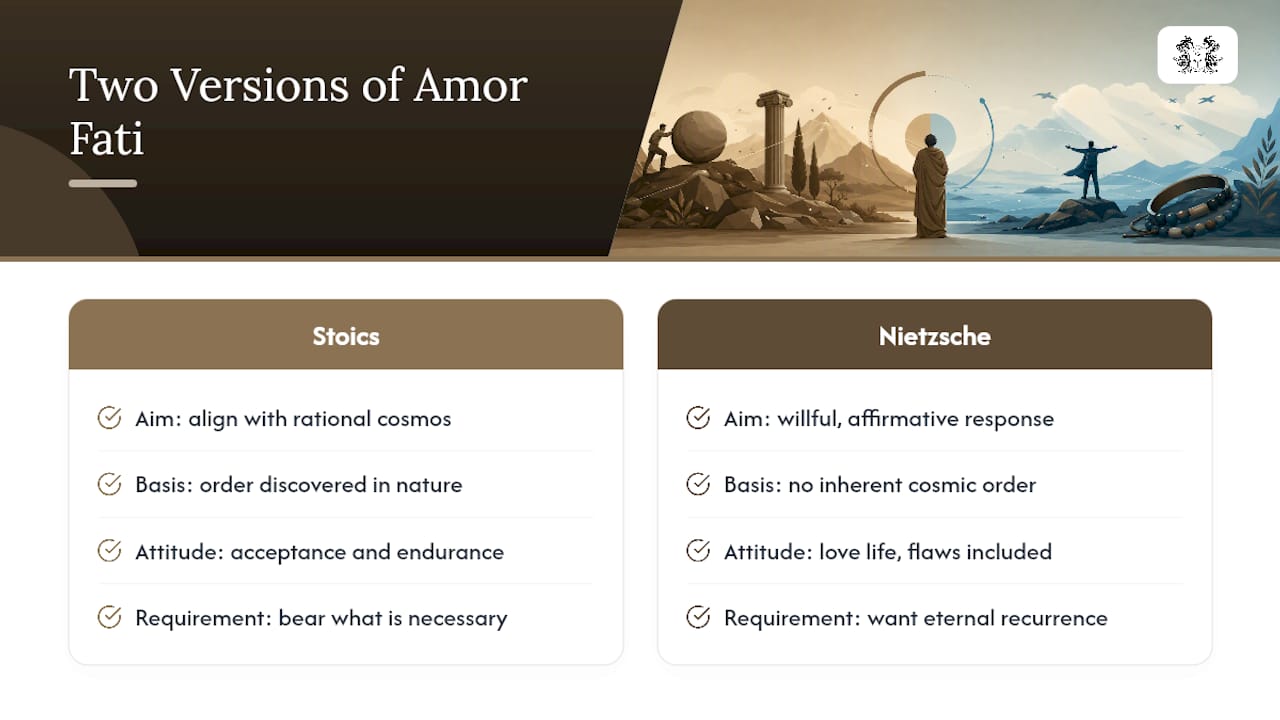
Nietzsche is the reason this phrase exists in the form we use today. He picked up the exact Latin words and made them his personal formula, and his aim was pointedly different from the Stoics’. Where they sought alignment with a rational cosmos, Nietzsche saw no such order waiting to be discovered. His affirmation had to be willed, almost defiantly, against a universe he considered indifferent or chaotic. Scholarly interpretation treats his version as an affirmative response to a purposeless world, not a return to natural harmony.
He tied the phrase directly to his concept of eternal recurrence, the thought experiment asking whether you’d will your exact life to repeat infinitely, down to every detail. Passing that test required more than tolerance. It required wanting the repetition.
My formula for greatness in a human being is amor fati: that one wants nothing to be different, not forward, not backward, not in all eternity. Not merely bear what is necessary, still less conceal it, but love it.
That line from Ecce Homo, along with related passages in The Gay Science, forms the core primary-source basis for how the phrase is understood today. Nietzsche’s amor fati is aesthetic and personal, closer to an artist declaring their whole composition beautiful, flaws included, than a philosopher describing cosmic law.
How to Practice Amor Fati Day to Day
The perceptual shift underneath amor fati is simple to state and hard to sustain: treat whatever happens as material, not as verdict. A delayed flight isn’t proof the universe is against you. It’s raw material for patience, for reading, for a conversation you wouldn’t otherwise have had.
A few habits make that shift concrete rather than aspirational:
- Morning commitment. Before checking your phone, state one sentence: today’s obstacles are usable, not personal.
- Evening reappraisal. Pick one frustrating event from the day and write one sentence on what it made possible.
- The “thank you” rewrite. Take a past setback and rewrite the memory ending in “and that gave me…” instead of “and that ruined…”
- Pause, reappraise, choose. When something goes wrong in real time, pause before reacting, reappraise what’s actually in your control, then choose one deliberate action.
Pro Tip: Write the reappraisal by hand if you can. The slower pace forces you past the first, most reactive interpretation of the event, which is usually the least accurate one.
None of this works as a substitute for real support. If what you’re facing involves trauma, abuse, or clinical depression, amor fati is not a treatment plan, it’s a mindset practice layered on top of whatever professional help you actually need.
What Amor Fati Isn’t: Passivity, Toxic Positivity, and Moral Complacency
Amor fati gets flattened into “just accept everything” more often than any other Stoic-adjacent idea, and that flattening causes real damage. The philosophy was never a license to endure abuse, excuse injustice, or stay quiet about harm. Loving your fate applies to what has already happened, the unchangeable past, not to ongoing situations you have the power to change or leave.
There’s a meaningful line between acceptance and moral complacency:
- Acceptance says: this event happened, and I choose how to respond to it now.
- Complacency says: this event is happening, and I’ll tolerate it indefinitely because resistance feels unphilosophical.
Contemporary critiques rightly flag amor fati’s misuse as a form of toxic positivity, a way to spiritually bypass legitimate anger or grief. If you notice yourself using the phrase to avoid setting a boundary, leaving a harmful situation, or seeking help, that’s a red flag the concept is being misapplied, not a sign you’re finally “doing Stoicism right.”
Beyond Stoicism and Nietzsche: How the Phrase Traveled
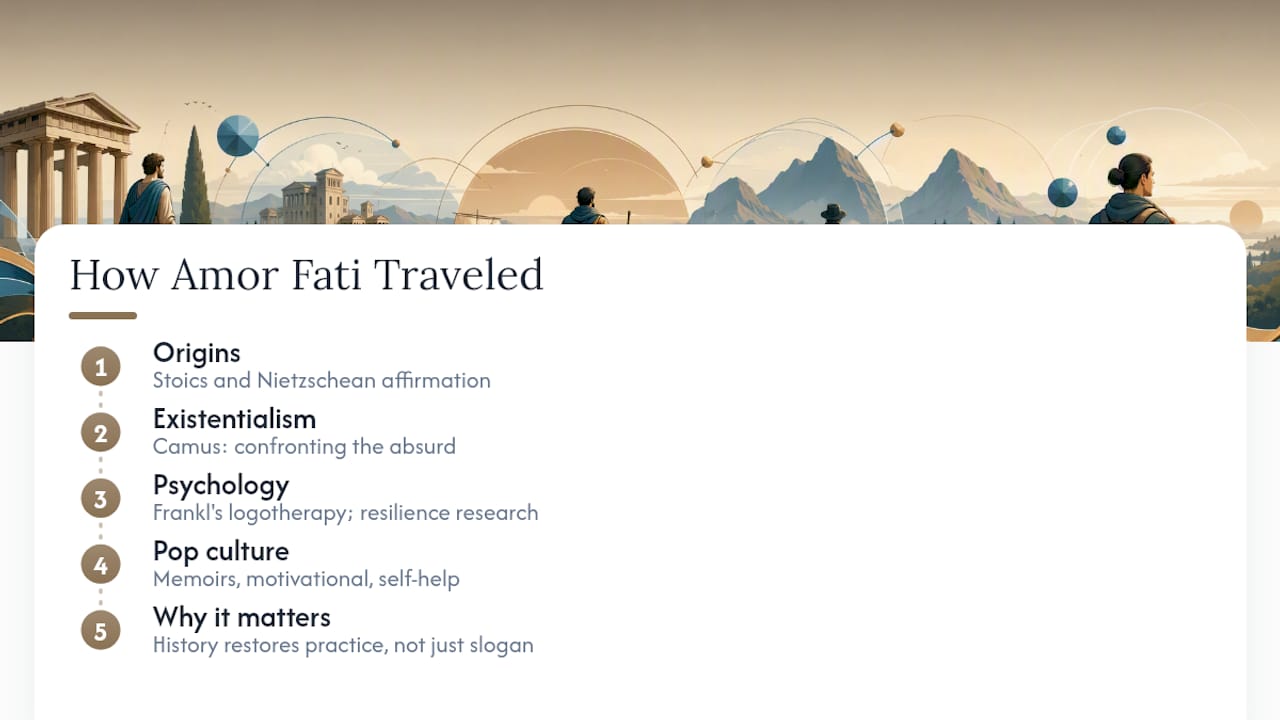
Amor fati didn’t stay locked inside 19th-century German philosophy. Existentialist writers in the 20th century picked up threads of the same idea, even without always using the Latin phrase, wrestling with how to build meaning inside an indifferent or absurd universe. Albert Camus’s writing on confronting the absurd shares real DNA with Nietzschean affirmation, even where Camus takes the argument in his own direction.
Psychology borrowed from the same well. Logotherapy, developed by Viktor Frankl out of his own experience surviving the Holocaust, argued that meaning can be found or made even inside suffering, an idea that runs parallel to amor fati without citing it directly. Modern resilience research and post-traumatic growth literature echo the same structure: people who reframe hardship as usable material tend to recover differently than people who frame it purely as loss.
Pop culture picked up the phrase itself more recently, often stripped of its philosophical scaffolding. It shows up in memoirs, motivational content, and self-help frameworks that borrow the Latin without engaging Nietzsche’s eternal recurrence or the Stoic discipline underneath it. That simplification isn’t necessarily wrong, but it’s incomplete. A phrase that took two major philosophical traditions to build deserves more than a caption’s worth of context. Understanding the Stoic and Nietzschean history behind it is what turns a slogan back into a practice.
Amor Fati vs. Acceptance, Fatalism, and Resilience
These four concepts get used interchangeably, and that’s a mistake worth correcting.
| Concept | Core stance | Key limitation |
|---|---|---|
| Amor fati | Actively love and affirm what happens | Requires ongoing effort; easy to misapply as passivity |
| Plain acceptance | Acknowledge reality without resistance | Can stop short of affirmation, staying neutral rather than positive |
| Fatalism | Believe outcomes are fixed regardless of effort | Removes agency; can breed real passivity |
| Resilience | Recover functioning after adversity | Focuses on bouncing back, not necessarily on affirming the event itself |
Fatalism is the concept most often confused with amor fati, and the two are nearly opposites in spirit. Fatalism says your actions don’t matter because the outcome is predetermined. Amor fati, in both its Stoic and Nietzschean forms, insists your response to fate is exactly where your agency lives. The event might be fixed. Your stance toward it never is.
Resilience overlaps more comfortably. Both concepts value recovering strength after hardship, but resilience research tends to measure a return to baseline functioning, while amor fati asks for something more demanding: genuine affirmation, not just survival.
The Psychological Upside and the Real Cost
The appeal of amor fati as a mental habit is straightforward. Reframing hardship as material rather than injury reduces the time spent in resentment, and resentment is expensive. It occupies attention, fuels rumination, and rarely changes the outcome it’s aimed at. People who practice reappraisal, a close cousin of amor fati in psychological terms, tend to report lower distress when facing the same stressors as people who don’t.
There’s also a quieter benefit: a reduction in the exhausting gap between how you wish things were and how they actually are. That gap is where a lot of chronic frustration lives. Closing it, even partially, tends to free up energy for actual problem-solving instead of protest against reality.
The cost is real too, and worth naming plainly. Amor fati demands consistency it’s genuinely hard to sustain. It’s one thing to affirm a delayed flight. It’s another to affirm a diagnosis, a loss, or a betrayal, and the philosophy doesn’t get easier just because the stakes are higher. There’s also a risk of self-gaslighting, forcing affirmation before you’ve actually processed an event, which can suppress necessary grief rather than metabolize it. The practice works best as a discipline you return to gradually, not a switch you flip the moment something goes wrong.
Amor Fati in Movies, Music, and Modern Self-Help
The phrase shows up more in contemporary culture than most Latin philosophy ever does, usually stripped down to its most quotable form. Musicians and public figures have used “amor fati” as album titles, lyrics, and tattoo text, almost always pointing toward Nietzsche’s version rather than the Stoic one, since the phrase’s rhetorical punch fits a defiant, individualist mood better than a quiet discipline of rational alignment.
Self-help and productivity content has absorbed the concept too, often folding it into broader “resilience” or “mindset” branding without naming Nietzsche or the Stoics at all. That’s part of why so many people encounter the phrase divorced from its history, as an aesthetic rather than an argument.
Tattoos deserve a specific mention, since the phrase is a popular one for ink. The symbolic weight people attach to an amor fati tattoo usually leans toward the Nietzschean reading: a permanent, visible commitment to affirming one’s whole life, difficulties included, rather than a quieter reference to Stoic discipline. Either reading is defensible. What matters is knowing which one you’re actually claiming.
A Veteran-Owned Perspective on Living the Philosophy
Modern Day Knight is veteran-owned, built around a code centered on integrity, loyalty, and strength, values that map directly onto what amor fati actually demands. Affirming your fate under difficult circumstances is not a new idea to anyone who has served. It’s closer to a daily discipline than a philosophy lecture.
Symbolic apparel works the same way a Stoic journaling habit works: as a repeated, physical cue that pulls your attention back to a commitment you made on your best day, not your worst one, illustrating how material innovation in streetwear can reflect deeper philosophical values. A shirt with the right message on a hard morning does some of the same work as a written reminder. For readers who want to see how clothing choices can reinforce a Stoic lifestyle, that connection between mindset and daily wear isn’t decoration. It’s reinforcement.
— Modern Day Knight
Wearable Reminders for Practicing Amor Fati
A philosophy this demanding benefits from something that keeps it in front of you, not just in your head. That’s less about slogans and more about honest reinforcement, a physical trigger for a discipline you’re trying to build.

The Army Brat Hoodie and Army Brat Tee carry an identity built on adapting to whatever circumstances come next, a fitting daily reminder for anyone practicing active affirmation rather than resistance. The Global Citizen Tee speaks to a broader stance, meeting a changing world on its own terms instead of resenting it. And the Modern Day Knight Old School Hoodie, the brand’s flagship piece, carries the heritage messaging that anchors the whole code: values worn, not just stated.
None of these pieces replace the actual work of reappraisal, journaling, or Stoic exercise. What they do is put a value where you’ll see it, every morning, before the day gives you a reason to forget it. Check availability and sizing on the Army Brat Hoodie or browse the full Old School Hoodie lineup to find the piece that matches the reminder you need most.
Sources
- Amor fati — Wikipedia
- Scholarly article on Stoicism and related concepts — Taylor & Francis
- Amor Fati: Meaning, Origins & How to Practise It — Stoic Handbook


