



Valhalla, from Old Norse Valhǫll, literally means “Hall of the Slain.” It names Odin’s great hall in Asgard, the mythic home built for chosen warriors who fell in battle. Valhalla was never a universal heaven. It was one destination among several in Norse belief, reserved for the einherjar, and entry depended on selection by Odin and the valkyries who served him.
TL;DR:
- Valhalla is specifically reserved for slain warriors chosen by Odin and the valkyries, not a general afterlife for all Norse dead.
- The hall’s features symbolize combat and resurrection, with daily fights, feasts, and endless food provided by Sæhrímnir and Heiðrún.
- Entrance depended on the manner of death, with only a portion of fallen warriors qualifying for Valhalla, while others went to Fólkvangr or Hel.
- Modern references often simplify Valhalla as a warrior’s paradise or heaven, stripping away its symbolic, combat-focused origins.
- The myth’s enduring power lies in its message that sacrifice and death in battle lead to eternal readiness, shaping contemporary warrior culture and values.
Table of Contents
- What Does Valhalla Actually Mean in Norse Mythology?
- Where Does Valhalla Appear in Norse Mythology?
- What Did the Hall of the Slain Look Like?
- Why Did the Einherjar Train for Ragnarök?
- Was Valhalla the Only Afterlife in Norse Belief?
- How Is Valhalla Used in Modern Language?
- Why Modern Day Knight Draws on These Themes
- What Valhalla’s Endurance Says About How We Remember
- Wear What Valhalla’s Story Still Means Today
- Sources
What Does Valhalla Actually Mean in Norse Mythology?
The word breaks into two parts, and both matter more than most retellings admit. Valr meant “the slain,” specifically those killed in combat, not death in general. Hǫll gave us “hall,” though philologists note the root may originally have pointed to something closer to a rock formation or burial mound before it settled into the meaning of a great feasting hall. That shift, from stone to structure, tracks a broader change in how Norse society imagined the afterlife over centuries.
Here’s what the etymology actually breaks down to:
- Valhǫll (Old Norse): the original compound, valr + hǫll, “hall of the slain”
- Valhalla (Modern English): the anglicized spelling that entered dictionaries and popular use
- Related Germanic roots: Old English wæl (slaughter, the slain) and Old High German cognates echo the same battlefield vocabulary, pointing to a shared Proto-Germanic concept of honoring death in combat
- Hall vs. mound: some scholarly accounts trace an earlier association with burial mounds or battlefield ground, which later crystallized into the golden hall image familiar today
That evolution isn’t a minor footnote. It tells you the concept of Valhalla wasn’t handed down whole. It grew, layer by layer, as poets and later Christian-era scribes reshaped older ideas about what happened to a warrior’s spirit after death. Understanding valhalla meaning starts here, at the word itself, before you ever get to shields and feasting halls.
Where Does Valhalla Appear in Norse Mythology?
The clearest picture comes from two medieval Icelandic texts, and they don’t always agree on the details. Grímnismál, a poem in the Poetic Edda, has Odin himself describe the hall while disguised as a traveler, naming its features and its inhabitants in verse form centuries before anyone wrote it down. Gylfaginning, part of Snorri Sturluson’s Prose Edda, expands that account into the narrative most readers know today: the roof of shields, the wolf at the western door, the endless supply of warriors.
Valhalla shows up elsewhere too, in ways that confirm it wasn’t a single poet’s invention:
- Heimskringla, Snorri’s saga history of Norwegian kings, references the hall in a political and dynastic context
- Eiríksmál, a skaldic poem composed for a dead king, imagines his welcome into Valhalla by name
- Scattered skaldic stanzas from court poets treat Valhalla as an established idea their audience already understood, not something requiring explanation
That last point matters. If tenth-century listeners needed no introduction to the hall, the concept predates its surviving written record by generations.
Snorri Sturluson’s role deserves its own mention, because his Prose Edda, written in the 13th century, is where most of the vivid imagery we now associate with Valhalla actually consolidates. Snorri was a Christian-era Icelandic chieftain and scholar working from older oral and poetic material. He organized, embellished, and in some cases reconciled contradictions between sources. That makes him something like an editor and interpreter rather than a neutral reporter, and modern scholars weigh his additions against earlier poetic fragments to separate older belief from later literary polish. The result is still the most complete account we have, even with that caveat attached.
What Did the Hall of the Slain Look Like?
Snorri and the poets who came before him didn’t describe a vague afterlife. They described a specific structure with specific features, and those details carry symbolic weight.
The hall’s roof was made of shields, its rafters said to be spears. Warriors’ gear became architecture, a detail that turns the building itself into a monument to combat. Multiple doors punctuated the walls, and a wolf and an eagle appear in the imagery associated with the hall’s approach, both animals long tied to battlefield scavenging in Norse poetry and therefore to death in combat specifically.
The daily rhythm inside Valhalla followed a strict cycle. The einherjar, the slain warriors chosen to dwell there, fought each other from dawn until dusk. Then, however grievously wounded, they rose whole again at nightfall and feasted through the evening. That resurrection every single day is the detail modern readers tend to find strangest, and it’s also the detail that carries the most meaning: death in Valhalla was rehearsal, not finality.
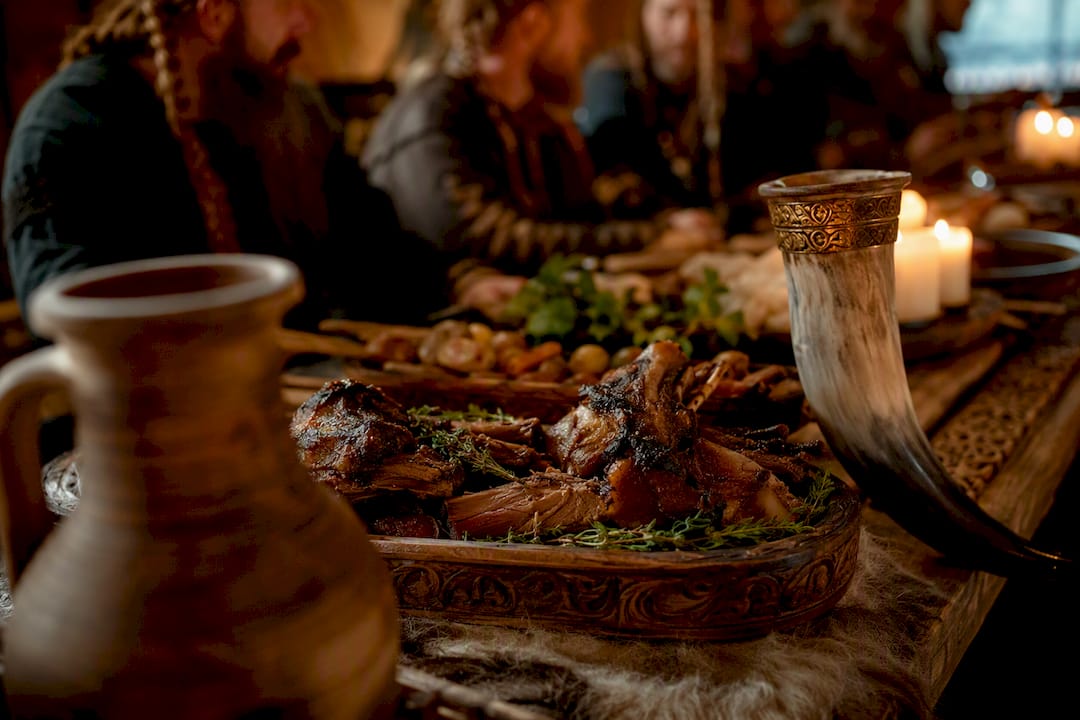
Two named details anchor the feasting side of the myth. Sæhrímnir, a boar, was slaughtered and cooked each day yet somehow remained whole again by the next meal, feeding the entire hall. Heiðrún, a goat, produced an endless supply of mead for the warriors to drink. Britannica’s account of the hall preserves both motifs as core, recurring elements of the myth rather than incidental color.
Pro Tip: When you read “540 doors” or “800 warriors per door” in retellings of Valhalla, treat those as symbolic numbers, not a census. Norse sources sometimes used a “long hundred” counting system, and figures like these were likely meant to convey overwhelming scale rather than a literal headcount.
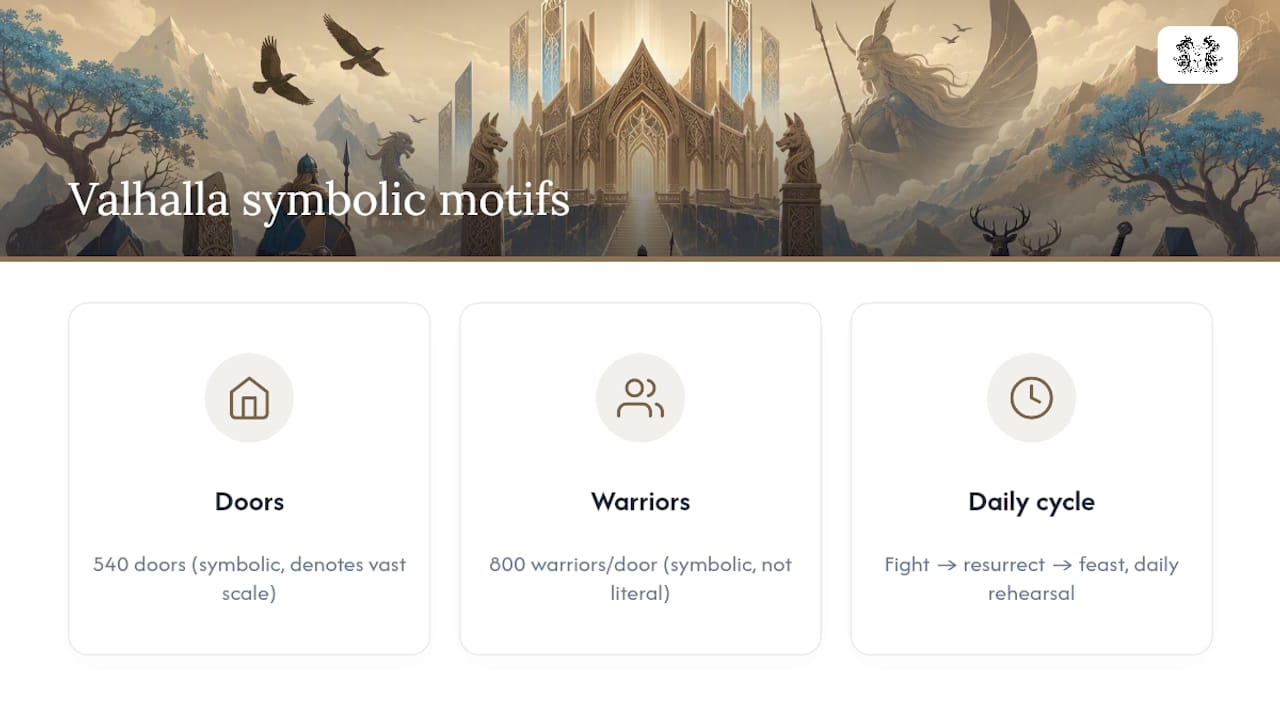
Those numeric motifs, while striking, come with a real scholarly caveat: medieval numerical conventions differed from modern ones, and treating the figures as literal misses the point the poets were making. The renewal cycle, the endless food, the countless doors: all of it points toward one idea. Valhalla promised that a warrior’s death in battle wasn’t an ending. It was an entry point into eternal preparation, fed and armed forever.
Why Did the Einherjar Train for Ragnarök?
Valhalla wasn’t a reward with no purpose attached. The einherjar trained every day for a reason, and that reason was Ragnarök, the foretold final battle where gods and giants would destroy each other and much of the cosmos with them.
Odin gathered these warriors deliberately, building what amounts to an army-in-waiting. When Ragnarök arrived, the einherjar were meant to march out through Valhalla’s many doors and fight alongside the gods against the forces of chaos. The daily combat inside the hall wasn’t idle violence. It was conditioning, myth’s version of standing readiness.
That framing tells you something about the worldview that produced this story:
- Dying in battle wasn’t just honorable in the abstract. It had cosmic utility, feeding directly into the survival of order itself
- Some scholars read Valhalla’s origins as tied to older initiatory or ritual warrior traditions, where symbolic death and rebirth marked a fighter’s transformation, long before the hall took its later literary shape
- The version preserved in Snorri’s writing comes through a Christian-era lens, meaning later embellishment likely shaped some details, even as the core concept clearly predates his account
The martial training and return cycle gives valhalla meaning its sharpest edge. This wasn’t a passive paradise of rest. It was purposeful, forward-looking, and built around the idea that a warrior’s usefulness didn’t end at death.
Was Valhalla the Only Afterlife in Norse Belief?
No, and this is where popular retellings most often go wrong. Valhalla was exclusive, not universal, and Norse cosmology held multiple afterlife destinations depending on how a person died.
Fólkvangr, ruled by the goddess Freyja, was another hall reserved for slain warriors. Norse sources indicate Freyja and Odin split the choice of the fallen between them, meaning not every battle death led to Valhalla at all. Hel, the realm named for the being who governed it, awaited those who died of illness, old age, or other non-combat causes, and it carried none of the martial prestige attached to Odin’s hall. Burial mounds themselves also functioned as a kind of afterlife dwelling in some traditions, with the dead imagined as remaining present within their grave sites rather than departing to a distant hall.
That range of destinations reshapes how you should read Valhalla’s fame:
- Selection depended heavily on the manner of death, with combat death as the baseline requirement for Odin’s hall specifically
- The valkyries acted as the selecting agents on the battlefield, choosing which slain warriors would join the einherjar, a detail that gives these female figures real narrative authority rather than a decorative role
- Only a portion of those who died in combat became einherjar at all; others went to Fólkvangr or elsewhere
The heavy cultural emphasis on Valhalla specifically, over Fólkvangr or Hel, likely reflects the values of the warrior elite who commissioned and preserved these poems. It’s the destination of kings, chieftains, and celebrated fighters in the surviving sources, which tells you something about whose stories got written down in the first place.
How Is Valhalla Used in Modern Language?
Valhalla long ago outgrew its mythological origin and entered everyday English as a metaphor. Merriam-Webster defines the word both in its original mythic sense and as “a place of honor, glory, or happiness,” a meaning you’ll see applied to anything from a beloved restaurant to a dream job with zero battlefield connection.
Military and veteran communities have built their own contemporary tradition around the name. The phrase “till Valhalla” functions today as a tribute, spoken or written to honor a fallen service member. It’s a modern adaptation, not an ancient Viking custom, and that distinction is worth holding onto: the sentiment behind it, honoring someone who died in service, echoes the old myth’s values without claiming to be a direct continuation of it.
Pop culture has run further with the name than the sources ever intended:
- Film and television regularly use Valhalla as shorthand for any warrior’s paradise, often stripped of the exclusivity and daily combat cycle the original myth describes
- Video games and novels frequently present Valhalla as a straightforward heaven, flattening the more complicated picture of selection, training, and eventual battle at Ragnarök
- A common misconception treats Valhalla as Norse mythology’s only afterlife, when the sources clearly describe several
Knowing the difference between the medieval sources and the modern shorthand is most of what separates a real understanding of Valhalla’s significance from the version most people pick up secondhand.
Why Modern Day Knight Draws on These Themes
Honor, sacrifice, and remembrance didn’t stop mattering when the sagas stopped being written. Moderndayknightco is veteran-owned, and the values behind Valhalla’s myth, courage recognized, loss honored, service remembered, sit close to what we build into every piece we make.
We believe clothing can carry meaning the same way a saga once did, passed down and worn as a statement rather than left as decoration:
- The einherjar’s story was about recognition earned through service, not luck or birth
- That same idea drives how veterans and military families think about identity today
- Symbolic apparel gives people a way to wear their values, not just their taste
Pro Tip: If a phrase like “till Valhalla” carries weight for you or someone you know, look for apparel that treats the sentiment with the same respect the myth intended, rather than as a decorative slogan.
If you want to go deeper on how symbolic clothing connects to warrior culture and honor, or how valor-inspired design translates old ideals into what you wear now, both are worth your time.
What Valhalla’s Endurance Says About How We Remember
Valhalla has survived a thousand years of retelling because it answers a question every culture eventually asks: what happens to sacrifice that has no undoing? The myth’s answer, that a warrior’s death becomes preparation rather than an end, still resonates because the underlying need, to make loss mean something, hasn’t gone anywhere.
If you want to see how that same instinct shows up in modern warrior identity and daily practice, it’s worth a closer look. The names and gods change across cultures, but the impulse to honor those who gave everything doesn’t.
— Modern Day Knight
Wear What Valhalla’s Story Still Means Today
Moderndayknightco built its apparel line for people who want their clothing to say something true, not just look good. If the ideas behind Valhalla, earned honor, remembrance, warrior identity, resonate with you, our pieces are designed to carry that weight without shouting it.

The Modern Day Knight Old School Hoodie anchors the collection, built around the same heritage-first values this article has walked through: honor recognized, service remembered, identity worn with intention. For military families specifically, the Army Brat Tee and Army Brat Hoodie speak directly to that experience, while the Global Citizen Tee fits anyone who sees service and integrity as values worth wearing daily, veteran or not. Browse the collection and find the piece that matches the code you already live by.
Sources
- Valhalla - Wikipedia
- VALHALLA Definition & Meaning - Merriam-Webster
- Valhalla - World History Encyclopedia
- Valhalla | Definition, Myth, & Meaning | Britannica


