



“Molon labe” means “come and take them].” It’s a defiant reply attributed to Leonidas I, the Spartan king who led 300 men against the Persian army of Xerxes I at the Battle of Thermopylae in 480 BC. The line survives through [Plutarch, and centuries later, it became a rallying cry for anyone who refuses to back down.
Here’s what you need to know at a glance:
- Classical source: Plutarch’s Sayings of Spartans records the exchange, not a battlefield transcript.
- Grammar: The phrase combines a participle (“having come”) with an imperative (“take!”).
- Modern life: It shows up today as a slogan of defiance, printed on flags, patches, and gear.
Key Takeaways
“Molon labe” literally renders as “when you come, take it,” commonly translated as “come and take them,” and it survives today as a slogan built on Spartan defiance rather than verified battlefield dialogue.
| Point | Details |
|---|---|
| Literal meaning | The phrase combines an aorist participle and imperative, glossed literally as “when you come, take it.” |
| Historical source | Plutarch’s Sayings of Spartans records the line centuries after Thermopylae, not as a contemporary account. |
| Grammar detail | The imperative is singular, meaning Leonidas addresses Xerxes personally, not the Persian army collectively. |
| Pronunciation options | Reconstructed ancient, Modern Greek, and common U.S. pronunciations are all acceptable depending on context. |
| Modern significance | The phrase now functions as a defiance slogan, especially in U.S. gun-rights culture and on apparel. |
Table of Contents
- What Does Molon Labe Mean, and Where Did It Come From?
- What Does the Phrase Literally Translate To?
- How Do You Pronounce Molon Labe?
- Why Is Molon Labe Still Used Today?
- What Do People Get Wrong About Molon Labe?
- Why Molon Labe Endures
- Frequently Asked Questions
- Sources
What Does Molon Labe Mean, and Where Did It Come From?
The story goes that before Thermopylae, Xerxes I demanded the Greeks lay down their weapons. Leonidas answered with two words: molon labe. Come and take them.
That’s the version most people know, and it’s grounded in a real ancient source. Plutarch’s Apophthegmata Laconica records the line as one of many terse Spartan sayings collected for their moral instruction, not as journalism. Plutarch wrote roughly five centuries after the battle, working from oral tradition and earlier writers rather than eyewitness testimony.
That gap matters. Herodotus, who wrote closer to the event and is the primary historian of the Persian Wars, never records this exact quote. It’s Plutarch’s later, anecdotal collection that hands it down to us, which is why serious historians treat the line as a probable literary flourish rather than a verified transcript.
- Xerxes’ demand to surrender arms was a real diplomatic ultimatum before the battle.
- Plutarch’s account is the earliest known written source for the reply.
- Herodotus, writing earlier, does not include this specific exchange.
None of that erases the phrase’s power. It captures something true about Spartan military culture: a warrior ethos built on discipline, brevity, and refusal to yield, even when the anecdote itself was polished long after the spears fell silent.
What Does the Phrase Literally Translate To?
Break the Greek down word by word and the phrase gets more interesting than the popular English version suggests. According to Wiktionary, “molon” (μολών) is an aorist participle meaning “having come,” and “labe” (λαβέ) is a second-person singular aorist imperative meaning “take!”
Strung together literally, that reads closer to “having come, take” or “when you come, take it.” English speakers smooth that into “come and take them” because English favors parataxis, chaining simple clauses with “and.” Classical Greek leans on hypotaxis, folding one action into a grammatical dependent clause instead of listing it as a separate step.
- Molon (μολών): aorist participle, “having come”
- Labe (λαβέ): second-person singular aorist imperative, “take!”
- Literal sense: “when you come, take it”
- Common English gloss: “come and take them”
One detail gets lost in translation: the imperative is grammatically singular. Leonidas isn’t addressing the Persian army as a mass; he’s speaking directly to Xerxes, one man to another. That personal framing sharpens the insult. It’s not “come and take them, all of you.” It’s “you, personally, come try.”
How Do You Pronounce Molon Labe?
You’ll hear at least three legitimate versions, and none of them is wrong for its context.
- Reconstructed ancient Greek: mo LONE lah BAY, an approximation scholars build from what’s known about classical Greek phonetics.
- Modern Greek: mo LON lah VEH, reflecting how the language sounds today, including the shift of beta to a “v” sound.
- Common U.S. pronunciation: MOW lawn lah BAY, the version you’ll hear most often stateside on gun ranges, at rallies, or in casual conversation.
Reconstructions of ancient pronunciation carry real uncertainty. Lexical sources like LSJ can confirm spelling and grammar with confidence, but nobody recorded fifth-century-BC Spartans speaking, so any reconstruction is an educated approximation.
Pro Tip: Use the reconstructed form in academic or historical discussion, Modern Greek if you’re speaking with a Greek audience, and the common U.S. version everywhere else. There’s no wrong choice among the three, only context.
Why Is Molon Labe Still Used Today?
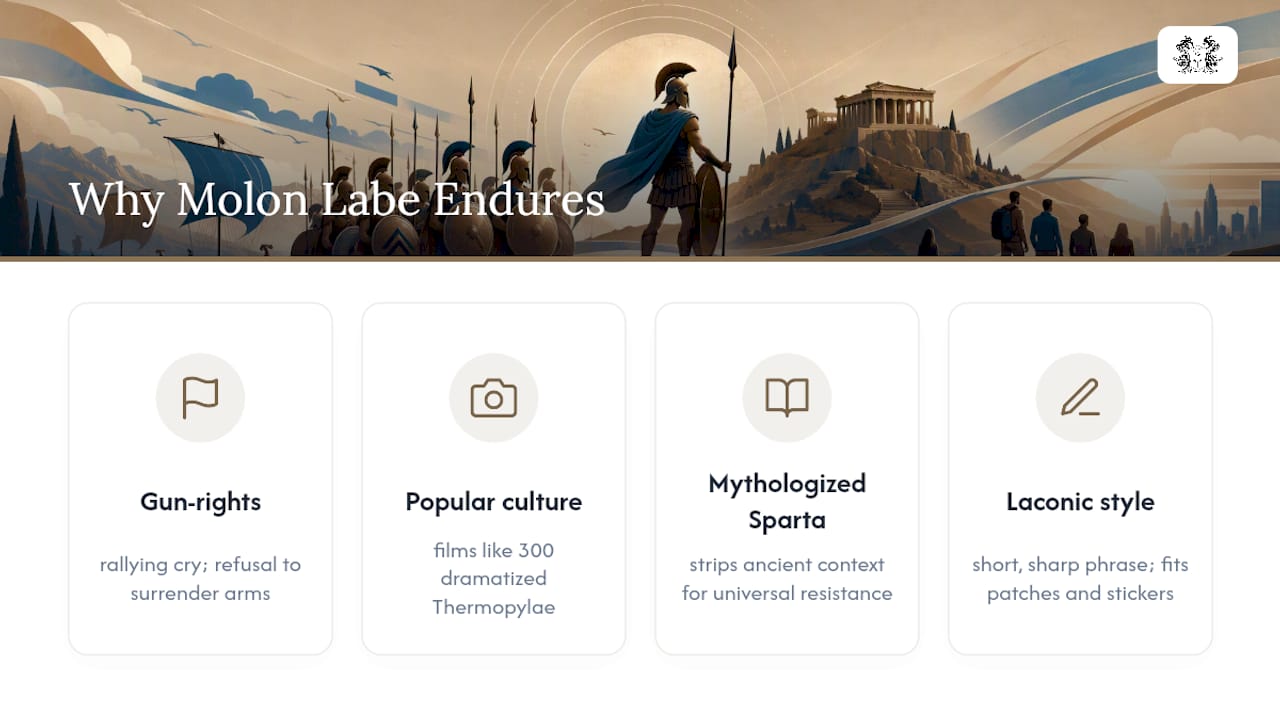
The phrase has traveled a long way from a Spartan king to a printed slogan. Today it shows up on flags, patches, stickers, tactical gear, and apparel, most visibly as a rallying cry within U.S. gun-rights culture, where it symbolizes refusal to surrender arms or ground. That specific modern meaning draws a direct line back to the original context: a demand to disarm, met with defiance.
Popular culture accelerated the spread. Films like 300 dramatized Thermopylae for a mass audience and helped turn a reported written reply into an imagined battlefield shout, cementing an image of Spartan resistance that’s more cinematic than historical.
Modern political and cultural use of “molon labe” often relies on a stylized, mythologized version of Sparta. Commentary on the phrase’s adoption notes that contemporary use frequently strips away the ancient context in favor of a simpler, more universal message of resistance.
Part of what makes the phrase durable is its style. Spartans were known for laconic speech, saying the most with the fewest words, and “molon labe” is a textbook example. That literary economy is why it still fits on a patch or a bumper sticker two and a half thousand years later. You can see the same instinct at work in how warrior culture continues to shape modern apparel design, where a short, sharp phrase carries more weight than a paragraph ever could.
What Do People Get Wrong About Molon Labe?
A few myths deserve a straight correction.
- Myth: Leonidas shouted it on the battlefield. The earliest source presents it as a written or spoken reply during negotiations, not a mid-combat yell.
- Myth: It reflects a single, unbroken Spartan ethos passed down verbatim. The phrase reaches us through a moralizing anecdote collection written centuries after the fact.
- Myth: Its modern political use matches Leonidas’s original intent. The ancient reply was aimed at one king’s demand for disarmament, not a policy platform.
The earliest full textual record comes from Plutarch, writing generations after Thermopylae for a genre built to teach a lesson, not preserve a court transcript.
Pro Tip: When you repeat the phrase, know the difference between the history and the legend. Both are worth knowing, but only one is verifiable.
Why Molon Labe Endures
The line survives because it does two jobs at once: it names a real historical moment and it says something universal about refusing to bend. That’s rare. Most ancient quotes fade into footnotes, but this one still means something to a person putting on a shirt in 2026.

We think the biggest misread of “molon labe” is treating it as either pure history or pure myth. It’s both, and pretending otherwise sells the phrase short. The grammar is genuinely instructive: a singular imperative aimed at one man carries more weight than a shouted slogan aimed at an army. That detail rarely makes it into casual retellings, and it should.
What we’d push back on is the idea that wearing the phrase requires certainty about its exact battlefield origin. Values don’t need a verified transcript to be real. What matters is whether you understand what you’re saying and why it still resonates: a refusal to surrender what matters, stated as plainly as possible. Know the history, then decide what the words mean to you.
Frequently Asked Questions
What does molon labe literally mean? It literally translates to “having come, take” or “when you come, take it,” commonly rendered in English as “come and take them.”
Who first said molon labe? The phrase is attributed to Leonidas I of Sparta, reportedly said to Xerxes I before the Battle of Thermopylae, though the earliest surviving record comes from Plutarch, writing centuries later.
How do you pronounce molon labe correctly? There’s no single correct pronunciation. Reconstructed ancient Greek sounds close to “mo-lone lah-bay,” Modern Greek sounds like “mo-lon lah-veh,” and the common U.S. version is “mow-lawn-lah-bay.”
Is molon labe a real historical quote or a myth? It’s a blend of both. The phrase appears in a real ancient text, but that text was written generations after Thermopylae as moralizing anecdote, not eyewitness reporting, so its exact historicity can’t be confirmed.
Why is molon labe popular in gun-rights culture? The phrase’s core meaning, a refusal to surrender weapons on demand, maps directly onto modern gun-rights messaging, which is why it appears widely on apparel, flags, and gear tied to that movement. You’ll find the same warrior-inspired symbolism woven into military-inspired apparel built around similar values of honor and resolve, including within Moderndayknightco’s own collection.
Sources
- Spartan history: Real origins of the phrase Molon Labe and the false right-wing myth.
- Molon Labe
- μολὼν λαβέ - Ancient Greek (LSJ)
- molon labe - Wiktionary, the free dictionary


