



“The Few, The Proud, The Marines” is the defining slogan of the United States Marine Corps, representing over 45 years of commitment to elite standards, honor, and service. Marines the few the proud is not just a recruiting phrase. It is a declaration of identity. The slogan has attracted generations of Americans willing to meet the Corps’ highest demands. It signals that earning the title of Marine requires more than physical strength. It demands Honor, Courage, and Commitment, the three Marine Corps values that define every Marine’s conduct from boot camp to retirement and beyond.
What does “The Few, The Proud, The Marines” really mean?
The slogan was intentionally crafted to represent exclusivity and attract individuals committed to excellence. Marine Corps Recruiting Command leadership built the phrase to signal that not everyone qualifies. That exclusivity is the point. The Corps does not want every applicant. It wants the right ones.
The three Marine Corps values sit at the heart of this message.
- Honor means integrity in every action, on and off duty. A Marine does not lie, cheat, or steal. Honor is not situational. It is absolute.
- Courage is both physical and moral. It means standing firm under fire and speaking truth when it is uncomfortable. The Corps trains both kinds.
- Commitment is the promise to complete the mission and support fellow Marines regardless of personal cost. It outlasts any single deployment.
These values are not decorative. They shape daily conduct, leadership decisions, and how Marines treat civilians, allies, and each other. The slogan exists to attract people who already sense these values within themselves and want a structure that sharpens them.
Pro Tip: If you are exploring whether military service is right for you, ask yourself which of these three values you already live by. That answer tells you more than any aptitude test.
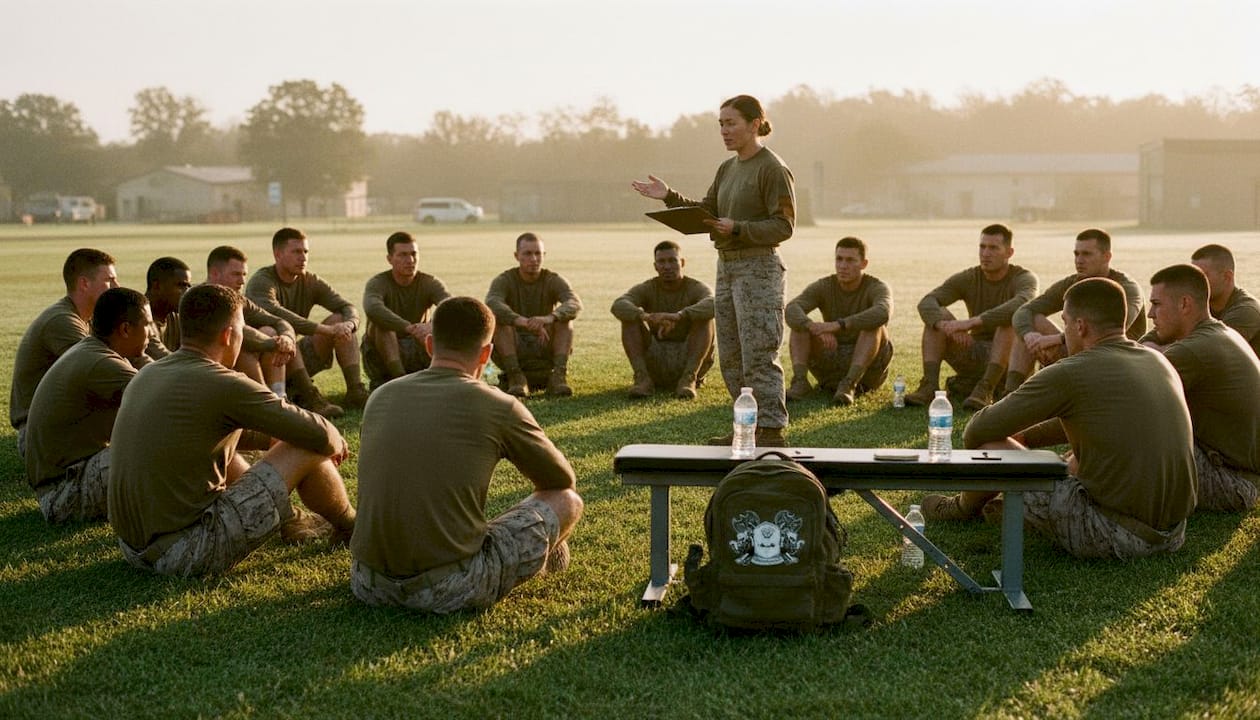
The slogan also carries a quiet challenge. “The Few” acknowledges that most people will not make it. That is not an insult. It is an honest standard. The Corps has always been the smallest branch of the U.S. armed forces. That size is a feature, not a limitation. Fewer Marines means tighter bonds, higher standards, and a culture where every individual carries real weight.
How does Marine Corps boot camp forge “The Few”?
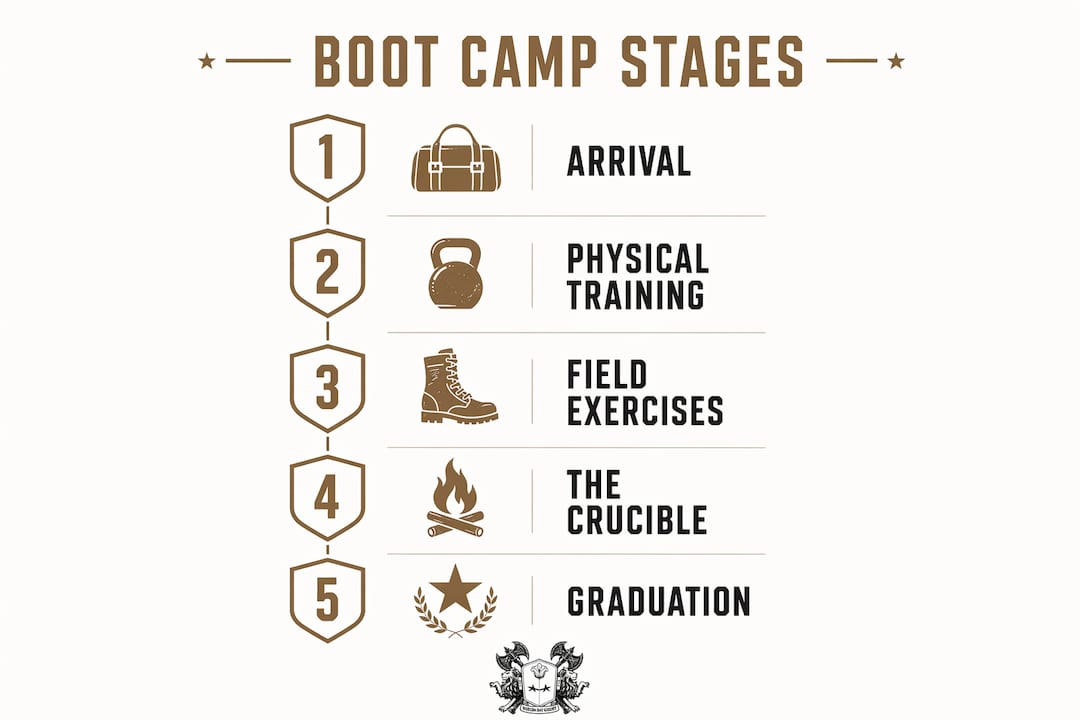
Recruit training is a 13-week program designed to physically and mentally transform civilians into Marines. It is the most demanding initial military training in the U.S. armed forces. Every element is deliberate. The Corps does not just build fit bodies. It builds character under pressure.
The training follows a clear progression:
- Receiving and initial processing — Recruits arrive, shed civilian identity, and begin learning the Marine Corps way of life from day one.
- Phase one: physical and mental conditioning — Drill Instructors establish discipline, physical standards, and the foundational habits of military life.
- Phase two: combat skills and weapons training — Recruits learn marksmanship, tactics, and the technical skills of a Marine rifleman.
- Phase three: advanced field training — Teams apply everything learned under realistic field conditions, building unit cohesion and tactical judgment.
- The Crucible — The 54-hour final event that tests every recruit at their absolute limit.
The 54-hour Crucible is the defining moment of recruit training. Recruits face obstacles named after Marine heroes, with Drill Instructors providing history and context after each challenge. That combination of physical stress and historical grounding is deliberate. It connects each recruit to a legacy larger than themselves.
“The Crucible does not just test whether you can endure. It tests whether you can lead, support your team, and keep your values intact when everything in your body is telling you to quit.”
The dedication required often starts long before boot camp. One documented example involves a recruit who lost 90 pounds before enlistment to meet the Corps’ strict physical standards. That kind of self-driven preparation reflects the Marine ethos before a single day of official training begins. Achieving the title of Marine demands years of commitment, not just 13 weeks.
How has the slogan shaped Marine Corps culture over time?
The slogan has been in active use since the late 1970s, making it one of the longest-running military recruiting campaigns in American history. That longevity is not accidental. The phrase captures something permanent about Marine identity that transcends any single era.
Over the decades, the Corps has discussed whether to update or complement the slogan. No replacement has taken hold. The phrase remains because it still tells the truth. The Marines are few. They are proud. And that combination still resonates.
Alongside the official slogan, the Corps carries several unofficial mottos that fill out the full picture of Marine culture.
| Motto | Purpose | What it reflects |
|---|---|---|
| “The Few, The Proud, The Marines” | Official recruiting slogan | Exclusivity and elite standards |
| “Semper Fidelis” (Always Faithful) | Official motto | Loyalty to Corps, country, and fellow Marines |
| “Improvise, Adapt, and Overcome” | Unofficial operational motto | Resilience and problem-solving under pressure |
| “Once a Marine, Always a Marine” | Cultural truth | Permanent identity and lifelong bond |
The unofficial motto “Improvise, Adapt, and Overcome” complements the official slogan by highlighting adaptability and toughness. Where “The Few, The Proud” speaks to who Marines are, “Improvise, Adapt, and Overcome” speaks to how they operate. Both are necessary to understand the full Marine ethos.
The balance between tradition and modern military culture is something the Corps manages carefully. New generations of Marines bring different backgrounds and perspectives. The values do not change. The application evolves. That balance is what keeps a 250-year-old institution relevant in the 21st century.
What does “Once a Marine, Always a Marine” mean for veterans?
“Once a Marine, Always a Marine” is a foundational truth representing permanent character transformation. The title of Marine does not expire at the end of a service commitment. It stays with every person who earned it, for life.
Major General John A. Lejeune stated that the Marine title is a lifelong bond forged through sacrifice and discipline. That bond does not weaken with time. Veterans who served decades ago still introduce themselves as Marines, not former Marines. The distinction matters deeply within the community.
This lifelong identity shows up in several concrete ways:
- Veterans carry the discipline, values, and sense of mission into civilian careers, families, and communities.
- The Marine network remains active long after service ends, with veterans supporting each other professionally and personally.
- The pride of earning the title shapes how Marines approach every challenge, from business decisions to personal setbacks.
- The phrase “proud to be a Marine” is not nostalgia. It is a present-tense statement of identity.
The permanent character transformation initiated during boot camp does not fade. It deepens. Marines who served 30 years ago often describe their training as the defining experience of their lives. That is not sentiment. It is the result of a deliberate system designed to change people at their core.
Pro Tip: If you know a Marine veteran, ask them about their Crucible experience. The story they tell will show you exactly what the Corps means by Honor, Courage, and Commitment.
The role of honor in warrior culture extends well beyond the military. The values Marines carry into civilian life influence families, workplaces, and communities in ways that rarely make headlines but matter every day.
Key Takeaways
The Marine Corps slogan “The Few, The Proud, The Marines” is a direct statement of values, not a marketing phrase, and its power comes from the Honor, Courage, and Commitment that every Marine earns through training and carries for life.
| Point | Details |
|---|---|
| Slogan origin and purpose | The phrase has been in use since the late 1970s to signal elite standards and attract high-caliber recruits. |
| Core values are non-negotiable | Honor, Courage, and Commitment define Marine conduct on and off duty, not just during service. |
| Boot camp is transformative | The 13-week program, including the 54-hour Crucible, reshapes identity at a fundamental level. |
| The title lasts a lifetime | “Once a Marine, Always a Marine” reflects permanent character change, not just a service period. |
| Culture runs deeper than slogans | Mottos like “Improvise, Adapt, and Overcome” show that Marine resilience is a way of life, not a phrase. |
The slogan that never needed updating
I have spent years around military culture, and one thing stands out about the Marine Corps above every other branch. They never had to reinvent their identity. The Army has cycled through recruiting slogans. The Navy has rebranded. The Marines have said the same four words for nearly five decades, and those words still hit harder than anything else in military advertising.
That is not stubbornness. That is confidence in what they built. The warrior culture that inspires modern life does not need constant reinvention. It needs consistency. The Marine Corps understood that before most institutions did.
What I find most powerful is the phrase “The Few.” It does not promise glory to everyone. It promises a standard. Most people will not meet it. That honesty is rare. We live in a culture that tells everyone they are exceptional. The Corps says something different. It says excellence is earned, not assumed. That message resonates far beyond recruiting offices.
The values behind this slogan, Honor, Courage, and Commitment, are not military-exclusive. They are human standards that any person can choose to live by. The Marines just built a system that makes those choices unavoidable. That is the real lesson.
— Modern Day Knight
Wear the values, not just the name
The ethos behind “The Few, The Proud” is not locked inside a military base. It lives in the people who carry those values every day, in uniform and out.
Moderndayknightco is a veteran-owned brand built for people who live by a code. Our Marine-inspired apparel is designed for those who understand that what you wear can be a statement of who you are. From the Army Brat Tee to our full collection of hats, every piece reflects the same principles Marines have carried for generations. Honor. Loyalty. Strength. These are not just words on fabric. They are the foundation of a community that refuses to settle for less.
FAQ
What does “The Few, The Proud, The Marines” mean?
The slogan signals that the Marine Corps holds the highest standards of any U.S. military branch and deliberately recruits only those committed to excellence. It reflects the Corps’ three core values: Honor, Courage, and Commitment.
How long has the Marine Corps used this slogan?
The slogan has been in use since the late 1970s, making it one of the longest-running military recruiting campaigns in American history.
What happens during the Marine Corps Crucible?
The Crucible is a 54-hour final event in recruit training that tests recruits physically, mentally, and emotionally through obstacles named after Marine heroes. Completing it marks the transition from recruit to Marine.
What does “Once a Marine, Always a Marine” mean?
The phrase reflects the permanent character transformation that boot camp initiates. The title of Marine does not expire at the end of service. It is a lifelong identity.
What are the Marine Corps core values?
The Marine Corps core values are Honor, Courage, and Commitment. These three values define the moral and professional standard expected of every Marine throughout their service and beyond.


