



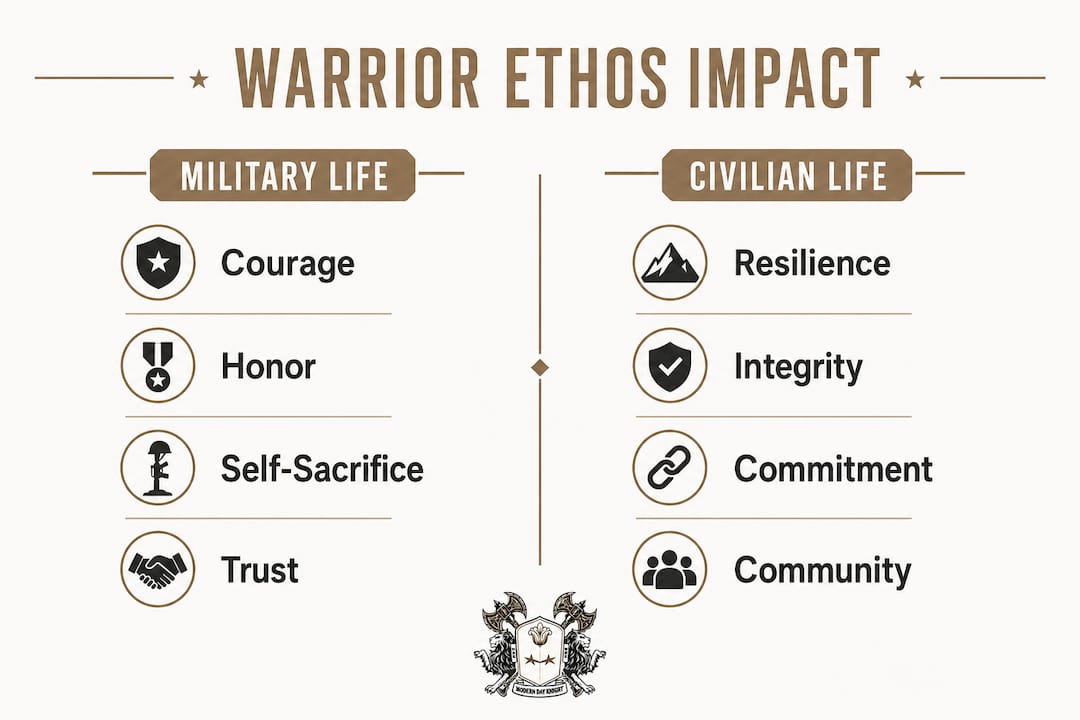
The warrior ethos is a moral and psychological framework built on courage, honor, self-sacrifice, and trust. It extends well beyond military service to shape civilian values, identity, and daily behavior. Fewer than 1% of Americans serve in uniform, yet the principles these warriors live by resonate with millions who have never worn a uniform. That gap tells you something important. The ethos fills a real need. People want a code. They want structure, accountability, and a reason to hold the line when life gets hard. Understanding why warrior ethos appeals beyond military contexts starts with understanding what the ethos actually is.
Why warrior ethos appeals beyond military life
The warrior ethos is not a military slogan. It is a living moral framework that structures meaning, sustains resilience, and guides judgment under extreme uncertainty. Researchers describe it as an “arc of enchantment,” a phenomenological process that moves through idealization, disruption, disenchantment, and reflective integration before arriving at re-enchantment. That cycle sounds abstract, but it maps directly onto how people grow through hardship.
Think about what civilians face: job loss, family breakdown, health crises, and a culture that often offers no clear moral compass. The warrior ethos steps into that vacuum. It provides what psychologists call cognitive and ethical armor, a structured way of thinking and acting that sustains agency when circumstances feel out of control. This is not borrowed valor. It is borrowed wisdom.
The moral domain is where the ethos does its most important work. Expert research shows that when the moral incentive of the warrior ethos is lost, cohesion collapses. That finding applies to military units, but it applies equally to families, businesses, and communities. Any group facing existential stress needs a shared moral framework to hold together.
Pro Tip: Start small. Pick one warrior principle, such as accountability, and apply it to one area of your life for 30 days. Concrete practice builds authentic alignment far faster than symbolic gestures.
The warrior ethos for civilians explained simply is this: it gives you a code when the world offers none. The values are not exclusive to combat. They are universal.
- Courage means acting despite fear, not the absence of it.
- Honor means doing what is right when no one is watching.
- Self-sacrifice means putting the mission or the team before personal comfort.
- Trust means being the person others can count on without question.
Each of these translates directly into civilian life. A parent raising children alone practices self-sacrifice daily. A manager who takes responsibility for a team’s failure practices honor. A friend who shows up at 2 AM practices trust.
How military aesthetics shape civilian identity
Military aesthetics have moved far beyond the base. Camouflage prints appear on runways. Tactical gear fills streetwear catalogs. The visual language of the warrior has become a civilian fashion staple, often stripped of its original context and repurposed as shorthand for toughness or rebellion.
This shift carries both opportunity and risk. The opportunity is real. Military apparel acts as a non-verbal catalyst for communication and mutual respect. A shirt bearing a military insignia can open a conversation, signal shared values, and educate younger generations about honor and sacrifice. That is not a small thing. Identity is partly built through the signals we send to others.
The risk is equally real. When aesthetics travel without context, meaning flattens. A camo jacket worn purely for style carries none of the weight it carries on a soldier’s back. The visual shorthand for toughness becomes decoration. The warrior spirit in everyday apparel only holds its power when the wearer understands what the symbols represent.
Pro Tip: Before buying military-inspired apparel, ask yourself what value or commitment the piece represents to you. Intentional choices build identity. Impulse purchases build a costume.
The role of identity in warrior lifestyle apparel is not about imitation. It is about alignment. Clothing becomes meaningful when it reflects a genuine internal commitment. Veterans who wear their branch insignia after service are not performing. They are signaling a lived experience. Civilians who wear values-driven apparel with full awareness of what those values demand are doing something similar.
Younger generations are particularly drawn to this kind of cultural signaling. They are searching for belonging and purpose in a fragmented culture. Military aesthetics offer a visual grammar for those values, provided the wearer engages with the substance behind the style.
What are the real challenges of adopting warrior culture?
Adopting the warrior ethos without understanding it creates problems. The cultural ideal of militant masculinity can become hollow when it is not rooted in genuine service. Historians and cultural analysts warn that admiration for warriors rings false when it substitutes symbols for real sacrifice. That hollowness is not just embarrassing. It is corrosive. It cheapens the ethos for everyone, including those who earned it.
Genuine engagement looks different from symbolic use in four specific ways:
- Accountability over aesthetics. Authentic warriors hold themselves responsible for outcomes. Symbolic adoption focuses on appearance. The test is simple: does your code cost you anything?
- Service over status. The ethos is built on contribution to something larger than yourself. If warrior identity is primarily about how others perceive you, the foundation is wrong.
- Discipline over performance. Consistent daily practice defines the warrior. One dramatic gesture does not.
- Humility over bravado. Real warriors respect the weight of what they carry. Performative toughness signals the opposite.
“The warrior ethos transcends physical courage and becomes a fundamentally moral domain issue. Its loss leads to fragmentation and collapse of cohesion in any group facing existential stress.” — Daniel K. Inouye Asia-Pacific Center for Security Studies
That insight applies directly to civilians. When you adopt warrior values superficially, you do not just fail to gain the benefits. You actively undermine the moral coherence those values are supposed to build. The solution is not to avoid the ethos. It is to engage with it honestly, knowing it will demand something real from you.
How can civilians embody warrior principles in daily life?
Civilians embody warrior principles most effectively through structure, community, and intentional choices. The U.S. Army Warrior Ethos, formalized in November 2003 under Army Chief Peter Schoomaker, codified four commitments in the Soldier’s Creed: never quit, never leave a fallen comrade, accept mission, and succeed in mission. Those commitments translate directly into civilian routines.
Discipline shows up in morning routines, training schedules, and financial habits. Accountability shows up in how you handle failure at work or at home. Clarity of purpose shows up in the decisions you make when comfort and principle conflict. None of these require combat experience. They require commitment.
Brands like Rogue American Apparel have built communities around purpose-driven clothing that appeals to civilians seeking discipline, accountability, and structured identity. The appeal is not the gear. It is the community and the code the gear represents. Moderndayknightco operates from the same foundation, combining veteran ownership with a modern code of honor that makes every piece a statement of values, not just style.
The non-military applications of warrior ethos are broad. Here is how they map across civilian contexts:
- Personal fitness: Training with a warrior mindset means showing up when motivation is absent. Discipline replaces feeling.
- Professional life: Accountability under pressure, protecting your team, and holding the line on ethics mirror battlefield leadership.
- Parenting: Self-sacrifice, patience under strain, and modeling integrity are warrior values practiced daily.
- Community: Showing up for neighbors, volunteering, and building local trust networks reflect the ethos of service.
Learning how to mix warrior aesthetic into professional settings is a practical skill. The goal is alignment between what you wear and what you practice. When those two things match, the clothing carries weight.
Key Takeaways
The warrior ethos appeals beyond military life because it offers a universal moral framework that sustains courage, accountability, and purpose in any person willing to live by it.
| Point | Details |
|---|---|
| Ethos as moral framework | Courage, honor, self-sacrifice, and trust apply to civilian life as directly as to combat. |
| Psychological armor | The ethos sustains agency under uncertainty, giving civilians structure when culture offers none. |
| Aesthetics require context | Military-inspired apparel builds identity only when the wearer understands the values behind the symbols. |
| Authentic over performative | Genuine warrior values demand accountability, discipline, and service, not just visual signals. |
| Daily practice matters | Warrior principles show up in fitness, parenting, professional life, and community, not just dramatic moments. |
The ethos is a code, not a costume
We have seen what happens when the warrior ethos is reduced to an aesthetic. The symbols lose their weight. The community loses its coherence. The individual loses the very thing they were searching for.
What I know from building Moderndayknightco is this: the people who connect most deeply with warrior values are not looking for a costume. They are looking for a code. They want something that holds them accountable, connects them to a community, and gives their daily choices a larger meaning. That is not a military-exclusive need. That is a human need.
The ethos works because it is demanding. It does not flatter you. It challenges you. It asks whether your actions match your stated values, every single day. That challenge is exactly what makes it worth carrying.
The risk of superficial adoption is real, and we take it seriously. Wearing a piece from Moderndayknightco is not a claim to have served. It is a commitment to the values that service represents: integrity, loyalty, and strength. The distinction matters. Honor-inspired clothing means something only when the person wearing it is actively working to earn it.
The warrior ethos is not a relic. It is a living framework for anyone willing to hold the line.
— Modern Day Knight
Moderndayknightco: apparel built on a code
Moderndayknightco is a veteran-owned brand built on the belief that what you wear should reflect what you stand for. Every piece in the apparel collection is designed with durability, intentional messaging, and deep respect for military heritage. This is not fashion for its own sake. It is clothing that signals a commitment to integrity, loyalty, and strength. Whether you are a veteran, a military family member, or a civilian who lives by a code, Moderndayknightco connects you to a community that holds those values seriously. Wear what you believe. Stand for something real.
FAQ
What is the warrior ethos explained simply?
The warrior ethos is a moral framework built on courage, honor, self-sacrifice, and trust. It guides behavior under pressure and applies to anyone committed to living by a disciplined code, not only military personnel.
Why do civilians wear warrior ethos apparel?
Civilians wear warrior-inspired apparel to signal shared values, build identity, and connect with a community centered on discipline and purpose. The clothing carries meaning when the wearer actively practices the values it represents.
When was the U.S. Army Warrior Ethos officially established?
The U.S. Army Warrior Ethos was formally approved on November 13, 2003, by Army Chief Peter Schoomaker and codified in the Soldier’s Creed as a leadership commitment to core values and combat readiness.
What are the benefits of a warrior mindset for personal growth?
A warrior mindset builds discipline, accountability, and clarity of purpose. These qualities improve performance in professional settings, strengthen relationships, and create resilience during personal hardship.
How does warrior ethos differ from performative toughness?
Genuine warrior ethos demands consistent daily practice, service to others, and accountability for outcomes. Performative toughness focuses on appearance and status without the underlying commitment those symbols represent.


