



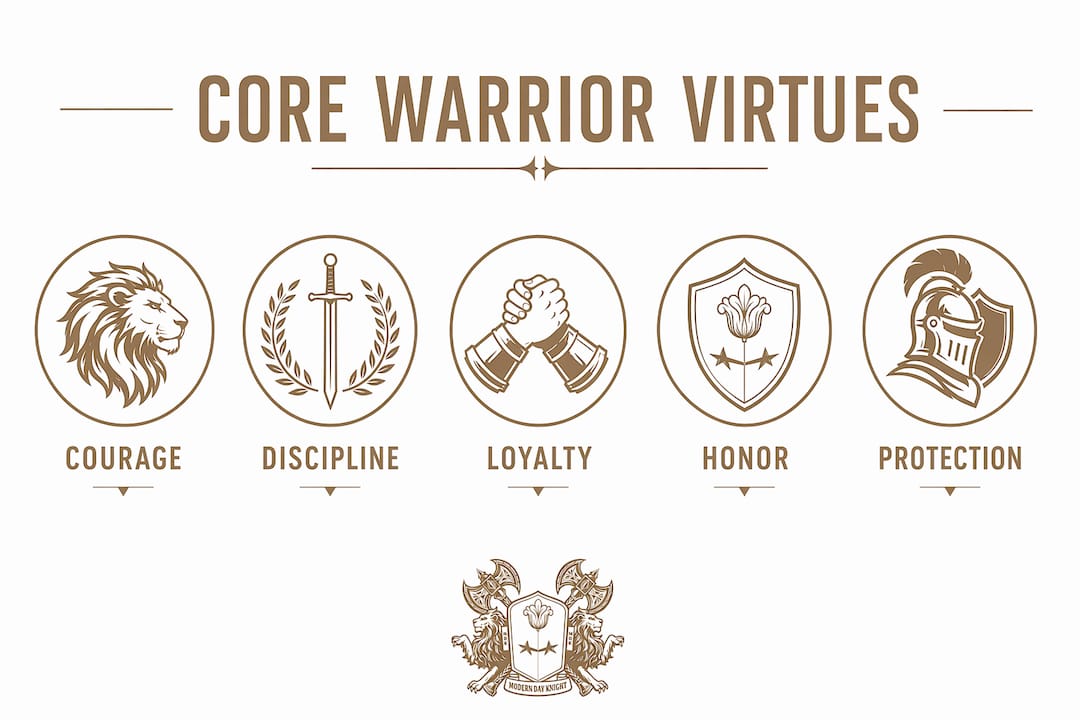
Ancient warrior codes are ethical frameworks built on virtues like courage, honor, loyalty, and discipline. These codes, including Japan’s Bushido and the Kshatriya warrior tradition of ancient India, were never just rules for combat. They were complete systems for living with integrity. The question of why ancient warrior codes still apply today has a direct answer: the moral challenges they addressed have not changed. Ethical ambiguity, failures of leadership, and the struggle for self-discipline are as present now as they were on any battlefield. These codes offer a tested structure for character development that modern life rarely provides on its own.
Why ancient warrior codes still apply today
The core virtues embedded in warrior codes address problems that no era has solved. Bushido includes rectitude, courage, benevolence, respect, honesty, honor, and loyalty, and each one maps directly onto a modern failure point. Rectitude answers ethical ambiguity. Courage answers avoidance. Loyalty answers self-interest at the expense of community.
These are not abstract ideals. They are behavioral standards. A person who practices Bushido’s rectitude does not rationalize dishonest shortcuts. A person who follows the Stoic tradition of courage acts on what is right even when the personal cost is high. Stoic philosophy teaches courage as moral strength to face difficult truths, not as fearlessness in the face of danger. That distinction matters enormously in personal development.
The Kshatriya code from ancient India adds another dimension. It frames the warrior’s duty as protection of the weak and upholding of dharma, or moral order. Dharmic warrior ethics require war as a last resort, mirroring the modern legal principle of jus ad bellum. That parallel is not coincidental. Both systems recognize that power without moral constraint destroys the very thing it claims to protect.
The table below compares core virtues across three major warrior traditions:
| Virtue | Bushido (Japan) | Stoicism (Greece/Rome) | Kshatriya (India) |
|---|---|---|---|
| Courage | Moral and physical bravery | Rational moral fortitude | Duty-bound protection |
| Honor | Alignment with virtue and truth | Living according to reason | Upholding dharma |
| Loyalty | Absolute commitment to lord and code | Commitment to reason and community | Fidelity to caste duty |
| Discipline | Rigorous self-regulation | Mastery of impulse and desire | Restraint in the use of force |
| Restraint | Avoiding reckless aggression | Choosing virtue over passion | Force only as a last resort |
Pro Tip: Pick one virtue from this table and define what it looks like in your own life this week. Specificity turns philosophy into practice.
Ability must be governed by character. That insight from the Bushido tradition is the reason these codes remain relevant. Skill without ethics produces harm. Modern society produces skilled people in abundance. It produces people of deep character far less reliably.

How do warrior codes shape modern leadership?
Leadership is where ancient warrior principles show their clearest modern application. The “Business Samurai” model, studied in organizational culture research, applies Samurai principles to negotiation, crisis management, team loyalty, and brand reputation. Business Samurai models emphasize authentic leadership to combat short-termism and burnout. That is a direct translation of Bushido’s rectitude and loyalty into a corporate context.
The connection is not metaphorical. It is structural. A leader who practices honor-based decision-making does not cut ethical corners to hit a quarterly target. A leader who practices loyalty builds teams that stay through difficulty rather than leave at the first better offer. These outcomes are measurable in retention, culture, and long-term performance.
Modern leadership practices inspired by warrior codes include:
- Honor-based accountability. Leaders own their failures publicly and correct course without deflection.
- Loyalty as a two-way commitment. Leaders protect their teams the way a samurai protected those under their care.
- Self-control in crisis. Leaders who practice Stoic restraint do not make reactive decisions under pressure.
- Mission over vanity. Business leaders who prioritize mission over vanity build cultures that outlast individual personalities.
- Respect as a daily standard. Warrior codes treat respect not as a reward but as a baseline expectation in every interaction.
Pro Tip: Before your next difficult leadership decision, ask one question: “Would I be comfortable if my team saw exactly how I made this choice?” That is honor-based accountability in practice.
Military institutions have applied this framework for generations. The U.S. military’s code of conduct, officer honor codes at West Point, and the ethos of special operations units all draw on warrior tradition. They work because they give individuals a fixed moral reference point when circumstances become chaotic.
What are the biggest misconceptions about warrior codes?
The most damaging misconception about warrior codes is that they glorify violence. They do not. True warrior codes treat violence as a last resort governed by strict moral rules. The confusion arises when people extract the warrior’s toughness while discarding the warrior’s restraint.
History provides a clear warning. Japan’s kamikaze program caused thousands of deaths and stands as one of the most cited examples of what happens when warrior sacrifice is stripped of rational moral judgment. The pilots were courageous by any measure. But the program abandoned the core Bushido requirement of strategic wisdom and proportionality. Courage without judgment is not a warrior virtue. It is a liability.
“Misinterpretation of courage as fearlessness leads to moral and strategic failures. Authentic codes demand moral fortitude and restraint.” — from the warrior ethos tradition
Three common misconceptions and their corrections:
- Misconception: Warrior codes reward aggression. Correction: Every major warrior code, from Bushido to Stoicism, places restraint above aggression. Authentic warrior codes integrate restraint and moral judgment, not reckless action.
- Misconception: These codes are outdated because war has changed. Correction: The virtues are not about war tactics. They are about character. Character challenges do not change with technology.
- Misconception: Warrior codes are only for soldiers. Correction: Bushido shaped Japanese merchants, artists, and administrators for centuries. The code was always about how to live, not just how to fight.
Integrating warrior codes with modern legal and ethical frameworks is not a compromise. It is the correct application. The codes themselves demand it.
How can you apply warrior values in everyday personal development?
Personal development is where these codes become most practical. Martial arts environments embody Bushido through ceremony and discipline, instilling values through practice rather than lecture. That model transfers directly to daily life. You do not need a dojo. You need consistent habits tied to clear values.
Practical ways to build warrior virtues into daily life:
- Courage: Identify one conversation you have been avoiding and have it this week. True courage is acting rightly despite fear, not the absence of it. Start small and build the habit.
- Loyalty: Write down the three commitments you consider non-negotiable. Review them every morning. Loyalty to values is the foundation of codes of honor in modern life.
- Discipline: Build one physical or mental practice into your daily routine without exception. Warrior traditions treat discipline as the foundation of all other virtues.
- Honor: Make decisions as if your character, not just your outcome, is being evaluated. Ask yourself whether your choice reflects the person you intend to be.
- Respect: Treat every interaction as a reflection of your values. Warrior codes do not reserve respect for superiors. They extend it to everyone.
Pro Tip: Read the Hagakure or Marcus Aurelius’s Meditations for 10 minutes each morning. Both are short, direct, and written for people who need to act, not just think.
The role of courage in everyday living is not dramatic. It shows up in small choices made consistently. That is exactly what warrior codes were designed to support.
Key Takeaways
Ancient warrior codes remain relevant because they provide fixed moral frameworks for courage, discipline, loyalty, and honor that address the same human failures present in every era.
| Point | Details |
|---|---|
| Codes define character, not combat | Bushido, Stoicism, and Kshatriya ethics are systems for living with integrity, not just fighting. |
| Restraint is the core virtue | Every major warrior code treats restraint and moral judgment as higher values than aggression. |
| Leadership benefits directly | Honor-based accountability and loyalty-driven culture produce measurable results in modern organizations. |
| Misapplication causes harm | Stripping warrior toughness from warrior ethics, as seen in WWII kamikaze tactics, leads to strategic and moral failure. |
| Practice beats theory | Warrior virtues are built through daily habits, not philosophical study alone. |
The warrior code is not a relic. It is a standard.
I have spent years around people who carry themselves differently. Veterans, coaches, tradespeople who take their word seriously. What they share is not toughness. It is a fixed internal standard they refuse to negotiate away. That is the warrior code in practice, and it is the rarest thing in modern life.
What strikes me most is how the misconception about these codes persists. People hear “warrior” and think violence. But every serious tradition, from the Hagakure to Aristotle’s ethics, points to the same truth: honor is a step toward virtue, not an end in itself. The warrior is not the person who wins the fight. The warrior is the person who does the right thing when it costs them something.
The balance between strength and compassion is where most people get lost. Strength without compassion becomes cruelty. Compassion without strength becomes passivity. Warrior codes hold both in tension deliberately. That tension is not a flaw. It is the point.
We do not need to romanticize ancient cultures to take their best ideas seriously. We need to ask what worked, why it worked, and how to apply it now. The answer, consistently, is that character built on clear virtues produces better outcomes than character built on convenience. That has not changed. It will not change.
— Modern Day Knight
Wear what you stand for
At Moderndayknightco, every piece of apparel is built around the same values these codes have carried for centuries: integrity, loyalty, and strength. This is a veteran-owned brand, and that heritage is not decoration. It is the reason the products exist.

If you are serious about living by a code, your gear should reflect it. The full apparel collection includes pieces designed for people who treat their values as non-negotiable. From the Modern Day Knight Old School Hoodie to the warrior-inspired tees, each item is a statement of what you stand for. Wear it with intention.
FAQ
What is a warrior code, exactly?
A warrior code is an ethical framework that defines virtues like courage, honor, loyalty, and discipline as standards for conduct. Bushido, Stoicism, and Kshatriya ethics are the most widely studied examples.
Do ancient warrior codes promote violence?
No. Every major warrior code treats violence as a last resort governed by strict moral rules. The Kshatriya tradition and Bushido both require restraint and proportionality as core obligations.
How do warrior codes apply to personal development?
Warrior codes provide fixed behavioral standards for courage, discipline, and loyalty that translate directly into daily habits. Martial arts culture embeds these values through practice, not just teaching.
Can warrior principles improve leadership in business?
Yes. The Business Samurai model applies Samurai principles to authentic leadership, team loyalty, and crisis management, producing cultures that resist burnout and short-term thinking.
Which warrior code is most relevant today?
Bushido is the most widely applied in modern contexts, appearing in martial arts, leadership models, and personal development frameworks. Stoicism runs a close second, particularly in Western philosophy and resilience training.


