



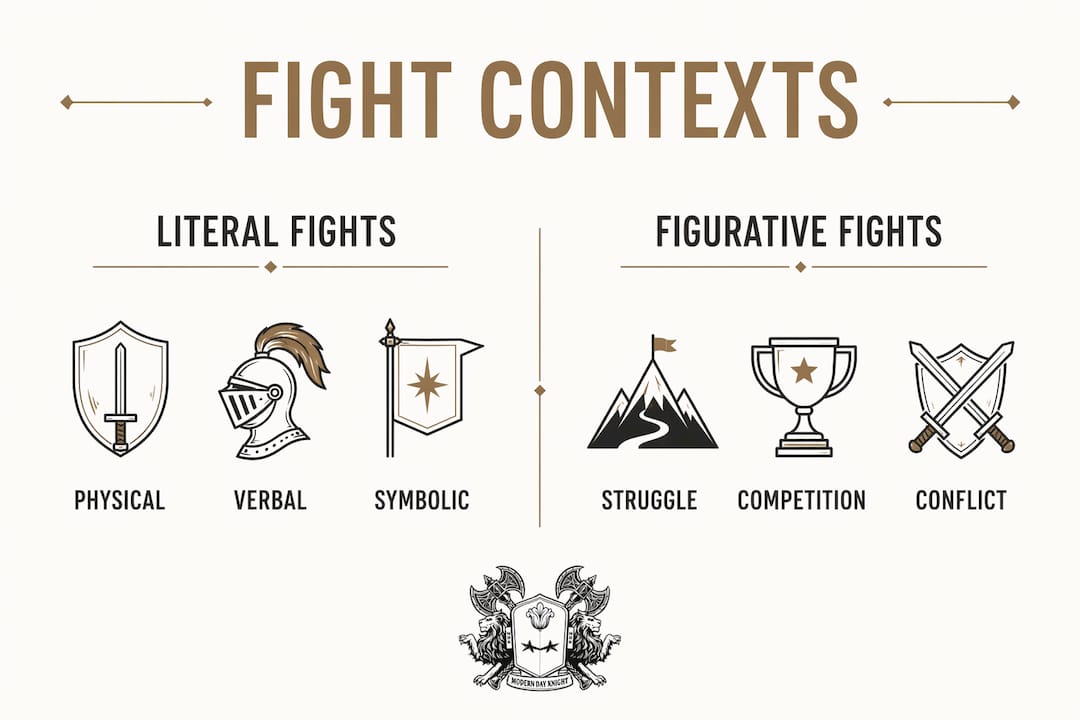
A fight is a purposeful conflict or struggle between two or more parties, whether physical, verbal, or symbolic. As a noun, it describes the confrontation itself. As a verb, it means to engage in that confrontation. The Cambridge English Dictionary defines it as “a situation in which two or more people or groups try to defeat each other.” That core idea, intentional opposition with something at stake, runs through every use of the word.
The word carries weight across wildly different contexts: a boxer trading blows in a ring, a soldier in close combat, a character in a novel battling inner demons, or a community standing up against injustice. Understanding those contexts is how you truly grasp what “fight” means.
How “fight” shows up in sports and martial arts
Competitive sports use the word fight to describe structured physical contests governed by rules, judges, and defined objectives.
- Boxing: Two fighters exchange punches across timed rounds, scored on accuracy, power, and defense.
- MMA (Mixed Martial Arts): Combines striking and grappling disciplines. Dricus Du Plessis defeated Kamaru Usman by unanimous decision in a high-profile 2026 UFC middleweight bout.
- Wrestling: Competitors use takedowns and pins rather than strikes to win.
- Rugby League: Philadelphia Fight is a professional rugby league team competing in the United States, bringing the sport’s physical contest culture to American audiences.
- UFC (Ultimate Fighting Championship): The world’s premier MMA organization, where fighters compete across weight classes under a unified set of rules.
Each of these sports structures the fight differently, but all share the same core: two competitors, a defined objective, and a winner determined by performance or submission.
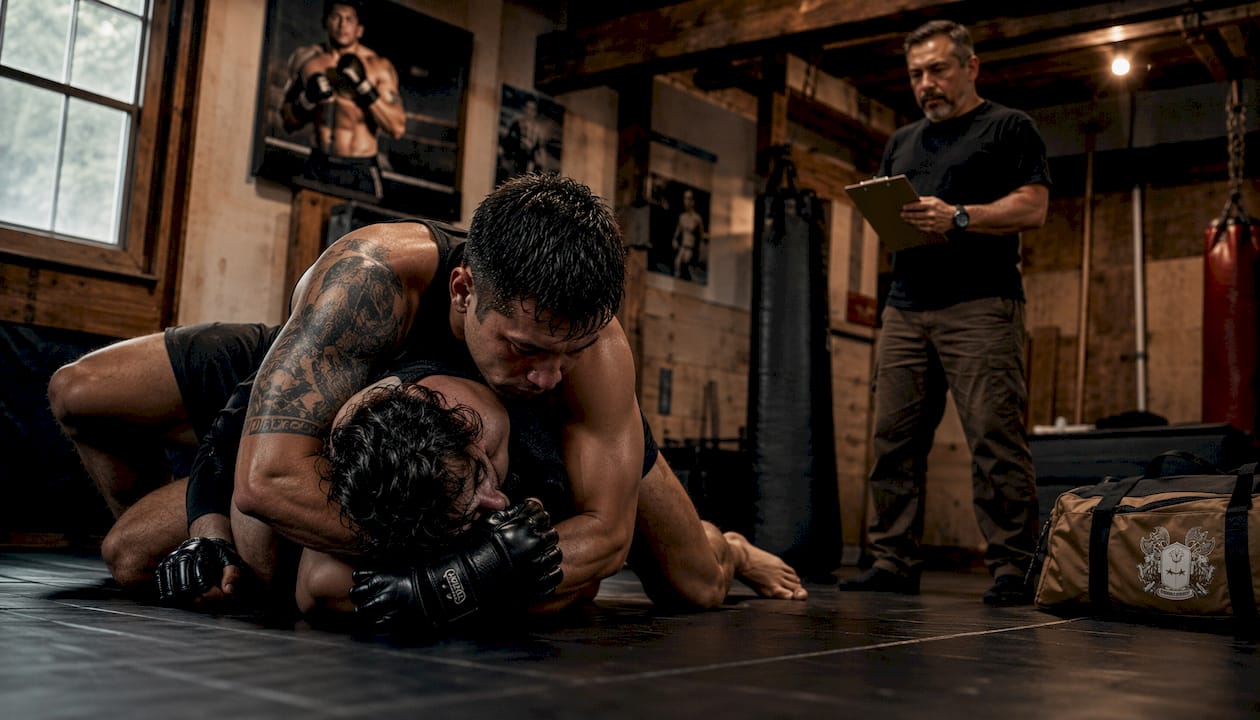
Pro Tip: In MMA and grappling arts, positional dominance before attempting a submission is a foundational principle. Professionals prioritize back mount or side control first, because a failed submission from a weak position often leads directly to defeat.
How fights appear in arts, entertainment, and media
Fight scenes are among the most powerful storytelling devices in film, television, literature, and music. They externalize internal conflict and force characters to reveal who they really are under pressure.
- Film: Choreographed fights in movies like Rocky, The Matrix, and John Wick use combat to drive narrative and character development.
- Television: Series like Game of Thrones and The Wire use fights as dramatic turning points, not just action filler.
- Literature: From Homer’s Iliad to Cormac McCarthy’s Blood Meridian, physical combat carries symbolic weight about human nature and survival.
- Music: Artists use “fight” metaphorically, as in Foo Fighters’ catalog or Kendrick Lamar’s lyrical battles, to represent personal struggle and resistance.
- Video games: Titles like Street Fighter and Mortal Kombat built entire genres around the concept of the structured fight.
The fight, in art, is rarely just about who wins. It reveals character, stakes, and consequence.

Synonyms and related words for “fight”
The English language offers a wide range of words for conflict, each carrying a different intensity or context.
- Battle: Large-scale, often military conflict with strategic objectives.
- Brawl: A messy, uncontrolled physical altercation, usually in a public setting.
- Combat: Formal or military engagement, often used in tactical and professional contexts.
- Skirmish: A brief, minor conflict, often a precursor to something larger.
- Clash: A collision of opposing forces, physical or ideological.
- Struggle: Broader than a fight; can be physical, emotional, or social.
- Scuffle: A minor, disorganized physical exchange.
- Confrontation: The moment of direct opposition, not always physical.
- Duel: A formal, agreed-upon fight between two individuals.
- Altercation: A heated verbal or physical dispute, often used in legal language.
Choosing the right word depends on scale, formality, and whether the conflict is literal or figurative. “Struggle” works for a personal journey. “Combat” belongs in a military briefing.
What experts say about fighting and self-defense
The most authoritative voices on fighting, from university safety experts to military doctrine, agree on one thing: avoiding a physical confrontation is always the priority.
“Specific moves get thrown out of the window in real world attacks. Just focus on the basic principles of the techniques and keep fighting. The will to survive is a powerful weapon all by itself.” — Sergeant Ryan Skiffington, University of Washington Medical Center Department of Public Safety
Utah State University’s guidance on personal safety emphasizes situational awareness, confident body language, and de-escalation before any physical response. Attackers typically seek easy targets. Looking alert and purposeful reduces your risk before a conflict ever starts.
The Marine Corps continuum of force defines five escalating levels of response, from verbal commands to deadly force, based entirely on the threat’s behavior. That framework applies beyond the military. Matching your response to the actual threat level is sound judgment in any context.
- Stay aware of your surroundings at all times.
- De-escalate verbally before any physical contact.
- Maintain distance and keep objects between you and a threat.
- Target vulnerable areas (eyes, throat, knees) only to create an escape opportunity.
- Pepper spray is effective: a study published in Criminology and Public Policy found that 68% of civilians who used it during an assault attempt successfully escaped.
For those serious about preparedness, understanding martial arts weapons safety is a natural extension of this mindset.
The psychology and emotion behind fighting
Fear, anger, and pride are the three emotions most directly tied to physical confrontations. Fear triggers the fight-or-flight response, flooding the body with adrenaline and narrowing focus. Anger lowers inhibition and can override rational judgment. Pride, particularly wounded pride, is one of the most common triggers for avoidable fights.
Research on self-defense education shows it increases assertiveness, confidence, and perceived control while reducing anxiety and fear. Training changes not just physical capability but mental posture. People who feel prepared are less likely to project vulnerability and less likely to freeze under pressure.
What causes fights?
Most fights trace back to a handful of recurring triggers: perceived disrespect, resource competition, territorial disputes, fear-based preemption, or intoxication lowering impulse control. Interpersonal conflicts often escalate because neither party feels heard or respected.
Social environments matter too. Crowded, high-stress settings with alcohol present produce more physical altercations than calm, structured ones. Understanding these triggers is the first step toward avoiding them.
The historical and cultural weight of fighting
Fighting has shaped human civilization. From gladiatorial combat in ancient Rome to medieval tournaments, to modern combat sports, cultures have always found ways to ritualize and contain physical conflict. The warrior archetype, the knight, the samurai, the soldier, carries deep cultural meaning across nearly every society. These figures represent not just physical strength but a code: discipline, honor, and the willingness to stand for something worth protecting. That tradition lives in military values that still resonate today.
Legal and social consequences of fighting
A physical fight carries real legal risk. In the United States, throwing the first punch can result in assault charges, civil liability, or worse. Self-defense laws vary by state, and the legal standard typically requires that force was necessary, proportionate, and that you had no reasonable means of escape. Beyond the law, fights damage relationships, reputations, and communities. The social cost of a reputation for violence follows a person far longer than any bruise.
Wear what you stand for

At Moderndayknightco, we believe the strongest fighters are the ones who know when not to fight. Our veteran-owned brand was built on integrity, loyalty, and the kind of strength that shows up in how you carry yourself every day. Browse the Moderndayknightco apparel collection and wear what you believe in.
Key Takeaways
Fighting means purposeful conflict, and understanding it fully means knowing when to engage and when to walk away.
| Point | Details |
|---|---|
| Core definition | A fight is a purposeful conflict, physical or symbolic, where intent and resistance both matter. |
| Avoidance first | Experts and military doctrine both prioritize de-escalation and escape over physical confrontation. |
| Pepper spray effectiveness | 68% of civilians who used pepper spray during an assault attempt successfully escaped. |
| Position before submission | In combat sports, controlling position before attempting a finish is a foundational principle. |
| Legal risk | Throwing the first punch in the U.S. can result in assault charges, regardless of provocation. |


