



Memorial Day honors Americans who died in military service. Veterans Day honors everyone who wore the uniform, living or dead. Memorial Day falls on the last Monday in May; Veterans Day is fixed on November 11 every year. One is a solemn day of remembrance marked by a moment of silence at 3:00 p.m. local time. The other is a day to look a veteran in the eye and say thank you.
TL;DR:
- Memorial Day is solely for remembering those who died in military service, with flags at half-staff until noon and a two-minute moment of silence at 3:00 p.m. local time.
- Veterans Day honors all who served, with flags flying at full staff all day and events like parades and ceremonies celebrating living and dead veterans.
- Memorial Day falls on the last Monday in May for long weekends, while Veterans Day is fixed on November 11 regardless of the day of the week.
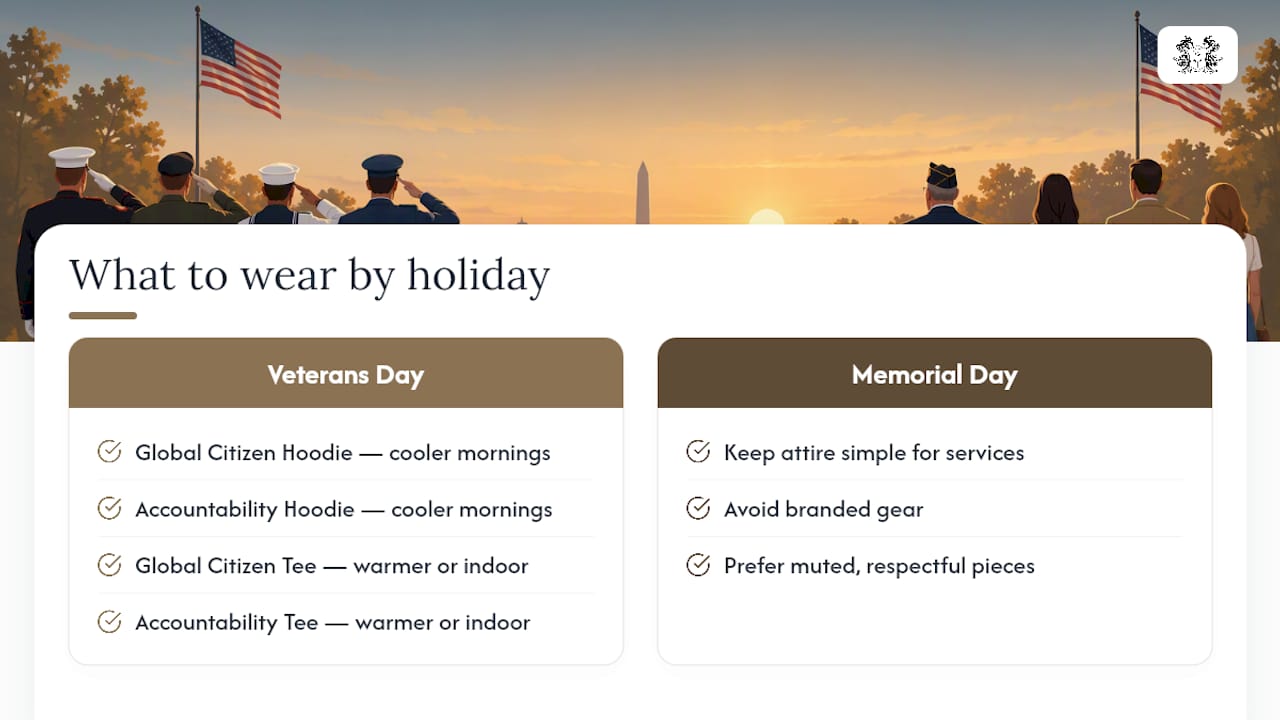
- Dress codes differ: Memorial Day observances call for simple, respectful attire, while Veterans Day events are suitable for patriotic or branded apparel.
- Direct thank-yous and active participation are more appropriate on Veterans Day, while Memorial Day is reserved for silent remembrance and honoring the fallen.
Table of Contents
- Memorial Day: Purpose, Observances, and How to Honor the Fallen
- Veterans Day: Purpose, Observances, and How to Thank Veterans
- Veterans Day vs Memorial Day: A Side-by-Side Etiquette Check
- Where These Two Holidays Actually Came From
- A Veteran-Owned Perspective on Wearing Your Values
- Tasteful Ways to Show Up in Modern Day Knight Gear
- Where to Verify the Facts Yourself
- Sources
- FAQ
Memorial Day: Purpose, Observances, and How to Honor the Fallen
Memorial Day exists for one purpose: to remember those who died wearing the uniform. It is not a general “thank a veteran” day, and treating it that way misses the point entirely. The Department of Veterans Affairs draws a hard line here: Memorial Day honors the dead. Veterans Day honors everyone who served.
That distinction shapes everything about how the day is observed. Families visit cemeteries. Communities place small flags on graves. Flags fly at half-staff until noon, then rise to full staff for the rest of the day, a gesture meant to reflect both mourning and the ongoing sacrifice of those still serving.
Pro Tip: Set a phone alarm for 3:00 p.m. local time on Memorial Day. That’s the National Moment of Remembrance, a two-minute pause Americans nationwide observe to honor the fallen. It’s not televised. It’s not announced with fireworks. It works because people choose to stop.
Practical etiquette matters here. A few ground rules:
- Skip “Happy Memorial Day” around grieving families. It reads as tone-deaf on a day built around loss.
- Use neutral, respectful language when you’re unsure of someone’s story: “We honor the service and sacrifice made” works in almost any situation.
- Wear the red poppy if you have one. It’s a long-standing symbol tied to the day’s remembrance tradition.
- At ceremonies, stay quiet during roll calls of the fallen and let silence do its work.
Memorial Day is quiet by design. Save the celebration for a different holiday.
Veterans Day: Purpose, Observances, and How to Thank Veterans
Veterans Day flips the emotional register entirely. This is the day for gratitude, spoken out loud, to the people who are still here to receive it. The VA’s own guidance is direct on this point: Veterans Day thanks and honors everyone who served honorably, whether they saw combat or spent a career in logistics stateside.
Parades happen. School assemblies happen. Municipal ceremonies and proclamations from local officials happen. The national ceremony at Arlington National Cemetery anchors the day, but most of the meaningful moments happen at the local level, in gymnasiums and town squares.
Pro Tip: If November 11 lands on a weekday, don’t assume the parade happens that day. Many towns shift public ceremonies to the nearest weekend for turnout. Check your city or county website before you show up.
What actually counts as a good way to thank a veteran? A few ideas beat generic gestures:
- Say “thank you for your service,” directly, without rushing past the moment.
- Ask about their branch or years served if the conversation opens naturally. Veterans generally appreciate genuine curiosity over vague platitudes.
- Support organizations that serve veterans directly through donations or volunteer hours.
- Attend a local parade or ceremony instead of treating the day as just a day off.
Veterans Day rewards presence. Show up, say the thing, mean it.
Veterans Day vs Memorial Day: A Side-by-Side Etiquette Check
The purpose gap between these two holidays drives every other difference, from the calendar to the wardrobe.
- Purpose. Memorial Day remembers those who died in service. Veterans Day thanks those who served, living or dead.
- Date rule. Memorial Day floats to the last Monday in May, guaranteeing a three-day weekend. Veterans Day sits fixed on November 11 regardless of what day of the week it lands on.
- Emotional tone. Memorial Day is solemn. Veterans Day is appreciative and often celebratory.
- What to say. Avoid “happy” language on Memorial Day around families who lost someone. On Veterans Day, direct thanks are not just appropriate, they’re the point.
- Flag protocol. Memorial Day flags fly at half-staff until noon, then full staff. Veterans Day flags fly at full staff throughout.
- What to wear. Understated dress fits Memorial Day cemetery visits. Patriotic or branded apparel fits Veterans Day parades and community events without any awkwardness.
Where These Two Holidays Actually Came From
Memorial Day began as Decoration Day, a Civil War era tradition of decorating soldiers’ graves. Veterans Day began as Armistice Day, marking the end of World War I on November 11, 1918.
Congress renamed Armistice Day to Veterans Day in 1954 to honor veterans of all wars, not just World War I. Decoration Day’s transformation into Memorial Day took longer. Congress moved it to the last Monday in May in 1971 under the Uniform Holiday Act, primarily to create consistent long weekends for federal employees.
That history explains the tonal split you still see today:
- Grave decoration on Memorial Day traces straight back to its Decoration Day roots.
- Parades and public gratitude on Veterans Day trace back to Armistice Day’s celebratory relief at war’s end.
- The fixed November 11 date for Veterans Day reflects its tie to a specific historical event, not a convenient weekend.
A Veteran-Owned Perspective on Wearing Your Values
This apparel brand was built by veterans, for people who believe honor is worn as much as it’s spoken. That gives us a stake in getting this etiquette right, not just explaining it.
Here’s an important distinction: context decides what’s appropriate. A parade, a Veterans Day tailgate, a community 5K, those are places where values-driven apparel belongs and even adds to the moment. A quiet Memorial Day cemetery visit calls for restraint instead, plain dress, no branding, nothing that pulls focus from the names on the stones.
Knowing the difference between those two settings is its own form of respect.
— Modern Day Knight
Tasteful Ways to Show Up in Modern Day Knight Gear
Modern Day Knight built this apparel for exactly the moments this article just walked through, not as a substitute for remembrance, but as a way to carry your values into the rooms where showing up matters.

For Veterans Day parades, volunteer events, and community gatherings, apparel that says something is a strength, not a distraction. The Global Citizen Hoodie and Accountability Hoodie work for cooler November mornings at a parade route. The Global Citizen Tee and Accountability Tee fit warmer climates or indoor ceremonies. Want to mark the day’s meaning without a slogan shouting it? The History Matters Tee or History Matters Hoodie leans into remembrance itself. Topping it off, the Global Citizen Hat and Global Citizen Trucker Hat round out an outdoor look for a parade or tailgate.
Save branded gear for Veterans Day and community events. Keep it simple for Memorial Day services. Browse the full lineup in the Modern Day Knight collections and pick out what fits how you plan to show up this year.
Where to Verify the Facts Yourself
For direct confirmation of holiday definitions, check the VA’s official explainer and Veterans Day facts page. To locate a grave or ceremony, use the VA’s national cemetery locator. Always cross-check specific event times against your local municipal calendar.
Sources
- The difference between Veterans Day and Memorial Day - VA News
- Department
- White House National Moment of Remembrance factsheet
- How Memorial Day and Veterans Day are different - NPR
- Cem
FAQ
Why do people confuse Memorial Day with Veterans Day?
Both holidays honor military service, and both fall within six months of each other, which blurs the line for many Americans. The actual difference is specific: Memorial Day honors those who died in service, while Veterans Day honors everyone who served, living or dead.
Should you recognize veterans on Memorial Day?
Memorial Day is meant to remember the fallen, not to thank living veterans, so direct “thank you” language is better saved for Veterans Day. If you want to acknowledge a living veteran on Memorial Day, respectful phrasing like “we honor the service and sacrifice made” fits without shifting focus away from those being mourned.
Can you say happy Memorial Day to a veteran?
It depends on context. Around families who lost someone in service, avoid “happy” language entirely; a simple “thinking of you today” is safer. Among living veterans in a casual setting, some people don’t mind it, but the safer default is to lead with remembrance language rather than celebratory phrasing.
What not to say on Memorial Day?
Avoid generic “Happy Memorial Day” greetings, especially with grieving families, and don’t assume every veteran you meet lost someone personally on that specific day. Steer toward neutral, respectful phrasing and let the person set the tone if they want to share more.
What is the National Moment of Remembrance?
It’s a two-minute pause observed at 3:00 p.m. local time on Memorial Day, meant to unify Americans in a shared moment of silence for the fallen. Because it runs on local time rather than a single national clock, individuals and organizations need to set their own reminders to participate together.


