



A statement shirt is a piece of apparel that carries a message, image, or symbol designed to speak for the wearer without a single word being spoken out loud. People put them on for identity signaling, humor, protest, fundraising, or building community with strangers who share their code. Understanding that purpose is the first step to wearing one with intention instead of just following a trend.
TL;DR:
- Most statement shirts are designed to convey specific messages that can be political, humorous, or based on identity, with design details shaping how the message is received.
- Wearing a statement shirt can reinforce personal values, attract like-minded people, and boost confidence, but it risks misinterpretation in different contexts.
- Historical use of slogan tees evolved from undergarments to tools for activism and fashion, with meanings that shift over time and audience.
- Proper fit, fabric, and pairing choices are essential to ensure the message lands as intended and the shirt looks intentional rather than sloppy.
- Before wearing strong messages, consider the setting, audience, and whether the shirt’s claims are accurate and appropriate for that moment.
Table of Contents
- What Statement Shirts Meaning Actually Covers
- Why People Wear Statement Shirts: The Psychology Behind the Choice
- A Brief History of Slogan Tees and Protest Apparel
- How to Wear Statement Shirts So the Message Lands
- Choosing a Message You Can Stand Behind
- Modern Day Knight’s Take on Values-Driven Apparel
- Three Modern Day Knight Tees Built Around Meaning
- Sources
- FAQ
What Statement Shirts Meaning Actually Covers
The meaning of a statement shirt depends entirely on what it is built to do. A graphic tee is never neutral. Every choice on the front of it, the words, the image, the size of the type, is doing work.
Statement shirts generally fall into a handful of categories, and each one carries its own weight:
- Political or protest tees — direct calls to action or solidarity, often tied to a specific movement or moment.
- Humor and irony shirts — jokes, puns, or absurdist statements meant to spark a laugh or start a conversation.
- Identity and affiliation shirts — team logos, hometown pride, military service, or subculture symbols that say “this is who I am.”
- Cause and fundraising tees — apparel tied to a nonprofit or campaign, where the shirt itself becomes a small act of giving.
- Brand or art shirts — designs rooted in aesthetics first, message second, though the two often blur.
Wording, typography, scale, and imagery all shift how a message lands. Bold block letters read as confident and confrontational. Small script text feels personal, almost like a whisper. A single word blown up across the chest reads very differently than the same word in a tucked-away corner. Some designs also lean on coded symbols and subcultural references that only make sense to people already inside that world, which is part of what makes them feel exclusive to the wearer and the audience who gets it.
Why People Wear Statement Shirts: The Psychology Behind the Choice
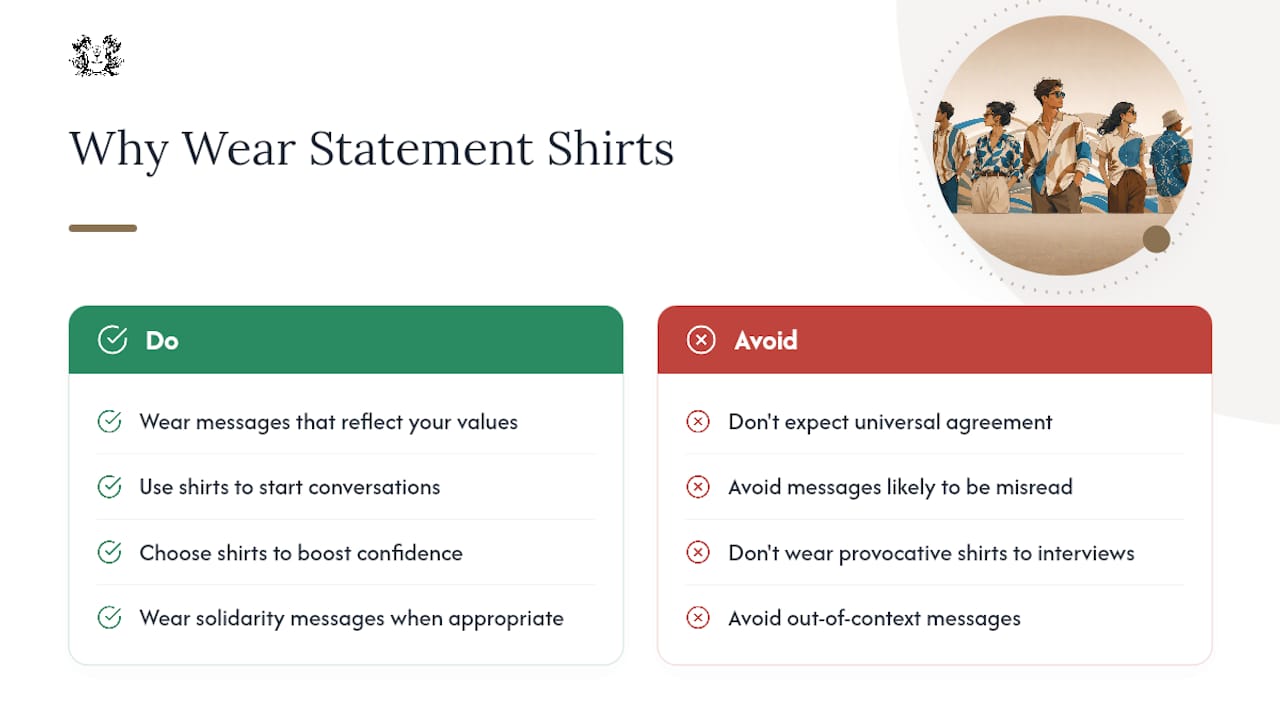
Wearing a message on your chest is a shortcut. It tells strangers something about your values before you say a single word, and that shortcut does real psychological work. A statement shirt reinforces the story you already tell yourself about who you are, and it broadcasts that story outward.
It also acts as a filter. Someone who clocks your shirt and smiles, nods, or strikes up a conversation is self-selecting into your circle. Fashion commentators have long noted that visible values act as a magnet, pulling like-minded people toward each other in public spaces where a conversation might otherwise never start. That is a low-effort way to find your people in a crowded room, an airport, or a gym.
There is an emotional payoff too. The right shirt on the right day can boost confidence, defuse tension with a joke, or signal solidarity with people going through something you understand firsthand. But there is a flip side. A message can be misread, taken out of context, or land wrong with an audience that does not share your frame of reference. A shirt that feels bold at a concert can feel reckless at a job interview or a family gathering.
Pro Tip: Before you wear a strong message somewhere new, picture the room you are walking into and ask whether the shirt still says what you want it to say there.
A Brief History of Slogan Tees and Protest Apparel
The T-shirt did not start as a statement piece. It started as an undergarment, something you wore under a uniform and nobody was ever meant to see. That changed fast after World War II, when soldiers came home and kept wearing them as casual outerwear, and Hollywood picked up the look soon after.
By the 1960s, the plain tee had become a canvas. Civil rights marchers, anti-war protesters, and later AIDS activists turned the shirt into a portable sign, something you could wear into any room without carrying a banner. The SIT Digital Collections archive traces this shift across roughly seventy years, from disposable underlayer to a primary tool people reach for when they want to say something in public.
Designer Katharine Hamnett pushed the idea further in the 1980s with oversized political slogans on runway tees, a move that The Conversation’s history of the slogan T-shirt credits with pulling activist messaging into mainstream fashion. Around the same time, “Silence = Death” became one of the most recognized pieces of AIDS activism ever printed on cotton.
A few things stand out across this history:
- Slogans rarely mean the same thing twice. “Choose Life” read as one thing in the 1980s and something else entirely decades later, reshaped by new audiences and new context.
- Wearing a slogan is often subtler and safer than carrying a sign, which is part of why the BBC’s reporting on political T-shirts describes them as a quieter form of political speech.
- The same design can shift from protest to fashion statement to nostalgia piece across a single generation.
How to Wear Statement Shirts So the Message Lands
A great message printed on the wrong shirt still falls flat. Fit and fabric change how a statement reads before anyone even gets to the words. Crisp cotton with a clean fit tends to read as intentional and put-together. A soft, worn-in drape reads more relaxed, almost like you have owned the belief a long time already.
Pairing matters just as much. A bold statement shirt wants a quiet supporting cast, so dark denim, neutral outerwear, or a plain jacket over the top gives the message room to breathe without a fight for attention. Layering also lets you dial intensity up or down depending on where you are headed. The Modern Day Knight guide to styling graphic tees walks through fit checks that keep a bold print looking sharp instead of sloppy.
Three quick templates worth keeping in your back pocket:
- Casual weekend: statement tee, straight-leg jeans, and worn sneakers. Let the shirt do all the talking.
- Smart casual: statement tee under an open button-down or field jacket, paired with clean boots. The layer softens the message just enough for mixed company.
- Event ready: statement tee tucked into tailored trousers with a blazer overtop. The structure signals you thought about the moment, not just the message.
Context should guide the call on when to keep a provocative message home. A shirt that works at a rally or a concert might not belong at a funeral, a client meeting, or your grandmother’s dinner table.
Choosing a Message You Can Stand Behind
Before you buy or wear a shirt with a strong opinion on it, run it through a short checklist. Who is actually going to see this? What do you want the shirt to accomplish, a laugh, a connection, a stand? And is the claim on it accurate, or does it oversimplify something that deserves more nuance?
Watch for a few clear red flags:
- Language that targets a person or group rather than an idea.
- Imagery or slogans that borrow someone else’s copyrighted work or trademark without credit.
- Claims that share private information about someone else without their consent.
- Fundraising tees with vague or unverifiable donation promises.
That last one deserves its own step. Before buying a cause tee, check who the beneficiary actually is and what percentage of the sale genuinely reaches them. The Modern Day Knight guide to purposeful messaging breaks down how to vet a message before you commit chest space to it.
Pro Tip: If you would feel uneasy explaining the shirt’s message to a stranger’s face, that is usually a sign to rethink it, not double down on it.
Modern Day Knight’s Take on Values-Driven Apparel
Our brand is built around a simple idea: integrity, loyalty, and strength are not slogans, they are standards. Every design we put on a shirt has to earn its place on someone’s chest, not just look good on a rack.
That standard shapes how we handle fit, fabric, and wording. A message only works if the shirt holds up, so we treat construction and print quality as part of the statement itself, not an afterthought. Our guide to how apparel shapes personal identity digs into why the right shirt does more than decorate. It connects you to people who carry the same code, whether that is a shared history, a shared oath, or a shared belief in doing right by the people around you.
— Modern Day Knight
Three Modern Day Knight Tees Built Around Meaning
Some shirts exist to fill a rack. Ours exist to say something specific. Three designs in particular show what values-driven apparel looks like when the message comes first.
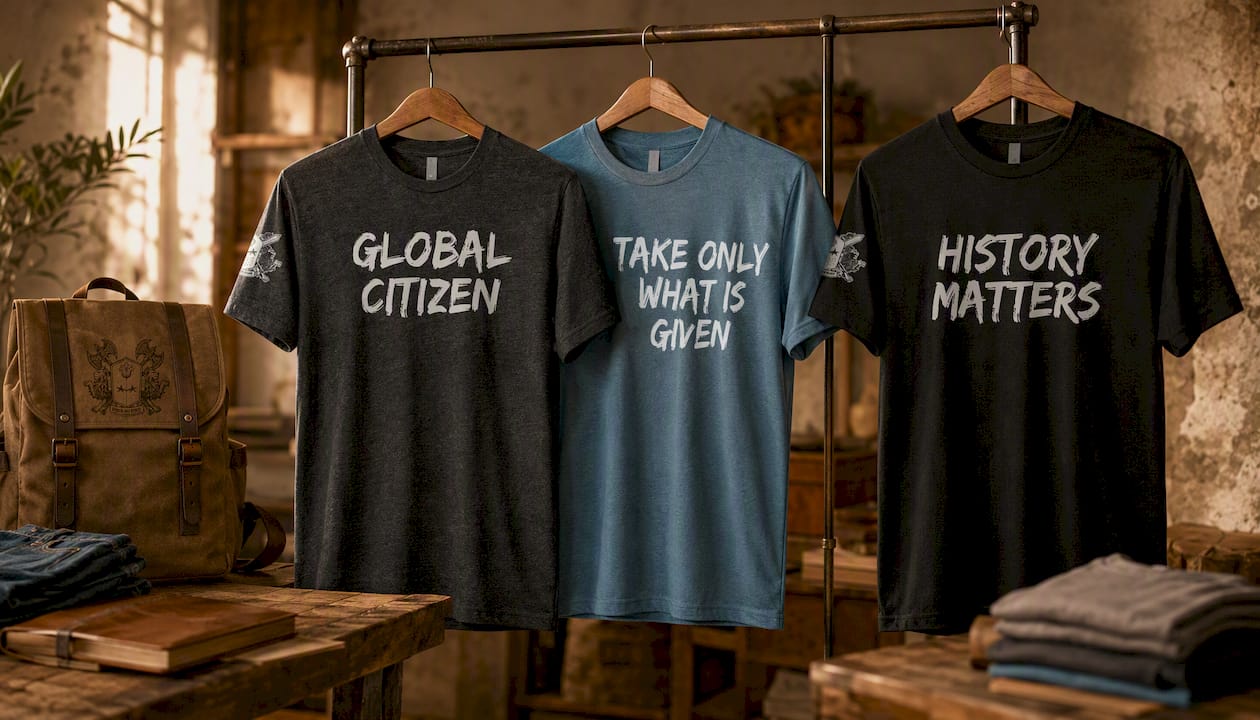
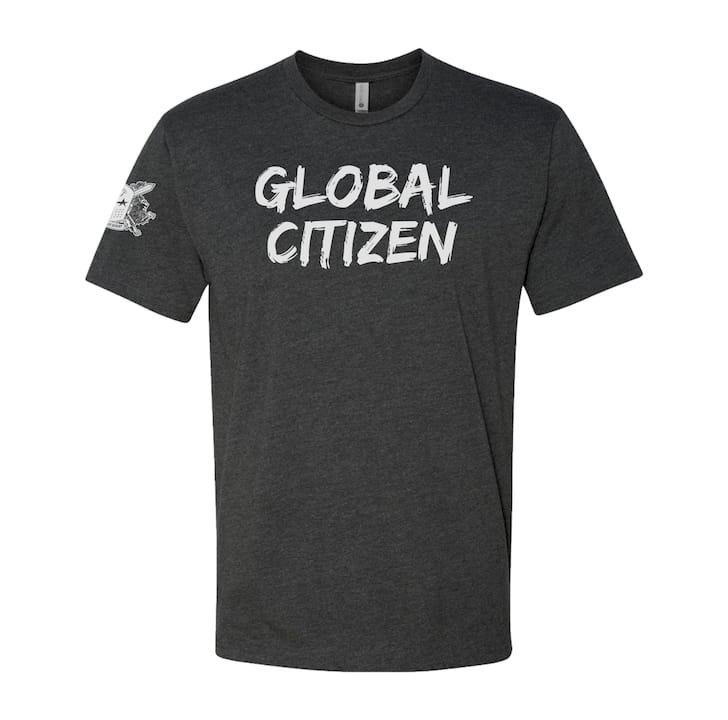
The Global Citizen Tee speaks to identity that stretches past borders, a message for anyone who sees loyalty as bigger than one flag or one zip code. The Take Only What Is Given Tee carries a code of restraint and integrity, a quiet reminder that strength includes knowing when to hold back. The History Matters Tee ties directly into the historical thread running through this whole article, honoring the idea that what came before still shapes what we owe each other now.
The entire product line, including gear, hats, hoodies, and shirts, is designed around the principle that clothing should reflect what you actually believe, not just what is trending. Browse the full collection to see fit, fabric, and message working together the way they are meant to. If a shirt on this page speaks to you, that is your next step, not a maybe for later.
Sources
- SIT Digital Collections — historical overview of T-shirt as social tool
- The Conversation — A brief history of the slogan T‑shirt (2025)
- BBC — How slogan T-shirts became political statements
FAQ
What Does Statement Shirt Mean?
A statement shirt is a piece of apparel printed with words, imagery, or symbols meant to communicate a belief, joke, affiliation, or cause without the wearer saying anything out loud. The message can be political, humorous, personal, or tied to a fundraising effort, and its meaning often shifts depending on who wears it and where.
What Does Statement Clothing Mean?
Statement clothing is a broader term covering any garment, not just shirts, designed to make a visible claim about identity, values, or opinion. Statement shirts are the most common form because they are affordable, easy to print, and visible at a glance.
What Two Colors Should Not Be Worn Together?
There is no fixed rule here, since color pairing depends on context, personal style, and the message you want a shirt to send. As a general styling principle, loud competing colors can distract from a bold printed message, so pairing a statement tee with a neutral like black, white, or denim usually lets the words or graphic stay the focus.
Should Your Stomach Show When You Raise Your Arms?
Fit matters for how intentional a statement shirt looks, and a shirt that rides up too far when you raise your arms usually reads as too small rather than stylistically loose. Choosing a length that stays tucked or covered during normal movement keeps the focus on the message instead of the fit.
Why Do People Wear Statement Shirts Instead of Just Talking About Their Beliefs?
A shirt broadcasts a belief passively and consistently, all day, without requiring a conversation to start. It also works as a filter, drawing in people who share the same values and giving the wearer a low-effort way to signal identity in any room they walk into.


