



Clothing does three things at once: it signals who you are to the world, it changes how you think and act through a process called enclothed cognition, and it anchors you to communities that share your code. This is not marketing language. It is documented psychology, and it works on you whether you notice it or not.
This article breaks down the mechanics of how apparel shapes personal identity, using the same research psychologists and sociologists use to study self-perception. You will see:
- How enclothed cognition rewires your mindset before you leave the house
- Why brands, symbols, and styles function as a social language
- How fashion and gender identity intersect, and how subcultures build belonging through dress
- A practical framework (built on the PCS-scale) for aligning your wardrobe with your values
Modern Day Knight builds apparel around this exact premise: what you wear is a statement of what you stand for, not just a covering for your back.
Key Takeaways
Clothing shapes personal identity through three linked mechanisms: it changes cognition and behavior through enclothed cognition, it signals status and belonging to others through fashion’s semiotic code, and it anchors wearers to communities that share their values.
| Point | Details |
|---|---|
| Enclothed cognition is measurable | Symbolic meaning plus physical sensation of a garment changes focus, confidence, and behavior. |
| Clothing preferences track personality | Harvard-summarized research links style choices like “essential” dressing to sociability and stability. |
| Style expresses three selves | Wardrobes reflect the true self, the ideal self, and the creative self, often simultaneously. |
| Bricolage manages identity under constraint | Layering, customizing, and accessorizing let wearers adapt signals across different settings. |
| Modern Day Knight applies the research directly | The Accountability Hoodie and Accountability Tee turn values like integrity and discipline into daily, wearable cues. |
Table of Contents
- Ways Apparel Shapes Personal Identity Through Psychology
- Clothing as Cultural and Social Signals
- Fashion, Gender, and Identity Expression
- Subcultures, Communities, and Belonging Through Dress
- The Research Behind Identity-Driven Apparel
- How to Build a Wardrobe That Matches Your Identity
- Self-Expression Through Clothing: True, Ideal, and Creative Self
- Historical Perspectives on Apparel and Identity
- How Media and Advertising Shape Clothing Choices
- Clothing’s Role in Professional Identity and Workplace Culture
- Globalization, Cultural Exchange, and Fashion Identity
- Intersectionality: Race, Class, and Ethnicity in Apparel
- Digital Identity and Virtual Fashion
- Wearing Your Values Isn’t Abstract. It’s Daily.
- Gear That Fits an Identity-Driven Wardrobe
- Sources
Ways Apparel Shapes Personal Identity Through Psychology
The clearest mechanism behind how apparel shapes personal identity is enclothed cognition, a concept researchers use to describe how clothing changes thought, emotion, and behavior. It works through two channels operating together: the symbolic meaning a garment carries, and the physical sensation of wearing it. Put a lab coat on someone and tell them it belongs to a doctor, and their attention to detail improves. Tell them the same coat belongs to a painter, and the effect disappears. The garment did not change. The symbolic meaning tied to the garment did.
Harvard-summarized research found that clothing preferences correlate with measurable personality traits. People who gravitate toward “essential,” pared-down styles tend to score higher on sociability and emotional stability than those with more erratic style preferences.
That correlation runs both directions. Your clothing reflects existing traits, and it can reinforce or shift them depending on the intention behind the choice.
Two small experiments make this tangible:
- Wear something you associate with discipline or strength (a piece with symbolic weight, not just a logo) before a hard conversation or a workout, and note whether your posture or focus shifts.
- Swap a “comfort default” outfit for one deliberate piece with meaning attached, then track whether your decision making feels sharper that day.
Neither test proves causation on its own. But repeated across enough days, the pattern becomes hard to ignore: what touches your skin talks back to your brain.
Clothing as Cultural and Social Signals
Fashion operates as a semiotic system. Every garment carries encoded information: status, group belonging, values, even political stance. A tailored blazer signals something different from a patched denim jacket, and both signal something different from a plain gray tee. Clothing and self-expression run through this same channel: you are constantly broadcasting, whether or not you intend to.
Branded items and symbolic pieces work as identity shorthand. A veteran wearing a piece that references service, rank, or a code of honor is not just dressing. They are transmitting a value system in three seconds, before a single word gets spoken. This is apparel and social perception in its most direct form.
Most people do not dress in pure categories. They practice bricolage, the strategic mixing of pieces from different codes to build something personal. Bricolage shows up as:
- Pairing a tailored jacket with rugged boots to blend authority and grit
- Customizing a plain piece with a patch or pin that carries private meaning
- Layering symbolic accessories (dog tags, rings, mission-driven merch) over neutral basics
Research on consumer bricolage frames this as a genuine negotiation strategy. Wearers use it to manage identity within social constraints they cannot fully control, whether that constraint is a workplace dress code or a cultural expectation.
Fashion, Gender, and Identity Expression
How style reflects personality gets more complicated, and more interesting, when gender enters the picture. Clothing has long enforced gender lines. It also remains one of the fastest tools people use to challenge or redraw those lines.

Gender-neutral styling, unisex cuts, and deliberately androgynous silhouettes let people opt out of binary categories entirely. For others, clothing serves as gender-affirming practice: a specific cut, fit, or fabric choice that finally matches internal identity to external presentation. Neither use case is trivial. Both draw on the same enclothed cognition mechanism covered earlier, where the physical experience of a correctly fitted garment can measurably ease the gap between how someone feels and how they are seen.
Context still matters. Safety and social readability vary by region, workplace, and family situation, and readers navigating identity-driven dressing in less accepting environments often build in flexibility: layering pieces that can shift meaning depending on setting, or reserving fully expressive choices for spaces where the risk is lower. That is not compromise. It is the same bricolage strategy from the previous section, applied to a higher-stakes context.
Subcultures, Communities, and Belonging Through Dress
Groups use apparel as a membership card long before anyone speaks a word. Subculture apparel gives members a way to signal shared values instantly, which builds belonging faster than almost any other channel available.
- Identity formation inside a group. Punk’s safety pins, skater brands’ logos, and military-inspired gear all work the same way: they compress a belief system into a wearable object. Wearing the object announces membership without a conversation.
- Community apparel in practice. Values-driven and military-inspired clothing lines give veterans and supporters a way to wear service and honor as a daily statement, turning private conviction into visible community.
- Commodification and meaning drift. Once a subculture’s look reaches the mass market, the original meaning dilutes. A design that once signaled insider status becomes decorative once everyone wears it. This is a documented pattern in fashion’s semiotic and social history, and it explains why authentic, mission-rooted apparel brands tend to hold their meaning longer than trend-driven ones.
The Research Behind Identity-Driven Apparel
The impact of clothing on self-image is not guesswork. Enclothed cognition research gives designers and brands a real lever: symbolic cues like patches, slogans, and silhouettes can shape wearer behavior and how a group perceives that wearer. Qualitative work on personal style adds another layer, finding that clothing choices consistently express three things: the true self, the ideal self, and the creative self.
Modern Day Knight was built on this exact intersection. Integrity, loyalty, and strength are not aesthetic themes. They are the intended cognitive cue.
Before buying into any brand’s identity claims, run this checklist:
- Does the brand name its actual values, or just use vague inspirational language?
- Is there a real origin story (founder background, community ties) behind the message?
- Does the design encode the value symbolically, or is the value only in the marketing copy?
- Would you still wear the piece if no one asked about the logo?
Pro Tip: Hold any “meaningful” garment to a simple test: read the message on it out loud. If it sounds hollow when spoken, it will feel hollow when worn.
How to Build a Wardrobe That Matches Your Identity
Self-knowledge comes before wardrobe strategy. The PCS-scale (Proximity of Clothing to Self) gives you a practical way to score how closely a garment aligns with your actual values, turning a random closet into an intentional identity tool.
- Ask three questions before buying anything. What does this represent about who I already am (true self)? Who am I trying to become (ideal self)? What does this let me create or express that nothing else does (creative self)?
- Pick two or three signature pieces. A capsule of meaningful items beats a closet full of neutral filler. Consistency in a few symbolic pieces builds a recognizable personal signature over time, a pattern confirmed in research on personal style themes. Start with a capsule wardrobe built around identity rather than trend cycles.
- Set outfit intent each morning. Before dressing, name the trait you want to embody that day (focus, resolve, warmth). Choose the piece that carries that symbol, then notice whether your behavior shifts.
- Watch for performative red flags. A slogan you cannot explain, a symbol you do not actually live by, a brand chosen only because it is trending. These choices tend to feel hollow fast, and other people can usually sense it too.
Pro Tip: If you cannot explain the meaning behind a piece in one sentence, it is decoration, not identity.
For a longer look at matching pieces to principles, see this guide on clothing that reflects personal principles.
Self-Expression Through Clothing: True, Ideal, and Creative Self
Personal identity and fashion choices split into three overlapping expressions, and most wardrobes contain all three without the wearer noticing — a concept explored in individual expression in clothing that guides how people craft their style. The true self shows up in the pieces you gravitate toward without effort: the worn boots, the same brand of tee, the fit you always return to. The ideal self shows up in aspirational purchases: the outfit for who you are becoming, not just who you are today. The creative self shows up in the choices that exist purely for expression: color combinations, layering experiments, pieces with no practical function beyond communicating something personal.
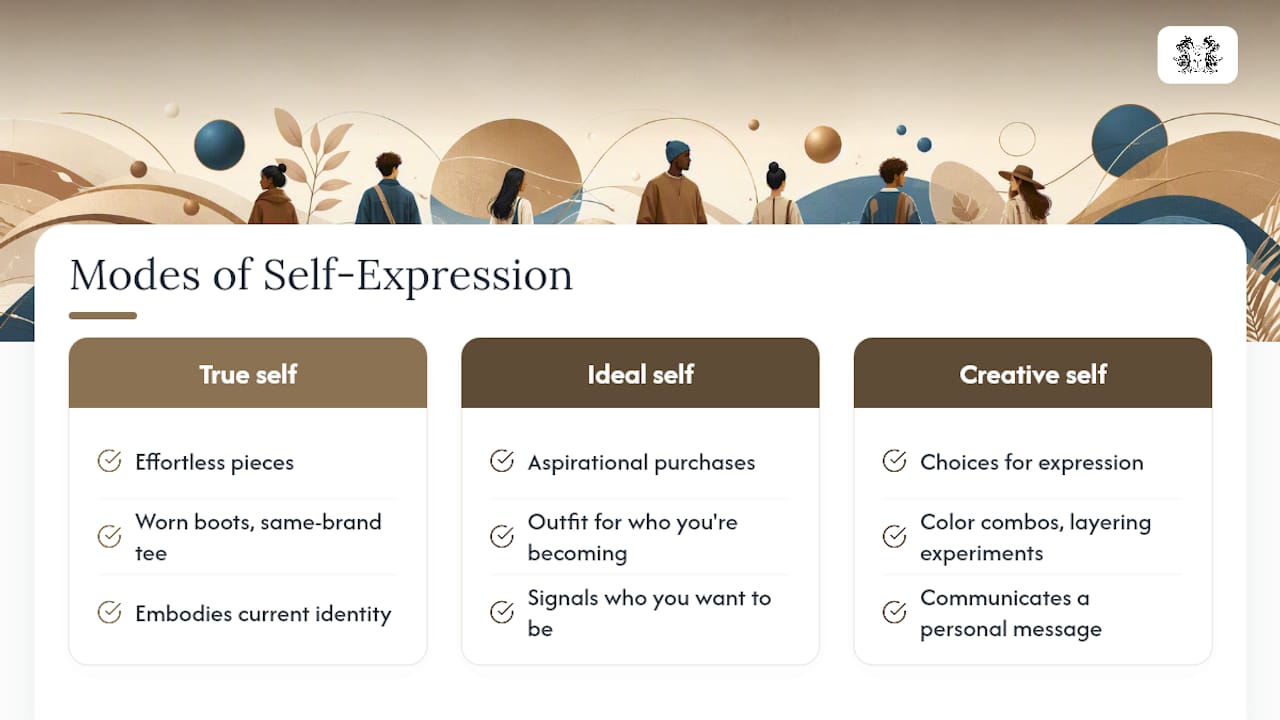
Qualitative research on personal style confirms this framework holds across different populations, finding that people consistently describe their clothing choices in terms of embodying, aspiring, and creating identity, not merely covering the body. None of the three modes is more “authentic” than the others. A person dressing for their ideal self, wearing the discipline they are actively building rather than the discipline they already possess, is doing something legitimate. Clothing can function as a forward signal to yourself as much as a backward-looking mirror.
The practical takeaway: audit your closet by category. If everything skews toward the true self, your wardrobe may be safe but static. If everything skews ideal, you may be dressing for a version of yourself that never quite arrives. Balance across the three tends to produce a wardrobe that actually moves with you.
Historical Perspectives on Apparel and Identity
Does fashion shape who we are? History says it always has. Sumptuary laws in medieval Europe restricted certain fabrics and colors to the aristocracy specifically because clothing communicated rank so effectively that rulers felt the need to regulate it. Military uniforms formalized the link between dress and collective identity centuries before modern branding existed, using insignia to communicate rank, unit, and loyalty at a glance.
The 20th century accelerated the pattern. Workwear from the industrial era became a fashion statement decades later. Punk’s safety pins and ripped denim in the 1970s turned deliberate anti-establishment messaging into a wearable identity. Each shift shows the same underlying mechanic: clothing has never been neutral. It has always carried a message about power, belonging, or resistance, and the message changes meaning as it moves through time and class.
What is different now is speed. A subculture’s signature look can go from underground to mass-market within a single fiscal quarter, a pace unimaginable in earlier centuries. The history matters because it proves this is not a modern phenomenon invented by marketing departments. Humans have used clothing to construct and defend identity for as long as clothing has existed. What changed is how fast that construction happens now.
How Media and Advertising Shape Clothing Choices
Media does not just show clothing. It assigns meaning to it before you ever try it on. A garment photographed on the right person, in the right context, absorbs an identity association that follows it into stores and onto other people’s bodies.
Advertising works by pairing a product with an aspirational identity, then letting enclothed cognition do the rest once you own the piece. This is why brand storytelling matters more than fabric weight in most purchase decisions. A tee with no story is just cotton. A tee tied to a mission, a community, or a code of honor becomes something closer to a wearable belief.
Social media compressed this cycle further. A single creator wearing a piece can generate more identity association in a week than a traditional ad campaign built over months, and algorithmic feeds now personalize which identities get marketed to which viewers. That personalization cuts both ways. It can help you find apparel that genuinely resonates with values you already hold, or it can manufacture a manufactured identity you did not actually choose, just absorbed through repetition.
The practical defense is simple: ask why a piece appeals to you before buying it. If the honest answer is “because everyone in my feed has one,” that is a different motivation than “because it represents something I actually believe.” Both are valid reasons to buy clothing. Only one of them is identity-driven in the sense this article means.
Clothing’s Role in Professional Identity and Workplace Culture
Workplace dress codes are identity negotiations disguised as policy. What counts as “professional” varies by industry, region, and era, but the underlying function stays constant: clothing signals competence, seriousness, and belonging within a specific work culture before a single sentence of work gets produced.
Research on work clothing and self-perception suggests the effect runs inward as well as outward. People who dress more formally for work-related tasks often report sharper focus and more decisive thinking, an effect consistent with the enclothed cognition mechanism covered earlier. The clothing is not just costume. It is a cognitive cue that primes a particular mode of thinking.
The shift toward casual and hybrid workplaces has not erased this dynamic. It has just made the signals subtler. A quality tee with intentional messaging can carry as much professional identity signal in a casual office as a blazer once did in a formal one, provided the message aligns with how the wearer wants to be read. The mistake is assuming casual dress codes mean identity signaling has stopped. It has only changed its vocabulary.
For veterans transitioning into civilian workplaces, this creates a specific tension: military dress codes offered unambiguous identity signals, and civilian codes rarely offer the same clarity. Choosing workwear that still carries a value statement, discipline, integrity, reliability, becomes a way to bridge that gap without violating office norms.
Globalization, Cultural Exchange, and Fashion Identity
Global supply chains and instant digital exposure mean fashion identity rarely stays contained within one culture anymore. A silhouette that originated in one region can appear reinterpreted on runways, streetwear brands, and fast-fashion racks on the other side of the planet within a single season.
This exchange cuts two ways. It can genuinely expand how people express identity, borrowing techniques, colors, or silhouettes from cultures they respect and want to learn from. It can also flatten meaning, stripping a garment of its original cultural context and selling it back as generic “trend,” a pattern that echoes the commodification dynamic covered earlier in subculture apparel. A pattern or cut that once signaled specific ancestry or ceremony can end up decorating a mass-market rack with no acknowledgment of where it came from.
The distinction usually comes down to intent and attribution. Wearing a globally influenced style while understanding and crediting its origin is cultural exchange. Wearing the same style while treating its origin as irrelevant is closer to extraction. Readers building an identity-driven wardrobe benefit from asking a simple question about any globally sourced piece: do I know where this actually came from, and does that origin matter to how I wear it? That single habit keeps cultural exchange from sliding into erasure.
Intersectionality: Race, Class, and Ethnicity in Apparel
Impact of clothing on self-image never happens in a vacuum. Race, class, and ethnicity all shape both which clothing choices are available to a person and how those choices get read by others, often in ways the wearer cannot control.
The same garment can carry different social risk depending on who wears it. A hoodie read as casual comfort on one body has, in documented cases, been read as threat on another. That gap is not about the fabric. It is about biased social perception layered onto a neutral object, which means the semiotic system covered earlier in this article does not apply equally to everyone.
Class shapes access before it shapes meaning. Some of the most symbolically loaded pieces, whether a designer logo or a specific silhouette, carry price points that put deliberate identity signaling out of reach for lower-income wearers, even when the desire to signal is identical across income levels. That gap has spawned entire secondary markets (resale, replica culture, DIY customization) built specifically to close it.
Ethnic and cultural dress carries its own layered risk. Traditional garments can be a source of pride in one context and a target for discrimination in another, sometimes for the same wearer on the same day depending on the setting. None of this erases clothing’s power to express identity. It does mean that power is distributed unevenly, and any honest discussion of how apparel shapes personal identity has to account for who gets to signal safely and who does not.
Digital Identity and Virtual Fashion
Personal identity and fashion choices no longer stop at the physical closet. Avatars, gaming skins, and social media personas now carry the same identity-signaling weight that physical clothing does, sometimes more, because the digital wardrobe faces none of the practical constraints (budget, climate, body type) that shape real-world choices.
Virtual fashion markets have grown around exactly this demand: digital-only garments, avatar customization, and branded skins that let people express identity in spaces where physical clothing is irrelevant. The psychological mechanism appears to translate too. Early research on avatar behavior found that people acting through more assertive or higher-status avatars tend to behave more assertively themselves, a digital echo of enclothed cognition.
The practical overlap with physical identity is real. Someone who curates a specific aesthetic online often ends up pulling that same aesthetic into physical purchases, and vice versa. Your Discord avatar, your gaming skin, and your closet are increasingly one continuous identity project rather than separate spaces. For readers building an identity-aligned wardrobe, the digital half of that project deserves the same intentionality as the physical half. A slogan you would not wear in person is worth questioning as an avatar choice too.
Wearing Your Values Isn’t Abstract. It’s Daily.
Modern Day Knight was not built on a mood board. It was built on the belief that a shirt can carry a code, the same way a uniform once did. When a piece in the closet reads “integrity” or “loyalty,” it is not decoration. It is a daily choice to embody something bigger than comfort.
Try this: pick one piece this week that actually represents a value you hold, not a trend you noticed. Wear it. Notice what shifts.
— Modern Day Knight
Gear That Fits an Identity-Driven Wardrobe
Most apparel asks nothing of the wearer beyond looking good. The Accountability Hoodie and Accountability Tee ask something different: that the wearer actually stands behind the word stitched into the fabric.
The Accountability Hoodie works as a signature piece for cooler days, workouts, or travel, where the enclothed cognition effect covered earlier has room to do real work: a heavier, structured garment reinforcing focus and resolve over a longer stretch of the day. The Accountability Tee is the accessible entry point, a single symbolic layer you can wear under a jacket for a subtle signal or on its own when you want the statement visible. Both suit veterans, active-duty supporters, and anyone building a capsule around discipline rather than trend cycles.
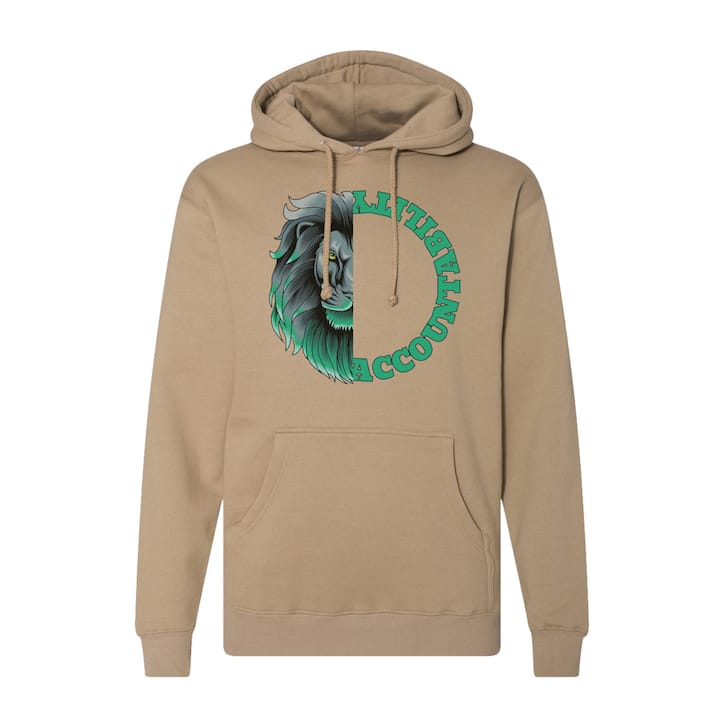
Neither piece is loud. Both are deliberate. If the practical steps earlier in this article convinced you to run the true self, ideal self, creative self test on your own closet, start with one of these two and see how the word changes how the day feels. Order either piece direct from Modern Day Knight and put the theory to a real test this week.
Sources
- Enclothed Cognition: How Clothing Shapes Our Thoughts, Feelings, and Behaviour | Springer Nature Link
- Why you wear what you wear | Harvard Gazette
- Personal clothing style themes (true/ideal/creative self) — UAL research
- Consumer bricolage and identity negotiation — Journal of Fashion Marketing and Management


