



The image people call a Spartan helmet stands for courage, discipline, protection, and a code of honor forged in battle. One clarification matters before you go further: the full-face design everyone pictures is technically the Corinthian helmet, worn across ancient Greece, not exclusively by Sparta.
- Strength and physical resolve
- Courage under direct threat
- Discipline within a unit
- Honor tied to duty, not ego
- Protection as an act of loyalty to your brothers in arms
Today that image shows up in tattoos, team logos, and apparel as shorthand for a warrior identity. The rest of this piece traces where the design came from, what its parts actually meant to the people who wore it, and how to use the symbol today without missing what it originally stood for.
Key Takeaways
The Spartan helmet endures as a symbol because its bronze form and crest translated communal discipline and courage into something visible, and that meaning still holds for anyone who wears it with intent.
| Point | Details |
|---|---|
| The “Spartan” label is a myth | The iconic design is the Corinthian helmet, used across ancient Greece, not exclusive to Sparta. |
| Design tradeoffs shaped its story | Full bronze coverage protected soldiers but limited vision and hearing, driving the later shift to the pilos. |
| The crest carried real meaning | The lophon signaled rank, added intimidating height, and made units look uniform and unbreakable. |
| Symbolism favors the collective | Spartan gear emphasized uniformity and shared duty over individual glory or personal distinction. |
| Modern Day Knight applies the code today | Products like the Army Brat Hoodie translate warrior discipline into apparel built around personal integrity. |
Table of Contents
- The History Behind the Spartan Helmet Meaning
- How the Helmet’s Design Created Its Meaning
- What Strength, Courage, and Honor Meant to a Spartan Soldier
- Why People Still Wear the Spartan Helmet Symbol Today
- Modern Day Knight’s Take on Wearing This Symbol With Purpose
- Myths, Gods, and the Warrior Identity Behind the Helmet
- How Spartan Symbolism Differs From Other Greek Helmet Traditions
- Why the Helmet Was Built to Intimidate, Not Just Protect
- How Pop Culture Reshaped the Spartan Helmet’s Meaning
- What the Research Actually Tells Us About This Symbol
- Wear the Code, Not Just the Image
- Sources
The History Behind the Spartan Helmet Meaning
The helmet you see on posters, tattoos, and gym walls is the Corinthian helmet, named for its frequent appearance on pottery made in Corinth, not because Sparta invented or monopolized it. Greek soldiers across many city-states wore this bronze form historically, according to the Corinthian helmet’s documented history. Sparta gets credit in pop culture mostly because of its outsized military reputation, not because the design belonged to them alone.
The Corinthian helmet offered a soldier full-face bronze protection, but by the late fifth century BC, Spartans and other Greeks increasingly switched to the simpler pilos helmet for better visibility and comfort on long campaigns.
That shift wasn’t cosmetic. A closed bronze shell kept you alive against a direct blow, but it also cut your hearing and narrowed your field of vision right when you needed both most. The pilos transition traded some protection for battlefield awareness, a tradeoff real soldiers made after real losses.
Key points worth remembering:
- The Corinthian form predates and outlasts any single city-state’s use of it.
- Its “Spartan” label is a modern branding choice, not a historical fact.
- The pilos helmet largely replaced it for practical infantry work by the century’s end.
- Artists kept drawing the Corinthian shape long after soldiers stopped relying on it, because it simply looked more heroic.
How the Helmet’s Design Created Its Meaning
Form and function collided in every piece of this helmet, and that collision is exactly why it still reads as powerful today.
- The lophon, or crest. Made from dyed horsehair, the crest added height, made a soldier look larger and more intimidating, and, when turned sideways instead of running front to back, signaled rank to everyone on the field, a detail confirmed by research on the crest’s psychological role.
- The tipped-up habit. Between clashes, soldiers pushed the helmet up off the face to see, breathe, and talk. That single practical habit is why so much ancient art shows helmets resting high on the forehead rather than sealed shut.
Pro Tip: If you’re studying the helmet for a tattoo or design project, notice how much of its power comes from that crest, not the shell. Artists often exaggerate the lophon because it carries the intimidation factor the plain bronze alone can’t.
What Strength, Courage, and Honor Meant to a Spartan Soldier
The helmet’s shape mapped almost perfectly onto the values Sparta drilled into every soldier from childhood. Full coverage meant duty to protect the man beside you, not just yourself. The raised crest meant command and intimidation. Every piece had a job beyond armor.
- Protection symbolized duty to the unit over individual survival.
- Height and crest color projected authority and unsettled the enemy before a blade was ever drawn.
- The shield’s lambda mark reinforced identity as part of a collective, not a lone fighter chasing glory.
- Red cloaks, paired with the helmet, tied visual identity to a broader code of shared discipline.
Here’s where most modern retellings oversimplify things: Spartan symbolism wasn’t really about individual aggression. Scholars point to a culture obsessed with uniformity and collective identity, where crests, cloaks, and shield markings existed to reinforce the group, not to let any one soldier stand out, a pattern documented in accounts of Spartan military culture. A Spartan didn’t wear this gear to look like a hero. He wore it to disappear into a wall of identical men who would not break.
That distinction changes how you should read the symbol today. It’s less “I fight alone” and more “I stand with people who won’t let me fall,” which tracks closely with how ancient warrior codes still shape modern conduct.
Why People Still Wear the Spartan Helmet Symbol Today
The helmet has migrated from battlefield to skin, storefront, and stadium, and it maps to a consistent set of modern meanings: strength, discipline, protection, honor, and fearlessness, according to research on how the symbol translates into contemporary use. What changes is context, not the core message.
Universities and sports programs lean on it hardest as institutional shorthand. Michigan State’s Spartan helmet brand identity turns the image into a promise about discipline and excellence shared across an entire athletic program, not a single athlete’s ego trip. That same logic extends into commercial spaces, where brands like Quarter King Billiards’ Spartan cue lineup and game day gear from GfaceGear borrow the imagery to signal competitive intensity.
| Use Case | What the Symbol Communicates |
|---|---|
| Tattoo | Personal code, resilience, a permanent reminder of standards held under pressure |
| University or sports logo | Shared discipline and excellence across a team or institution |
| Apparel and streetwear | Warrior ethos worn as daily identity, not costume |
| Commercial branding | Competitive intensity borrowed for marketing punch |
The helmet’s bold silhouette also just works graphically. Clean geometric shapes scale cleanly across embroidery, small prints, and logos in ways more detailed imagery can’t. If you’re picking the symbol for a tattoo or piece of apparel, that simplicity is part of the appeal, but it only means something if the code behind it means something to you first.
Modern Day Knight’s Take on Wearing This Symbol With Purpose
We’re a veteran-owned brand, and we built our identity around one idea: symbols only matter when they’re backed by conduct. The helmet, the crest, the shield mark, all of it existed to hold soldiers to a standard higher than comfort. That’s the same standard we design toward.
- Army Brat Hoodie carries that lineage forward for anyone raised inside military life, honoring service without needing to have served.
- Army Brat Tee puts the same message into a simpler, everyday piece.
- Modern Day Knight Old School Hoodie leans into the chivalric framing, turning the ancient warrior code into a modern statement of integrity and loyalty.
Pro Tip: Before you put this symbol on your body or your back, ask yourself what code you’re actually committing to. The helmet meant nothing without the discipline behind it, and that hasn’t changed.
If you’re drawn to warrior spirit in everyday apparel, wear it because it reflects something you live by, not just something that looks strong on a shelf.
Myths, Gods, and the Warrior Identity Behind the Helmet
Spartan military culture leaned heavily on myth to justify its brutal training regimen. Soldiers traced their lineage and discipline back to Herakles, the demigod whose strength and endurance became a template for what a Spartan man was supposed to become. The helmet, worn into battle, wasn’t just protective gear. It was a physical link to that mythic ideal, a visible claim that the man underneath had trained his body and mind toward something almost superhuman.
Ares, the god of war, loomed over Spartan religious life more than in most other Greek city-states. Spartans built their entire social structure around martial readiness, and helmets, crests, and shields carried that reverence into physical form. A soldier heading into formation wasn’t just following orders. He was stepping into a role his culture treated as sacred.
The agoge, Sparta’s grueling education and training system, reinforced this from childhood. Boys as young as seven entered a program built to strip away individual comfort and replace it with total loyalty to the group. By the time a young man received his first shield and helmet, the gear symbolized graduation into a brotherhood bound by shared suffering and shared purpose, not a personal achievement to boast about.
That’s the piece most modern retellings skip. The helmet wasn’t a trophy. It was an admission ticket into a collective identity that demanded everything and offered belonging in return, a trade many people still find appealing enough to ink onto their own skin centuries later.
How Spartan Symbolism Differs From Other Greek Helmet Traditions
Sparta didn’t invent a unique helmet design, but it did attach unique meaning to shared Greek equipment. Athenian hoplites wore Corinthian helmets too, often paired with more ornate crests and personalized shield emblems that celebrated individual family lineage or personal achievement. Spartan gear, by contrast, prized uniformity almost to the point of erasing individual identity.
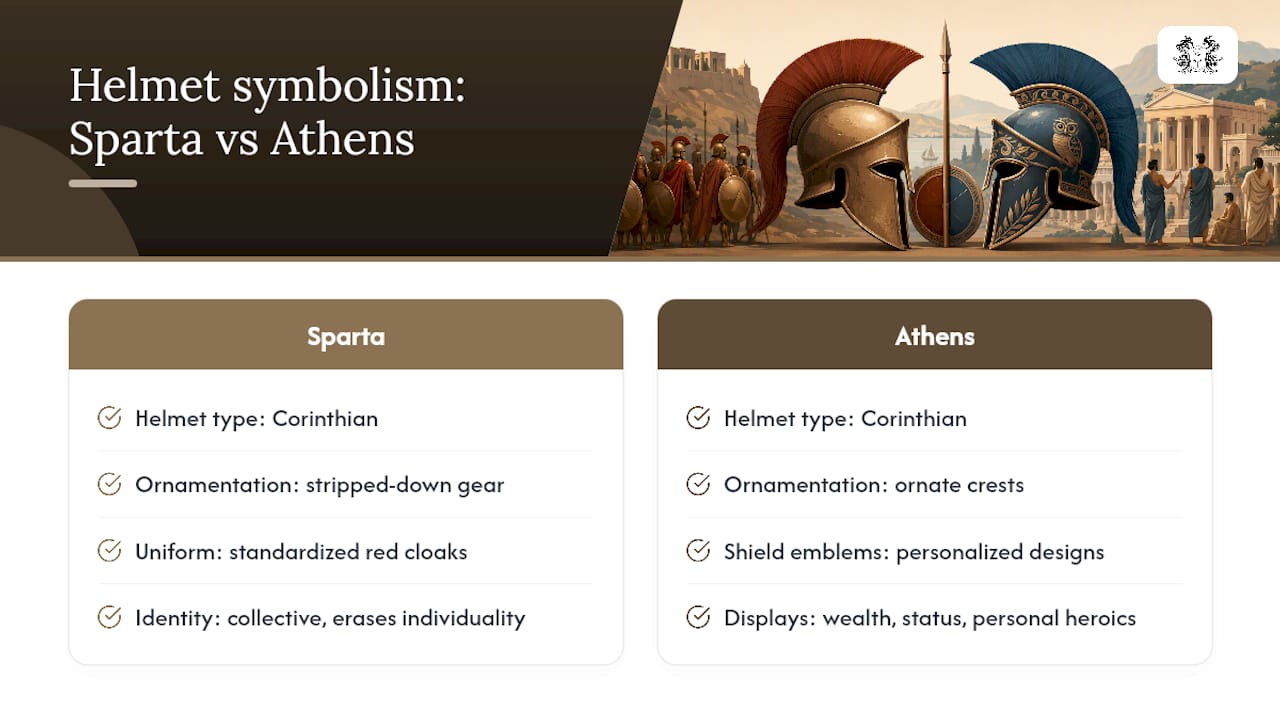
Other Greek city-states used helmet crests and shield designs to display wealth, status, or personal heroics. A wealthy Athenian might commission elaborate engravings or a distinctive crest color to stand out among his peers. Spartans moved in the opposite direction, standardizing red cloaks and stripped-down gear specifically to make one soldier indistinguishable from the next in the phalanx line.
That difference is the real symbolic divide. Where an Athenian helmet might say “remember my name,” a Spartan’s said “you’ll never need to know it, because the man beside me matters just as much.” The lambda symbol painted on Spartan shields reinforced this further. It marked the wearer as part of Lacedaemon, the broader Spartan state, rather than as an individual fighter chasing personal glory.
Later Hellenistic and Macedonian forces layered in more decorative flourishes as helmet design evolved, moving further from Spartan austerity. By the time Alexander’s armies marched east, helmets had become almost as much about visual spectacle as protection, a shift that stands in sharp contrast to the utilitarian uniformity Sparta clung to for generations.
Why the Helmet Was Built to Intimidate, Not Just Protect
A soldier staring down a Spartan phalanx wasn’t just facing spears and shields. He was facing a wall of identical bronze faces, raised crests, and red cloaks moving in perfect unison, an image engineered to break enemy morale before a single blow landed.
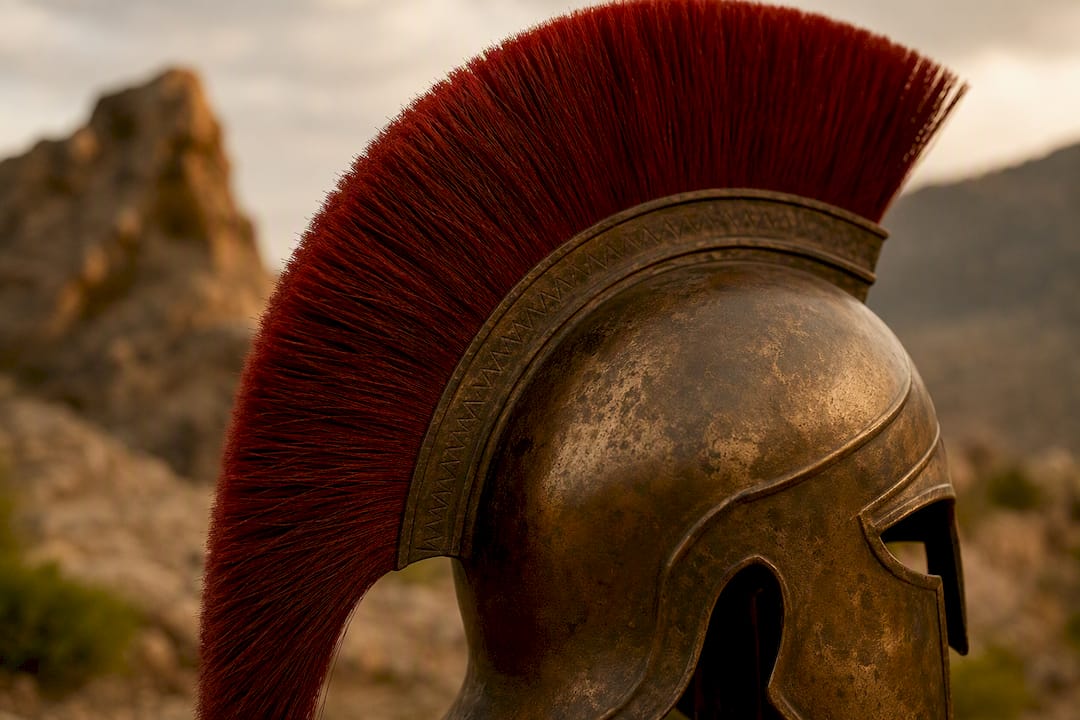
The lophon did real psychological work here. Dyed horsehair crests added visual height, making already imposing men look taller and more formidable from a distance, a tactic confirmed by analysis of the crest’s intimidation function. Combined with the blank, mask-like face created by narrow eye slits, the effect stripped away individual humanity. Enemies didn’t see men. They saw an advancing, faceless machine.
Sound played into this too. The synchronized march of hundreds of armored men, shields clashing rhythmically against spear shafts, created a wall of noise meant to unsettle enemy nerves well before contact. Historical accounts describe entire opposing forces breaking formation and fleeing before Spartan lines even closed the distance, undone entirely by psychological pressure rather than physical combat.
That’s the part modern retellings tend to flatten into pure aesthetics. The helmet’s blank, uniform menace was a weapon in its own right, deployed deliberately to win battles before they started. Fear, carefully manufactured through gear and formation, saved Spartan lives by ending fights early.
How Pop Culture Reshaped the Spartan Helmet’s Meaning
Films, video games, and graphic novels have done more to spread this image globally than any museum exhibit ever could. 300, the 2006 film built around the Battle of Thermopylae, cemented the crimson-cloaked, crested warrior as the modern visual shorthand for Spartan identity, even while taking heavy creative liberties with historical accuracy.
Video game franchises leaned into the same imagery for entirely different reasons: raw power fantasy. Players don’t need historical context to understand what a Spartan helmet silhouette promises. Strength, resilience, and a willingness to stand against overwhelming odds translate instantly, regardless of the medium.
That widespread reach cuts both ways. It’s why the helmet now shows up on gym apparel, sports logos, and tattoo flash sheets far removed from ancient Greece, but it’s also why so many people carry a distorted version of the history behind it. Pop culture sells spectacle. It rarely sells the collective discipline and communal identity that actually defined Spartan military culture.
Understanding that gap matters if you’re choosing this symbol for something permanent, like a tattoo, or something personal, like a piece of apparel you’ll wear daily. The image works because of centuries of cultural reinforcement, but the meaning worth claiming for yourself goes deeper than what a movie poster captured.
What the Research Actually Tells Us About This Symbol
Most explainers stop at “strength and courage” and call it done. That’s incomplete. The research points somewhere more specific: this symbol’s real power comes from what it erased, not what it displayed. Spartan gear stripped away individual identity so a unit could move and fight as one body. That’s a harder, less flattering idea than the lone-warrior myth pop culture sold us, but it’s the truer one.
Conventional advice on tattoos or logos using this image usually stops at “make it look intimidating.” We’d argue that misses the point entirely. The helmet only earned its meaning because Spartan soldiers backed it with brutal discipline and loyalty to each other. Buy the image without the code behind it, and you’re wearing decoration, not symbolism.
If you’re serious about this symbol, start with the values, not the ink or the fabric. Ask what code you’re actually committing to before you commit it to your skin or your closet. The warrior ethos resonates with people far beyond active military service precisely because it’s about conduct, not combat history.
— Modern Day Knight
Wear the Code, Not Just the Image
Moderndayknightco exists for people who want their clothing to carry the same weight this symbol carried on an ancient battlefield: a visible marker of standards you actually live by, not decoration borrowed for looks.
We build apparel around the same values that shaped Spartan discipline, which is why our line leans on integrity, loyalty, and strength rather than surface-level military aesthetics. The Army Brat Hoodie speaks directly to anyone who grew up inside military life, while the Army Brat Tee delivers that same statement in a simpler daily piece. If you want the full chivalric framing, the Modern Day Knight Old School Hoodie carries that code into a heavier, everyday layer. Our collection of hats rounds out the lineup for anyone building a full look around these values. Browse the collection and pick the piece that matches the code you actually stand for.
Sources
- Corinthian helmet — Wikipedia
- What is the red thing on a Spartan helmet? | 33rd Square
- Michigan State University — Spartan helmet brand identity


