



The reversed U.S. flag on a military uniform is intentional. The star field (union) faces forward so the flag appears to stream backward as the wearer moves, exactly as it would if carried into battle at full charge.
- Symbolic meaning: The reverse orientation signals respect and forward motion. The wearer is the flagpole. The flag flies behind them.
- Where you’ll see it: Right sleeve of military uniforms, sides of military vehicles, aircraft, and spacecraft.
- Not a distress signal: An upside-down flag signals emergency. A reversed flag on a right sleeve or vehicle does not.
Key Takeaways
The reverse flag on military uniforms is intentional, legally grounded, and rooted in centuries of standard-bearer tradition — the union faces forward so the flag streams back, exactly as it would in motion.
| Point | Details |
|---|---|
| Reverse flag is intentional | The star field faces forward on the right sleeve so the flag appears to stream backward as the wearer moves. |
| Legal and regulatory basis | U.S. Flag Code (4 U.S.C. § 8) and Army Regulation 670-1 both govern this orientation. |
| Historical roots | Cavalry and infantry standard bearers established the visual logic: union near the pole, stripes streaming back during a charge. |
| Not a distress signal | An upside-down flag signals emergency; a reversed patch on a uniform signals respect and forward motion. |
| Civilians can honor it | Wear the motif on clearly civilian apparel, understand its meaning, and never replicate official uniform insignia. |
Table of Contents
- What U.S. law and military uniform rules say about the reversed flag
- How the cavalry tradition shaped today’s uniform practice
- Where you’ll see the reverse flag now
- How to tell a reverse flag from an upside-down distress flag
- Guidance for civilians on using the reverse flag design
- Why the forward-facing union makes visual and practical sense
- Modern Day Knight’s perspective on what this symbol means
- Sources
What U.S. law and military uniform rules say about the reversed flag
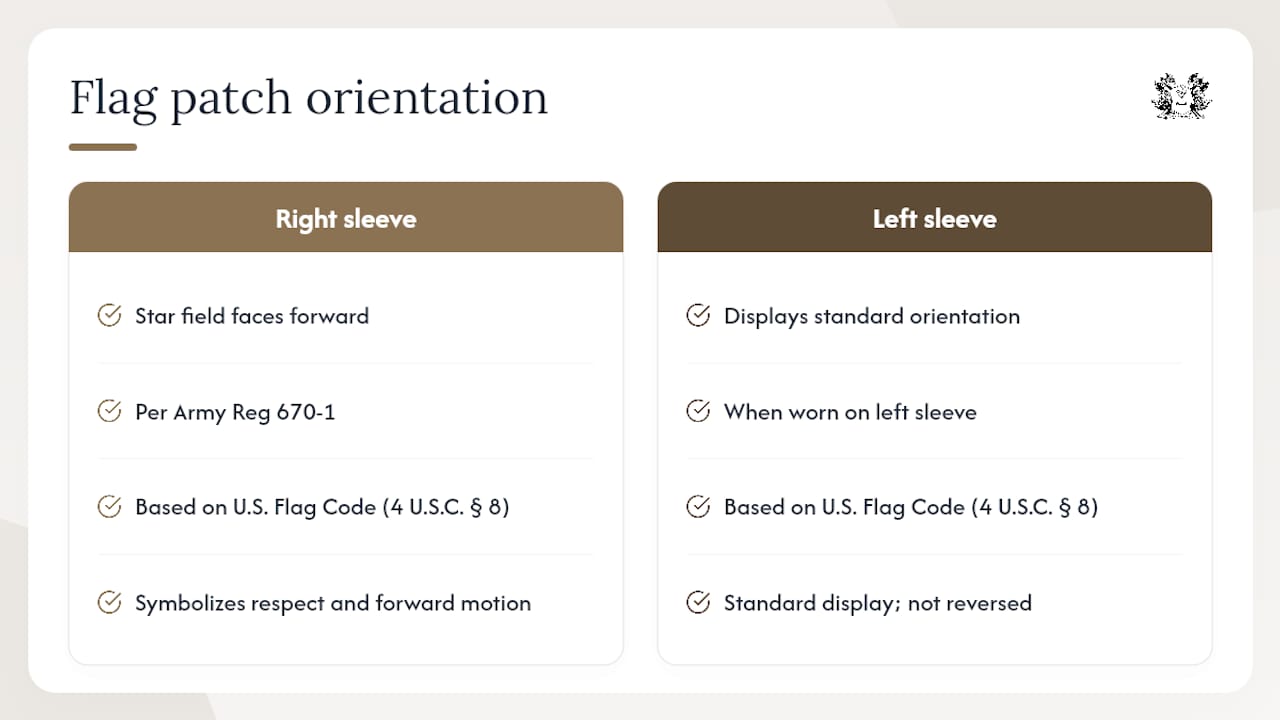
The legal foundation is U.S. Flag Code (4 U.S.C. § 8), which establishes that the union should face the direction of movement on any moving object. That principle is what drives the reverse patch orientation you see on every deployed soldier’s right sleeve.
Army Regulation 670-1 translates that principle into a specific uniform rule: the flag patch worn on the right sleeve must have the star field facing forward, toward the front of the body. The left sleeve, when worn, displays the flag in its standard orientation. The regulation’s logic is direct.
Medals of America’s uniform explainer captures this well, noting that the arrangement symbolizes respect and forward motion rather than any error or disrespect. The Smithsonian’s National Air and Space Museum confirms the same principle applies across every moving platform, from soldiers to spacecraft.
How the cavalry tradition shaped today’s uniform practice
The visual logic behind the reverse flag is centuries old. It did not begin with a regulation. It began on horseback.
- Standard bearers in mounted units carried the flag as the unit charged. Wind and speed pushed the stripes backward while the canton (star field) stayed near the pole, close to the bearer’s body.
- Infantry color guards replicated the same effect on foot. As they advanced, the flag streamed behind them, union forward, stripes trailing.
- 20th-century uniform policy formalized what soldiers had always seen in the field. The STFD Veterans Museum’s historical account documents this lineage directly, linking the cavalry visual to the modern patch rule.
- The phrase “assaulting forward” emerged from this tradition. It captures the symbolism accurately, though it is a descriptive term used in military communities, not an official legal designation.
The soldier became the flagpole. The patch became the flag in motion. That continuity from cavalry charge to combat uniform is what gives the practice its weight.
Where you’ll see the reverse flag now
The reversed union appears across every platform where the flag moves with its carrier.
Military uniforms: The flag patch sits on the right sleeve with the canton pointing toward the front of the body. On the left sleeve, the standard orientation applies. The difference is not an inconsistency. It reflects which direction each side of the body faces when moving forward.
Vehicles and aircraft: When flags are applied to both flanks of a vehicle or aircraft, the star field faces the front on each side. This means the flag on the right side of a vehicle looks reversed compared to the left side. Both are correct. Both have the union pointing toward the nose of the vehicle.

Spacecraft and suits: NASA mission patches and spacesuit markings follow the same convention. The Smithsonian’s Air and Space collections include photographic examples readers can examine at their online portal.
Pro Tip: If you see a flag on a vehicle and one side looks “wrong,” check the front of the vehicle. The union on both sides should point toward the hood or nose. If it does, the placement is correct.
How to tell a reverse flag from an upside-down distress flag
These two displays look different and mean entirely different things. Confusing them is the most common civilian mistake.
| Feature | Reverse (standard) flag | Upside-down flag |
|---|---|---|
| Star field location | Upper corner nearest the front or right | Lower corner (stars at bottom) |
| Stripes orientation | Horizontal, normal | Horizontal, but red stripe at top |
| Context | Right sleeve patch, vehicle, aircraft | Pole display, protest, or distress |
| Meaning | Respect, forward motion | Distress signal or protest |
| Official basis | Army Reg. 670-1, Flag Code | Flag Code distress provision |
The Tactical Distributors explainer addresses the civilian misconception directly: a reversed flag on a uniform patch is a sign of respect, not disrespect or error.
Pro Tip: Check the stars. On a correctly flown pole flag, the union is in the upper-left corner. On a right-sleeve patch, the union is in the upper-right corner. On an upside-down flag, the stars drop to the bottom. Location of the star field tells you everything.
Guidance for civilians on using the reverse flag design
Civilians can honor this tradition without crossing into misrepresentation by choosing tasteful clothing like the Veteran unisex t-shirt that respectfully incorporates military motifs. The line is clear.
Do:
- Wear apparel featuring the reverse flag design when it is clearly civilian clothing, not a uniform replica.
- Understand the meaning before you wear it. Honor requires intention.
- Choose designs that reflect the values behind the symbol, not just the aesthetic.
Don’t:
- Display an upside-down flag as a fashion statement. It carries a specific distress meaning under the Flag Code.
- Replicate official military uniform patches in ways that could be mistaken for actual insignia.
- Confuse thin line flag variations (such as the thin green line, which honors conservation officers and military) with the reverse-flag practice. They are separate traditions with distinct meanings.
For civilians drawn to military-inspired apparel, the reverse flag motif carries real weight when worn with knowledge of what it represents. Wearing it without that understanding reduces a symbol of honor to decoration. If you want to carry the tradition forward, carry its meaning too.
Why the forward-facing union makes visual and practical sense
The Smithsonian frames this as a design principle, not just a rule. A flag on a moving object should behave as a real flag would in motion.
- A static flag on a pole has the union at the top-left because the pole is on the left.
- A moving person or vehicle becomes the pole. The union stays near the “pole” (the front or right side) and the stripes stream back.
- The Smithsonian’s editorial describes the flag as a living symbol responding to movement, not a static emblem stamped onto a surface.
- The veterans museum PDF frames it as translating a 2D symbol into 3D movement: the reverse flag is the correct visual when the pole is moving.
Picture a soldier running. The flag on their right arm streams back. Stars lead. Stripes follow. That is not backwards. That is the flag doing exactly what a flag does.
Modern Day Knight’s perspective on what this symbol means
At Moderndayknightco, we are a veteran-owned brand. We do not take symbols lightly. The reverse flag is not a design trend. It is a declaration of direction. Forward. Always forward. That principle shapes every piece we put our name on. When we incorporate flag motifs into our apparel, we do it with the same intention a soldier carries onto the field: honor first, aesthetics second. The code we live by demands nothing less.
Sources
- Here’s Why The US Flag Sometimes Appears Backwards | National Air and Space Museum
- Why is the Flag Backwards? (STFD Veterans Museum PDF)


