



Noble character is defined as the consistent practice of core moral virtues, including integrity, dignity, courage, and selflessness, regardless of social rank or personal advantage. This is not a medieval concept reserved for kings and knights. It is a living behavioral standard that psychologists, philosophers, and communities recognize as the foundation of a well-lived life. Understanding what does noble character mean today requires separating it from its aristocratic origins and seeing it for what it truly is: a daily commitment to who you are when no one is watching.
What does noble character mean in today’s society?
Modern noble character has shifted from aristocratic lineage to behavioral standards built on moral qualities like integrity and courage. Birth status no longer defines nobility. Conduct does. The person who tells the truth under pressure, who stands up for someone being treated unjustly, who keeps their word when breaking it would be easier — that person embodies noble character today.

This shift matters because it makes nobility accessible to everyone. A veteran, a teacher, a parent, a young professional — any person can choose to live by a higher standard. The meaning of noble character is no longer gatekept by bloodlines or titles.
Psychologists studying the VIA (Values in Action) character strengths framework have identified specific traits that define this modern standard:
- Integrity: Aligning your actions with your stated values, even at personal cost
- Courage: Acting on principle when fear or social pressure pushes you the other way
- Dignity: Treating yourself and others as inherently worthy of respect
- Selflessness: Prioritizing the well-being of others without expecting recognition
- Gratitude: Acknowledging what you have received and honoring those who gave it
These are not soft ideals. They are measurable traits that research links directly to life satisfaction and resilience. Noble character traits today are the traits that hold under pressure.
Pro Tip: Write down one value you claim to hold. Then ask yourself: did my behavior this week reflect that value? That gap between claim and conduct is exactly where character work begins.
How do ancient virtues like sophrosyne shape modern noble character?
Sophrosyne is an ancient Greek virtue encompassing moderation, self-control, and reflective discernment. Plato and Aristotle both treated it as foundational to a sound mind and a just life. The word translates roughly as “sound-mindedness,” and it describes the capacity to govern your impulses through reason rather than reaction.
Aristotle’s core argument was direct: virtue is not a feeling. It is a habit. You do not become courageous by thinking about courage. You become courageous by repeatedly choosing the courageous action until it becomes second nature. That principle applies with full force today.
“Noble character involves a civil war within oneself, mastering impulses through reason continuously over a lifetime rather than in brief moments.”
In an age of social media outrage, political tribalism, and AI-generated distraction, sophrosyne is more relevant than ever. The person who can pause before reacting, who can choose principle over impulse, who can resist the pull of short-term gratification — that person holds a rare and powerful advantage.
Here is how sophrosyne maps onto modern noble character in practice:
- Moderation: Refusing to let any single desire, whether for money, status, or approval, override your values
- Self-control: Managing anger, fear, and ego before they manage you
- Discernment: Distinguishing between what feels right in the moment and what is actually right over time
- Reflectiveness: Reviewing your choices honestly and adjusting without self-destruction
These four components are not abstract philosophy. They are the operating system of a person with genuine noble character in society today.
What psychological and societal benefits does noble character provide?
The benefits of practicing noble character are measurable, not just moral. Character strengths correlate with well-being at r = .44, a statistically significant relationship showing that virtues like hope, gratitude, and zest are directly tied to life satisfaction. That number means character is not just ethically good. It is psychologically protective.
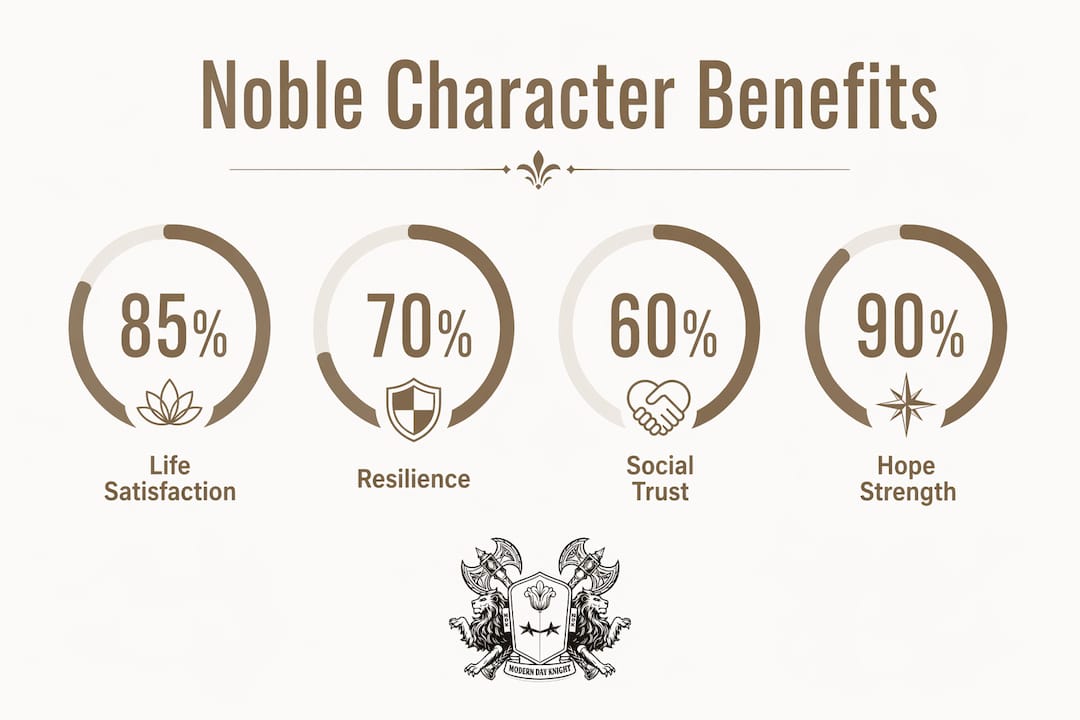
Among all character strengths studied, hope is the strongest predictor of well-being. Hope here does not mean wishful thinking. It means the active belief that your choices shape your future. That belief drives persistence, which drives results.
| Benefit | What It Means in Practice |
|---|---|
| Higher life satisfaction | People with strong character strengths report greater overall well-being |
| Greater resilience | Virtue-based habits provide stability when circumstances deteriorate |
| Stronger relationships | Integrity and loyalty build trust that sustains long-term bonds |
| Social stability | Self-mastery reduces conflict and supports cooperation in communities |
The societal dimension is equally significant. Without moral virtue, individuals rely on laws to compensate for poor character, which is unsustainable and threatens social order. Laws can punish bad behavior after the fact. They cannot manufacture the internal restraint that prevents it. Noble character fills that gap.
Justice requires self-mastery to give others their due. A person who cannot govern their own anger, greed, or cowardice will not consistently act justly toward others, regardless of what the law requires. Noble character is the infrastructure of a functioning society, not just a personal achievement.
Pro Tip: Track one character strength each week. Choose hope, gratitude, or courage. Notice every moment you express it or suppress it. Awareness is the first step toward making it a habit.
How can you cultivate noble character in daily life?
Noble character is not about perfection but the consistent effort to overcome egocentricity and self-focus throughout life. That reframe is critical. Most people abandon character development because they set a standard of flawlessness and then quit when they fall short. The real standard is direction, not destination.
Micro-behaviors and daily habits are the actual mechanism of character change. Performing specific gratitude exercises daily shifts character traits from concept into neurological habit. The brain rewires around what you repeatedly do, not what you occasionally intend.
Here are concrete practices that build noble character traits today:
- Morning accountability check: Before the day starts, name one value you will act on today. Courage, patience, honesty. Pick one and make it specific.
- Impulse pause: When you feel reactive, whether in anger, defensiveness, or ego, pause for ten seconds before responding. That pause is sophrosyne in action.
- Evening reflection: Ask yourself two questions at day’s end. Where did I act in line with my values? Where did I fall short? No judgment, just honest accounting.
- Gratitude practice: Write down three specific things you are grateful for each morning. Research from the VIA Institute on Character shows this builds the hope and zest that correlate most strongly with well-being.
- Accountability partner: Share your character goals with one person who will tell you the truth. Isolation is where character erodes. Community is where it strengthens.
- Courage reps: Take one small courageous action each day. Speak up in a meeting. Apologize when you were wrong. Defend someone who cannot defend themselves. Small acts compound.
The key insight is consistency over intensity. One dramatic act of heroism does not build noble character. Three hundred small, honest, courageous choices across ninety days do. That is how attributes of noble character become who you are rather than what you perform.
Key takeaways
Noble character today is defined by consistent moral conduct, not status, and it is built through daily habits that rewire both the individual and the society around them.
| Point | Details |
|---|---|
| Character over lineage | Modern noble character is defined by conduct and virtues, not birth status or wealth. |
| Sophrosyne as foundation | Self-control, moderation, and discernment are the core ancient virtues that still define nobility today. |
| Measurable well-being link | Character strengths correlate with life satisfaction at r = .44, making virtue a psychological asset. |
| Society depends on it | Moral virtue fills the gap laws cannot cover, enabling justice and cooperation at every level. |
| Habits build character | Daily micro-behaviors, not occasional reflection, are what transform noble values into lived identity. |
Why noble character is the ultimate modern advantage
Here is what I have come to believe after years of building a community around these values: character is the one thing AI cannot replicate, automate, or replace.
AI cannot simulate conscience or true ethical reasoning. Technical skills are becoming commoditized at a pace no one predicted five years ago. What remains irreplaceable is the person who shows up with integrity when it costs them something. The person who leads with loyalty when it would be easier to walk away. The person who holds the line on truth when the crowd is moving in the opposite direction.
We built Moderndayknightco on exactly this belief. Not because it sounds good on a shirt, though we think it does. Because we have seen what happens to men and women who live without a code. And we have seen what happens to those who live with one. The difference is not subtle.
What I find most people get wrong about noble character is that they treat it as a destination. They think they will have it once they have done enough good things. That is backwards. Noble character is the practice itself. It is the daily decision to govern your impulses, tell the truth, and serve something larger than yourself. You do not arrive at it. You choose it, again and again.
The modern world makes that harder and more necessary at the same time. Distraction is constant. Incentives are misaligned. Social pressure rewards performance over substance. That is precisely why the person who commits to genuine noble values today stands out. Not because they are perfect. Because they are real.
— Modern Day Knight
Wear what you stand for
At Moderndayknightco, every piece of apparel carries a message that goes deeper than fabric. We are a veteran-owned brand built on the belief that integrity, loyalty, and strength are not just words. They are a way of life.

The Accountability Tee and Accountability Hoodie are designed for people who hold themselves to a higher standard. Wearing them is not a fashion statement. It is a declaration of values. Browse the full apparel collection and find the piece that speaks to who you are and who you are committed to becoming. Join a community that takes the code seriously. Wear what you believe.
FAQ
What is the core definition of noble character today?
Noble character today is defined as the consistent practice of moral virtues like integrity, courage, dignity, and selflessness, regardless of social status or personal gain. It is measured by conduct, not birthright.
How does sophrosyne relate to noble character?
Sophrosyne is the ancient Greek virtue of self-control, moderation, and discernment. It is a foundational component of noble character because it governs the impulses that, left unchecked, undermine integrity and justice.
Can noble character be learned or is it innate?
Noble character is learned through repeated habit, not inherited. Aristotle’s principle holds: virtue becomes neurological through consistent practice, not occasional intention.
Why does noble character matter for society?
Without moral virtue, societies rely entirely on laws to manage behavior, which is unsustainable. Noble character enables individuals to govern themselves, which is the basis of genuine justice and cooperation.
What are the strongest character strengths linked to well-being?
Research identifies hope, zest, gratitude, curiosity, and love as the character strengths most strongly correlated with life satisfaction, with hope serving as the single strongest predictor.


