



Yes, you can wear flag-themed clothing. Printed and stylized flag designs on shirts, hats, and hoodies are customarily accepted, even though 4 U.S.C. § 8 states an actual flag “should never be used as wearing apparel.” That statute is advisory, not a criminal code most Americans will ever face charges under. The narrow exceptions are flag patches on authorized uniforms and lapel pins worn near the heart.
TL;DR:
- Wearing printed flag designs on clothing is widely accepted and not illegal, as the Flag Code specifically applies only to the physical flag itself.
- A physical flag sewn into a garment or used as raw material crosses into prohibited territory, but printed graphics are considered decorative references rather than flags.
- Exceptions exist for patches on military, fire, and police uniforms, where specific placement and display standards must be followed to reflect service and avoid disrespect.
- The Flag Code carries no enforcement mechanism, making violations extremely unlikely to result in legal action or charges.
- Proper respectful wear involves choosing quality, printed apparel, maintaining it well, and avoiding careless use of actual flag fabric or official insignia.
Table of Contents
- What the Flag Code Actually Says About Clothing
- Are Printed or Stylized Flag Designs on Clothing Allowed?
- Authorized Exceptions: Patches, Pins, and Uniform Rules
- How to Wear Flag-Themed Clothing Respectfully
- Common Misconceptions About Wearing the Flag
- Modern Day Knight’s Approach to Respectful Patriotic Apparel
- Why Intent Matters More Than the Rulebook
- Choosing Apparel That Honors the Flag, Not Just Wears It
- Sources
- FAQ
What the Flag Code Actually Says About Clothing
Read the plain text of Section 8 and you’ll find it never mentions T-shirts or hoodies. It talks about the flag itself, the physical, hoisted, folded, saluted flag. That distinction is the whole ballgame.
The Flag Code lays out a code of conduct that generations of veterans, scouts, and civic groups have followed voluntarily. Key provisions include:
- The flag “should never be used as wearing apparel, bedding, or drapery”
- It should never touch the ground or floor beneath it
- It should not be used for advertising purposes in a way that cheapens its meaning
- When a flag is worn beyond repair, it should be retired, preferably by burning, in a dignified ceremony
- No part of the flag should be used as a costume or athletic uniform
Congress passed the Flag Code in 1942 to codify customs that had already existed for decades among veterans’ groups and patriotic organizations. It was never written as criminal law. The House-hosted version of the statute carries no enforcement mechanism, no fines, no jail time. That’s by design. The Supreme Court has also weighed in on flag-related expression more broadly, reinforcing that the government has limited authority to punish how citizens display or depict the flag.
Here’s where people get confused. Washington, D.C., once had its own local statute predating the modern Flag Code that did carry criminal penalties for flag misuse. That old law is the source of half the internet myths about “It’s illegal to wear the flag.” Experts at the North American Vexillological Association point directly to this historical statute as the root of the confusion. It doesn’t reflect current federal law, and real-world enforcement against someone wearing a flag T-shirt is essentially nonexistent nationwide.
This brand builds apparel around this reality. The Flag Code is a moral compass, not a courtroom weapon. You honor it by understanding its spirit, not by fearing a knock on the door.
Are Printed or Stylized Flag Designs on Clothing Allowed?
Printed flag designs are treated differently than a physical flag, and that distinction settled a lot of arguments back in 1989. Congress clarified the legal definition of “flag” that year, and the clarification excluded printed images, decorative motifs, and stylized graphics from the same category as an actual manufactured flag. A shirt with a flag graphic silkscreened on it isn’t “a flag” under that definition. It’s a design that references the flag.
The American Legion states plainly that clothing featuring a flag design is commonly accepted and that the Flag Code’s literal language applies to actual flags, not printed imagery. That’s why you see flag-print apparel at every Fourth of July cookout in the country without a single arrest.
A few examples make the distinction concrete:
- A hoodie with a screen-printed flag graphic across the chest: widely accepted, sold everywhere from small veteran-owned shops to major retailers.
- A ball cap embroidered with stars and stripes: standard patriotic gear, no controversy attached.
- Socks or sneakers with a flag pattern: common, and generally viewed as an expression of pride rather than desecration.
- A garment literally sewn from a cut-up physical flag: this crosses into the territory the Flag Code actually addresses, since you’re repurposing the flag itself, not printing a design inspired by it.
The practical takeaway is simple: printed designs aren’t treated as the physical flag under the interpretation most legal scholars and veterans’ organizations follow. If you’re a business owner planning to manufacture or sell flag-themed items, especially disposable ones like napkins or paper plates, it’s worth checking your state’s specific advertising and commercial-use statutes, since a handful of states still have narrower rules on the books than the federal code.
Authorized Exceptions: Patches, Pins, and Uniform Rules
The Flag Code carves out specific exceptions for people who serve. Military members, firefighters, police officers, and members of patriotic organizations can wear flag patches on their uniforms without violating the spirit of the code. This exception exists because a patch functions as an emblem of service and unit identity, not casual decoration.
Uniform regulations get specific about how that patch is worn. Army Regulation 670-1 requires the flag patch to sit on the right shoulder, with the star field facing forward and the stripes reversed, so the flag appears to be flying backward as the wearer moves. That’s not a printing error. It’s intentional: the convention makes the flag look like it’s streaming in the breeze as the soldier advances, the same way a flag carried into battle would appear from the side.
Lapel pins follow their own quiet tradition. Flag Code guidance recommends wearing a flag pin on the left lapel, near the heart, when worn as jewelry rather than a uniform component.
- Flag patches on military, fire, and police uniforms: authorized by Flag Code language and governed by each agency’s own uniform policy
- Lapel pins: recommended near the heart, left side
- Patriotic organization uniforms: American Legion, VFW, and similar groups follow their own bylaws for patch placement
- Civilian organizations that adopt flag patches for team gear should model uniform policy after military convention rather than improvising placement
Pro Tip: If you’re outfitting a youth sports team, first responder unit, or company uniform with a flag patch, don’t guess at orientation. Look up your organization’s own uniform policy first, since improvised flag patch placement can look like stolen valor even when the intent is pure respect.
How to Wear Flag-Themed Clothing Respectfully
Etiquette isn’t about memorizing a rulebook. It’s about a handful of habits that keep your gear looking like a statement of pride instead of an afterthought.
Start with the basics. Don’t let a flag-print garment drag on the ground, and wash it before it looks worn out or faded beyond recognition. A flag hoodie that’s stained, torn, or grayed from neglect sends the opposite message of the one you intended.
- Never construct a garment by cutting up an actual flag; buy printed apparel designed for wear instead
- Keep flag-themed clothing clean and in good repair; retire a piece once it’s stained or falling apart
- Avoid printing flag imagery on items meant to be thrown away, like disposable napkins or cheap giveaway swag
- If wearing a flag lapel pin, place it on the left side, near the heart
- Think through design placement before buying. A flag graphic stretched across the back of a jacket reads differently than a small, tasteful emblem on the chest
Retailers frequently accept printed flag imagery on wearable products, but the American Legion is clear that using an actual flag as raw material, or slapping flag graphics on throwaway goods, runs against the spirit of the code even where no law technically applies.
When a flag-themed garment finally wears out, treat the moment with a little intention. You don’t need a formal burning ceremony for a screen-printed T-shirt the way you would for a physical flag, but tossing it in the trash alongside food scraps misses the point entirely. Cut off any flag graphic you want to dispose of thoughtfully, or simply repurpose the fabric as a cleaning rag reserved for respectful use rather than casual discard.
Common Misconceptions About Wearing the Flag
The biggest myth in circulation: that wearing a flag shirt is a federal crime. It isn’t. NAVA’s flag etiquette experts confirm the Flag Code functions as a codification of custom across most of the country, advisory rather than punishable. The confusion traces back to that older, narrower Washington, D.C. statute mentioned earlier, which doesn’t govern the other 49 states and carries essentially no modern enforcement even in D.C. itself.
That said, real legal exposure does exist in a few specific corners:
- Some municipal ordinances still contain flag-related language on the books, even if rarely enforced
- Using flag imagery in advertising in a way that implies false government endorsement can trigger separate consumer protection or trademark issues
- Misusing military insignia, rank, or medals alongside flag imagery can veer into stolen valor territory, which carries its own legal consequences under federal law
- Licensing restrictions may apply if you’re using a specific government seal or agency emblem alongside a flag design
Sellers and organizations planning a larger production run of flag-themed merchandise should run designs past local counsel first, particularly if military insignia, agency seals, or advertising claims are involved.
Modern Day Knight’s Approach to Respectful Patriotic Apparel
The brand is built on a code of honor, not just aesthetics. Every piece we put out carries a standard: integrity, loyalty, strength. That standard shapes how we design flag-themed gear from the first sketch.
We follow a few non-negotiable principles when we build patriotic apparel:
- Print quality designs onto quality fabric; never repurpose an actual flag as raw material
- Keep insignia and flag imagery accurate to established convention rather than improvised for looks
- Design pieces meant to be worn with pride for years, not thrown away after one season
- Respect the line between civilian apparel and official military patch placement
If you want to go deeper on how apparel choices connect to honoring those who served, we’ve written about how apparel honors military service and what it really means to honor service through fashion. Both dig into the values side of this conversation beyond the legal fine print.
Why Intent Matters More Than the Rulebook
Rules only get you so far. A shirt printed with the flag means something different depending on why you put it on. We built Modern Day Knight around the belief that wearing the flag is a statement, one that should reflect respect for service, sacrifice, and the community built around both.
Not everyone reads flag apparel the same way, and that’s fine. Veterans, families, and supporters all carry different relationships to that symbol. What we ask is simple: before you wear it, know what it represents to the people who bled for it. Choose apparel built with that respect baked in, not just the design slapped on top.
— Modern Day Knight
Choosing Apparel That Honors the Flag, Not Just Wears It
This brand builds flag-inspired apparel emphasizing quality construction, printed designs rather than repurposed flag fabric, and meaningful messaging.

Our Army Brat Hoodie and Army Brat Tee carry designs built for military families who grew up moving base to base, honoring that specific kind of service without ever touching an actual flag’s fabric. The Accountability Tee and Accountability Hoodie push a values-first message for anyone who believes character should show up in what they wear, not just what they say.
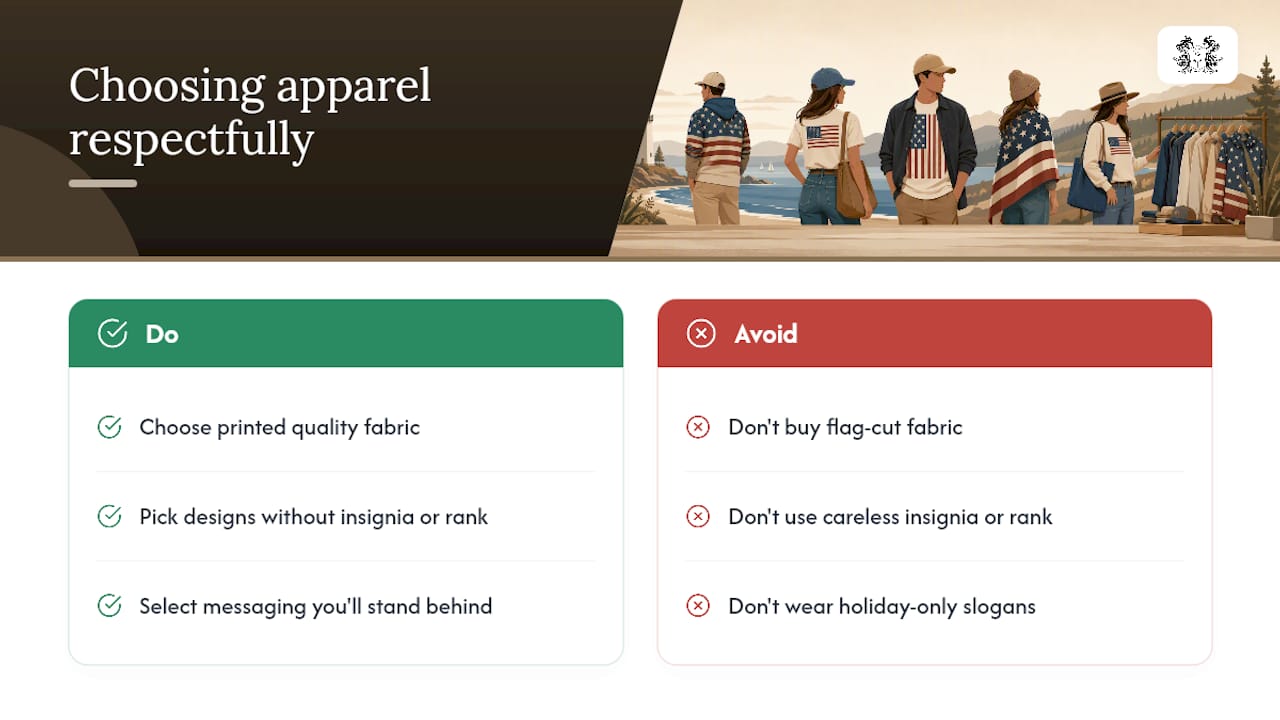
Before you buy any flag-themed piece, run it through a short checklist: Is it printed on quality fabric rather than cut from an actual flag? Does the design avoid careless use of official insignia or rank? Is the messaging something you’d stand behind years from now, not just this Fourth of July? If the answer is yes across the board, you’re wearing it the right way.
Browse the collection and pick the piece that matches your code.
Sources
For direct verification, read the full text of 4 U.S.C. § 8, the American Legion’s Flag Code guidance, and NAVA’s flag etiquette Q&A for expert interpretation.
- 4 U.S. Code § 8 - Respect for flag
- U.S. Flag Myths, FAQs, & Terminology | The American Legion
- FQ&A—Flag Etiquette and Protocol - North American Vexillological Association
- FAQs ~ US Flag Etiquette (The Institute of Heraldry / Army FAQs)
- 4 USC 8: Respect for flag
FAQ
Is It Legal to Wear American Flag Clothing?
Yes. Printed or stylized flag designs on clothing are widely accepted under customary interpretation, and the Flag Code itself carries no criminal enforcement mechanism for wearing flag-themed apparel.
What Are the Main Flag Code Rules People Should Know?
The core rules cover not letting the flag touch the ground, not using it in advertising, retiring a worn flag with dignity, avoiding it as a costume or uniform, and reserving flag patches for authorized military, fire, police, and patriotic organization uniforms.
Why Do People Wear American Flag Shirts?
Flag apparel is a common way to express patriotism, honor service members, or mark holidays like Independence Day, and it’s treated as protected expression rather than flag misuse under current legal interpretation.
Is It Disrespectful to Fly the Flag at Night Without a Light?
Flag Code guidance recommends flying the flag only during daylight unless it’s properly illuminated after dark; while this specifically concerns flying a physical flag rather than clothing, it reflects the same underlying principle of treating the symbol with care and visibility in mind.
Are Flag Patches on Civilian Clothing Treated the Same as Military Patches?
No. Military, fire, and police uniforms have specific placement rules under regulations like Army Regulation 670-1, while civilian flag-themed clothing, printed shirts, hats, and hoodies, falls under the more relaxed customary interpretation covering everyday apparel.


