



When people read a lion as a symbol of strength, they invoke a tradition that links ferocity, rulership, and protection across cultures. The lion symbolizes strength, courage, leadership, and protection, and that meaning recurs from ancient Mesopotamia to Egypt, from biblical scripture to Asian guardian traditions. For anyone drawn to this image today, the lion carries a charge beyond decoration: it calls for protective leadership and courage disciplined by wisdom.
TL;DR:
- Lions symbolize both strength and protective leadership, influenced by ancient Mesopotamian, Egyptian, Greek, and biblical traditions.
- Heraldic poses like rampant and passant lions convey aggression, authority, or calm command, with details like crowns indicating legitimacy.
- Modern spiritual interpretations focus on courage and self-command, but historically lions also represented destruction and threat, requiring balance.
- In African cultures, lions are symbols of community protection and leadership, emphasizing safeguarding the group rather than conquest.
- For personal empowerment, choosing a calm, composed lion image enhances resilience and steadiness rather than raw aggression.
Table of Contents
- Where Lion Symbolism Strength Began: Ancient and Classical Roots
- Biblical and Christian Meanings: The Lion of Judah
- How Art and Heraldry Turned Lions Into Shorthand for Power
- What the Lion Means as a Modern Spirit Animal
- Lions in Modern Branding, Mascots, and Civic Identity
- Symbolism of Lion Strength in African and Indigenous Cultures
- The Psychology Behind Lion Symbolism and Personal Empowerment
- Bringing Lion Symbolism Into Daily Mindfulness or Meditation
- Modern Day Knight Perspective: Wearing Lion-Inspired Values Responsibly
- Apparel That Carries the Weight of the Symbol
- Sources
- FAQ
Where Lion Symbolism Strength Began: Ancient and Classical Roots
Lion symbolism did not start as a metaphor. It started as observation. Early civilizations watched an apex predator dominate its territory and built entire belief systems around that dominance.
In Sumerian and Mesopotamian art, the goddess Inanna, known later as Ishtar, is frequently shown standing on or flanked by lions. The image fused sovereignty with ferocity: a ruling power that did not ask permission. Ancient civilizations used lion imagery as an emblem of war, protection, and royal authority, and that pattern repeats across Mesopotamia, Egypt, and Greece before flowing into later European heraldry.
Egypt took the symbolism somewhere more complicated. Sekhmet, the lioness goddess, embodied both destruction and healing. She could unleash plague and war, and she could also protect and restore health. That duality matters. It shows an early culture already understood that raw power, left unchecked, needed a counterbalance.
Greek myth gave the West its most famous proof-of-strength story: Heracles and the Nemean lion, a beast whose hide no weapon could pierce. Heracles won by strength and strategy combined, and the lion’s pelt became his signature. That single myth planted the idea that conquering a lion, literally or symbolically, marks a hero.
- Mesopotamia: lions paired with goddesses as emblems of divine sovereignty
- Egypt: Sekhmet’s lioness form blending destruction and healing
- Greece: the Nemean lion as the ultimate test of heroic strength
- Medieval Europe: classical lion imagery absorbed into rulership and heraldic art
Biblical and Christian Meanings: The Lion of Judah
Scripture treats the lion as one of its most loaded symbols, and it does not settle for a single meaning. Genesis 49:9 names Judah “a lion’s whelp,” the origin point of the Lion of Judah as a tribal emblem of strength and dominion. That image resurfaces centuries later with far greater weight.
Revelation 5:5 identifies Christ as “the Lion of the tribe of Judah,” a title tied directly to triumph and messianic authority. The Lion of Judah became one of Christianity’s central emblems of sovereignty, representing a victory already won rather than a battle still pending.
Scripture never lets the symbol sit comfortably on one side of the ledger, though. First Peter 5:8 warns that “your adversary the devil prowls around like a roaring lion, seeking someone to devour.” The same creature that represents divine kingship also represents predatory threat. Biblical writers used lion imagery across dozens of passages to capture both meanings, sometimes within the same book.
- Genesis 49:9: the tribal root of the Lion of Judah emblem
- Revelation 5:5: Christ as the triumphant, sovereign Lion
- 1 Peter 5:8: the lion as a warning image, not just a royal one
- Ongoing biblical pattern: lion imagery used for both divine strength and adversarial danger
That tension carried straight into medieval Europe. Kings and knights adopted lion imagery precisely because it held both halves: God’s favor and battlefield ferocity in one image.
How Art and Heraldry Turned Lions Into Shorthand for Power
Medieval heraldry did not invent lion symbolism, but it standardized it into a visual language anyone could read at a glance. A lion rampant, standing on its hind legs with claws bared, signaled aggression and readiness. A lion passant, walking calmly with one paw raised, signaled controlled authority rather than a threat.
- Heraldic poses carry distinct meanings. A rampant lion reads as active strength; a passant lion reads as composed command; a lion with a forked tail (queue fourchette) marks a specific noble lineage.
- Guardian lion pairs mark thresholds. Chinese guardian lion statues and Japanese komainu figures flank gates and temples in pairs, one often open mouthed and one closed, signaling protection at a boundary.
- Stylization was often deliberate, not accidental. Medieval European artists rarely saw a real lion, so they exaggerated manes, teeth, and posture, and that exaggeration amplified the symbolic message rather than weakening it.
- Small details change the whole reading. Add a crown to a heraldic lion and it shifts from raw strength to legitimate rule; open its jaws in a roar and it shifts from guardian to warning.
What the Lion Means as a Modern Spirit Animal
Contemporary readers often meet lion symbolism through spirit-animal frameworks rather than ancient texts. That lineage traces largely to modern popular writing, which compressed centuries of varied lion roles into single psychological keywords like courage, leadership, and inner sovereignty. Contemporary spiritual and wellness writing frames the lion as an “inner king,” a prompt for stepping into courageous, self-commanded action.
That framing is useful, but it is a simplified layer sitting on top of a much older, more ambivalent tradition. The historical lion was never only noble. It was also destroyer, threat, and predator. Strength without wisdom curdles into pride or aggression, which is exactly the danger Sekhmet’s dual nature and 1 Peter’s roaring lion both warned about long before self-help writers picked up the theme.
Used carefully, though, the modern reading has real value:
- A lion tattoo chosen deliberately, not decoratively, as a daily reminder of self-command
- Lion imagery in jewelry worn as a personal check on courage under pressure
- A visual cue, glanced at during a hard decision, meant to prompt composure over impulse
Pro Tip: Choose a calm, composed lion image rather than a snarling one if your goal is steady courage instead of raw aggression. The pose you pick shapes the message you send yourself every time you see it.
Lions in Modern Branding, Mascots, and Civic Identity
Modern American culture reads lion symbolism the same way it has for millennia: courage, leadership, protection, and pride, just applied to new surfaces like team logos, tattoos, and corporate branding. The specifics of how a lion is drawn still change what it says.
Sports teams lean on lions for toughness and collective identity, betting that fans will absorb some of that ferocity as their own. Luxury and heritage brands go a different direction, using a lion crest to imply continuity and earned authority rather than aggression, the same logic medieval monarchs used centuries earlier.
The design choices carry real weight:
- A roaring lion signals confrontation and raw force
- A calm, seated lion signals composed authority and restraint
- A crowned lion signals legitimate rule, not just physical dominance
- A lioness signals protection and cooperative strength rather than solitary conquest, reflecting a distinction many cultures draw between male and female lion roles
Readers who want to express a specific value, courage versus composure versus protection, should pick the pose and context that actually matches it rather than defaulting to the fiercest image available.
Symbolism of Lion Strength in African and Indigenous Cultures
Across much of sub-Saharan Africa, the lion carries a symbolic weight that predates and runs parallel to the ancient Near Eastern traditions. Among many Southern and East African peoples, lion imagery has long marked chieftaincy and communal protection rather than solitary conquest. Titles referencing the lion, worn by tribal leaders across multiple nations, signal that leadership means shielding the group, not just dominating it.
That framing differs subtly from the Mesopotamian and Greek versions. Where Heracles proved himself by defeating a lion, many African oral traditions treat the lion as a leadership model to emulate directly rather than an obstacle to overcome. The animal’s role as an apex predator with strong social cooperation, lions hunt and defend territory in coordinated prides, maps closely onto ideals of communal leadership: a leader who protects the group survives and strengthens it, while one who acts only for personal glory weakens it.
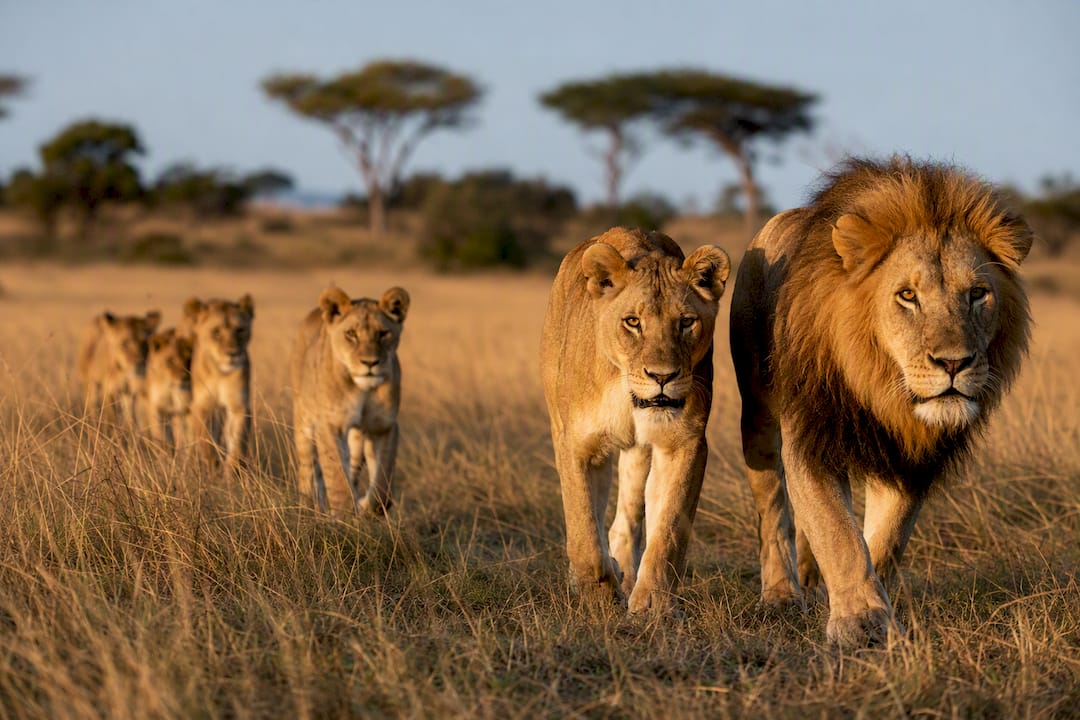
Indigenous storytelling traditions elsewhere reinforce a similar pattern, using lion or big-cat figures as teachers of patience and territorial responsibility rather than pure aggression. The recurring thread is protection anchored in community, not conquest performed for its own sake.
This matters for anyone drawing on lion symbolism for personal meaning today. The African emphasis on the lion as communal guardian offers a useful correction to the more individualistic “conquer the beast” reading inherited from Greek myth. Strength, in this framing, is measured by what it protects, not by what it defeats.
The Psychology Behind Lion Symbolism and Personal Empowerment
Lion symbolism resonates psychologically because it maps onto a real internal experience: the moment someone has to choose courage over avoidance. People often reach for the lion image specifically during major personal transitions, a career change, a health crisis, a period of caregiving, as a prompt to step into leadership they were previously avoiding.
The mechanism is straightforward. A lion is not just a strong animal; it is a visibly confident one prompting ideas about walking with purpose and confidence. Its posture, its stillness before it acts, its refusal to flinch, all read to the human eye as settled self-assurance rather than frantic effort. Adopting that image as a personal symbol works less like magic and more like a rehearsal cue: seeing it, wearing it, or picturing it primes a person to act with more composure than they might otherwise manage.
There is a real risk in this framing, though, worth naming directly. Scholars who study modern spirit-animal interpretations caution that this reading simplifies a much older, more ambivalent symbol. Historically, the lion was both protector and destroyer, and treating it as a purely positive empowerment token risks license for aggression dressed up as confidence. The psychologically useful version of lion symbolism pairs boldness with restraint, the same balance Sekhmet’s dual healer and destroyer role encoded thousands of years earlier.
Used with that caveat in mind, the lion becomes a workable personal symbol: a reminder to act decisively, protect what matters, and hold that strength accountable to something larger than ego.
Bringing Lion Symbolism Into Daily Mindfulness or Meditation
Lion symbolism works best as a practice, not just an idea you hold once and forget. A few concrete ways to build it into a daily routine:
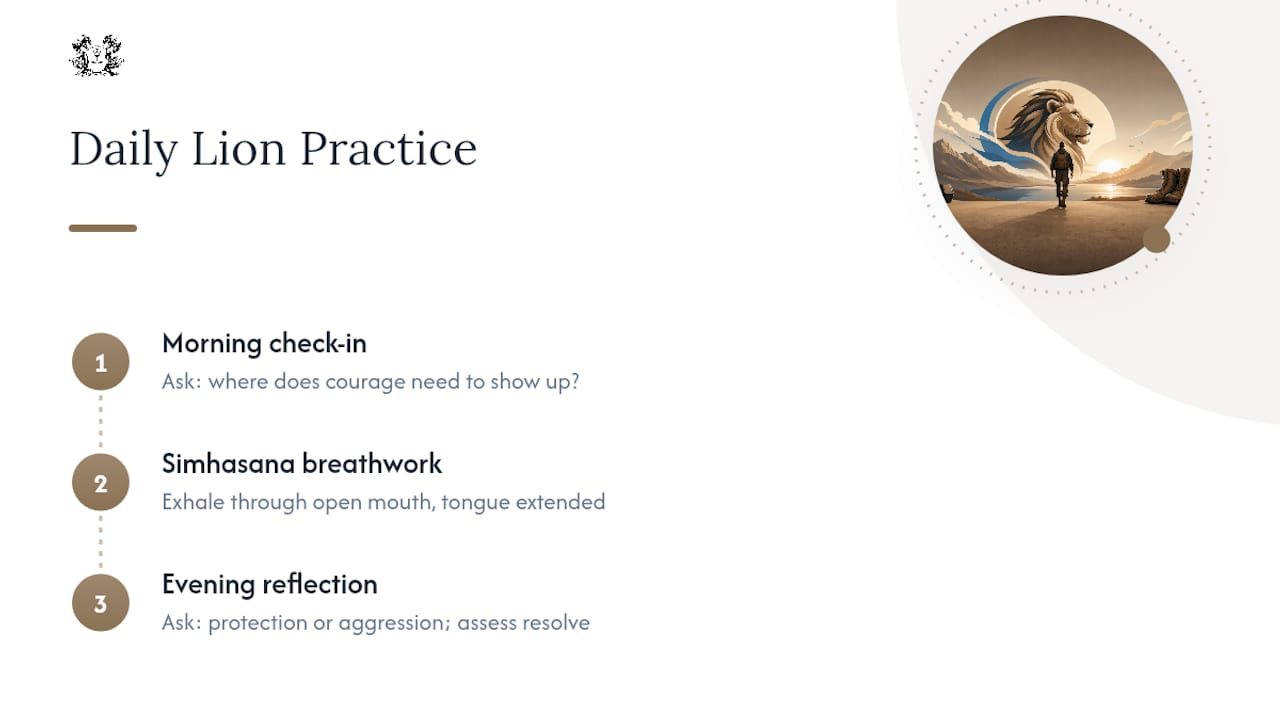
Start a morning check-in with a single question: where does courage need to show up today? This mirrors the ancient function of lion imagery as a call to protective leadership, not passive strength. Some practitioners keep a small lion object, a carving, a coin, a piece of jewelry, on a desk or nightstand specifically as a physical trigger for that question.
Breathwork traditions in yoga already use a literal lion pose, Simhasana, which involves an exhalation through an open mouth with the tongue extended, mimicking a roar. Practitioners use it to release tension and reset before a demanding moment, a physical echo of the same courage-summoning function the symbol has carried for millennia.
At day’s end, a short reflection works well: did strength show up as protection today, or as aggression? That question keeps the practice honest, guarding against the same drift toward unchecked ferocity that Sekhmet’s dual nature and the biblical roaring lion both warned against. The goal is not to feel fierce. It is to act with settled, protective resolve, then check whether that resolve served something beyond the self.
Modern Day Knight Perspective: Wearing Lion-Inspired Values Responsibly
Modern Day Knight is veteran owned and operated, and that background shapes how we read lion symbolism strength. The warrior ethos was never about raw aggression. It was about disciplined strength placed in service of something larger than the self, exactly the tension Sekhmet embodied and scripture repeated across centuries.
Apparel carrying that message works the same way a heraldic crest once did: a visible signal of what someone stands for. Our loyalty symbol writing and our piece on warrior spirit in everyday apparel both trace this same thread: strength earns meaning only when it protects something.
— Modern Day Knight
Apparel That Carries the Weight of the Symbol
There are other ways to mark this kind of meaning, a coin in your pocket, a tattoo, a framed print. This brand takes a different route: apparel built around a modern code of honor, where every piece is meant as a statement of ideals rather than a fashion choice.
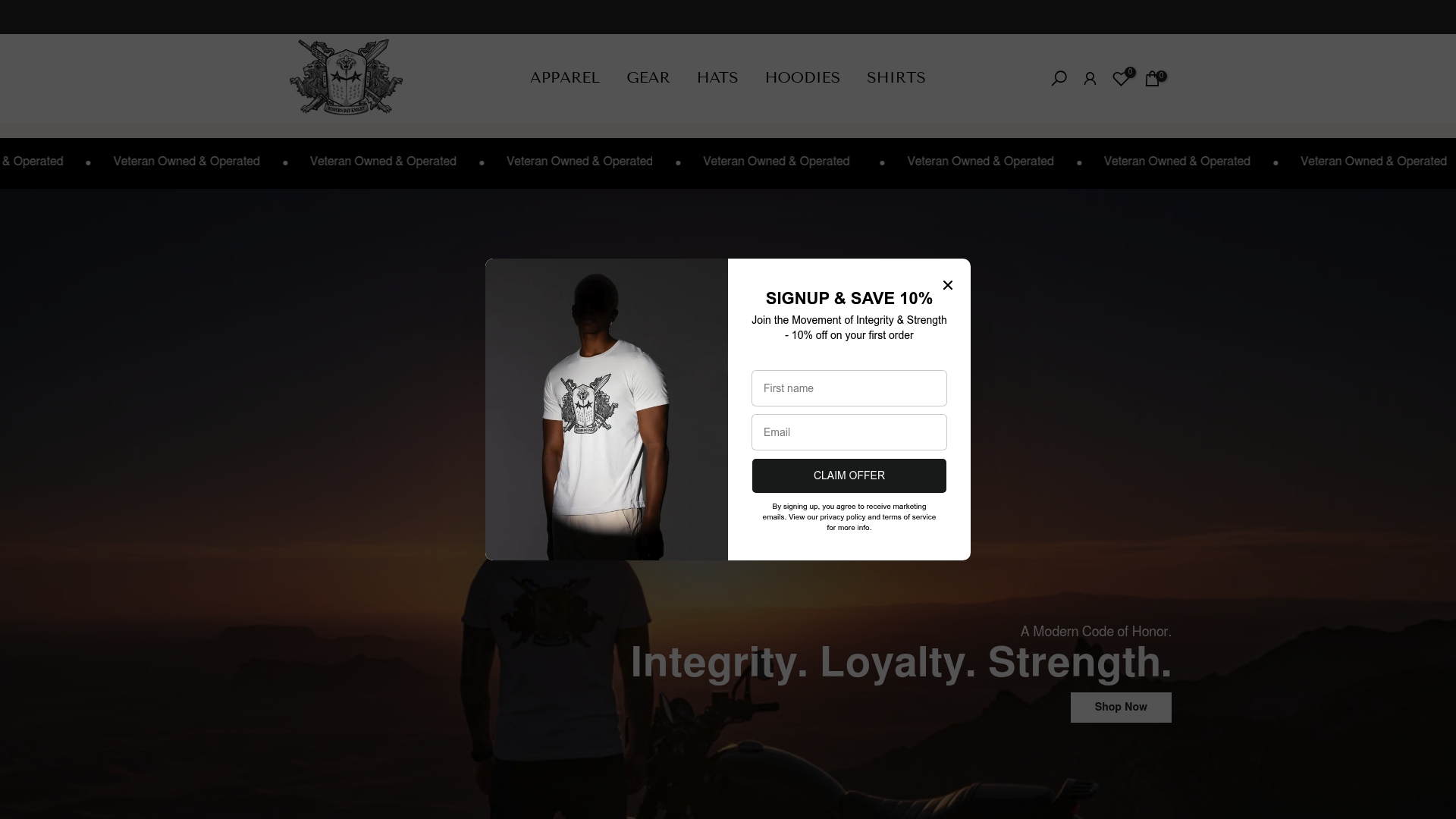
The Global Citizen Hoodie and History Matters Hoodie pair heritage themes with everyday wear, while the Accountability Hoodie and Army Brat Hoodie speak directly to responsibility and military family identity. For lighter options, the Global Citizen Tee, Army Brat Tee, History Matters Tee, and Accountability Tee carry the same values-driven messaging in a simpler form. Every piece comes from a brand built around integrity, loyalty, and protective strength rather than aesthetics alone.
Browse the full collections and pick the piece that matches the value you want to carry.
Sources
- Wikipedia — Cultural depictions of lions
- Gotquestions
- PBS Nature — Lion fact sheet
- MindBodyGreen — The spiritual meaning of lions
- BibleHub — Topical: Lion: Strength of
FAQ
What is the deeper meaning of a lion?
The lion represents strength, courage, leadership, and protection across nearly every major tradition that has used it, from Mesopotamian sovereignty imagery to the biblical Lion of Judah. Its deeper meaning almost always pairs raw power with a responsibility to protect rather than simply dominate.
What is the spiritual symbolism of a lion?
In modern spiritual and wellness writing, the lion often represents the “inner king,” a prompt toward courage, self-command, and stepping into leadership during difficult transitions. That reading simplifies an older tradition where the lion could be both protector and destroyer, so the fuller spiritual lesson includes restraint alongside boldness.
Why is the lion so powerful?
Lions occupy the apex predator role in their ecosystems, combining physical dominance, a roar audible for miles, and coordinated social behavior within a pride. Those biological traits gave ancient cultures a real-world model for what unchecked power and cooperative strength both look like.
Which animal is a symbol of strength?
The lion is one of the most widely recognized animal symbols of strength across cultures, appearing in Mesopotamian, Egyptian, Greek, biblical, and heraldic traditions alike. Its consistent presence across unrelated civilizations, each independently linking the lion to strength, courage, and protection, is part of what makes lion symbolism strength so durable.


