



Wearing military-style clothing alone is generally not a federal crime under stolen valor laws. The law turns on three things: intent to obtain a tangible benefit, a false claim about specific military decorations or service, and whether you are impersonating an officer or fraudulently using forged documents. Here is where the line sits:
- Lawful: Wearing camouflage, military surplus gear, or apparel with military-inspired messaging for fashion, film, cosplay, or tribute purposes, with no false claims attached.
- Unlawful: Claiming you earned a Medal of Honor, Purple Heart, or other decoration to obtain money, VA benefits, employment, or any other tangible advantage.
- Unlawful: Manufacturing, selling, or importing official military medals or colorable imitations without authorization, regardless of intent to deceive anyone verbally.
- Check your state: Some states criminalize military impersonation more broadly than federal law does. Federal law sets a floor, not a ceiling.
The two anchors for every legal question here are 18 U.S.C. §704 (the Stolen Valor Act of 2013) and United States v. Alvarez, 566 U.S. 709 (2012). Know both, and you know the law.
Key Takeaways
Wearing military-style clothing is generally lawful; the federal crime of stolen valor requires a false claim about decorations made with intent to obtain a tangible benefit, plus a separate prohibition on manufacturing or selling medals applies regardless of speech.
| Point | Details |
|---|---|
| Apparel alone is usually lawful | Wearing military-style clothing without false claims or impersonation does not violate federal stolen valor laws. |
| Intent and tangible benefit are the legal pivot | A false claim about decorations becomes criminal only when made knowingly to obtain money, property, or another tangible benefit. |
| Selling or making medals is separately illegal | Manufacturing, selling, or importing official medals or colorable imitations violates 18 U.S.C. §704(a) regardless of any verbal claim. |
| State laws can be stricter | Some states criminalize military impersonation more broadly than federal law; check your state’s statutes directly. |
| Report fraud through official channels | Use VA OIG, DoD OIG, or the FBI for suspected fraud; document evidence before reporting and avoid public confrontation. |
Table of Contents
- What “stolen valor” actually means under U.S. law
- Federal law decoded: 18 U.S.C. §704, the Stolen Valor Act, and Alvarez
- When wearing military clothing or insignia can lead to criminal charges
- How state impersonation laws differ from federal statutes
- Social norms and etiquette around military apparel
- If you suspect stolen valor or fraud: how to report it
- Wearing military-inspired apparel responsibly with Moderndayknightco
- Primary sources and further reading
- The line between law and honor is not the same line
- Sources
What “stolen valor” actually means under U.S. law
Stolen valor is not a vague social concept in a courtroom. It has a precise legal test, and prosecutors must meet every element to secure a conviction.
The test has three parts: (1) a false representation about military awards or service, (2) knowledge that the representation was false, and (3) an intent to obtain money, property, or another tangible benefit. Miss any element, and the First Amendment likely shields the speaker. That is the constitutional lesson Alvarez taught Congress, and it is the reason the 2013 statute was written the way it was.
The agencies most likely to investigate and prosecute are the FBI, U.S. Attorneys’ offices, the VA Office of Inspector General (VA OIG), and the DoD OIG. The VA OIG handles cases where false military claims are used to obtain federal veterans’ benefits. The FBI and U.S. Attorneys step in when fraud crosses state lines or involves wire communications. Local law enforcement handles state-level impersonation charges.
One thing practitioners stress: a stolen valor charge rarely travels alone. When false military claims are used to secure federal benefits or cross state lines, prosecutors frequently add wire fraud, identity theft, or benefits fraud charges. Those additional counts can carry felony penalties far heavier than the misdemeanor base of §704.
Federal law decoded: 18 U.S.C. §704, the Stolen Valor Act, and Alvarez
Three legal documents define the federal framework. Read them together, and the picture is clear.
18 U.S.C. §704 has two distinct prohibitions. The first targets commercial conduct: manufacturing, selling, or importing authorized military decorations or colorable imitations without authorization carries fines and up to six months in prison. The second targets fraudulent speech: knowingly making a false representation about receiving certain high-valor decorations to obtain money, property, or other tangible benefits carries fines and up to one year in prison for awards like the Medal of Honor.
The Stolen Valor Act of 2013 (H.R. 258, P.L. 113–12) was Congress’s direct response to Alvarez. The Supreme Court had struck down an earlier, broader version of the law that criminalized any false claim about military awards, even without proof of intent to gain anything. Congress rewrote the statute to add the “intent to obtain tangible benefit” element, threading the constitutional needle the Court required.
United States v. Alvarez (2012) involved Xavier Alvarez, a California water district board member who falsely claimed at a public meeting that he had received the Medal of Honor. The Supreme Court held, 6–3, that the government cannot broadly criminalize false statements about military awards without showing the speech was intended to secure money or other tangible benefits. False speech alone, however offensive, is generally protected under the First Amendment unless it causes concrete harm or constitutes fraud.
| Element | 18 U.S.C. §704 (post-2013) | Effect of Alvarez |
|---|---|---|
| What is prohibited | False claims about decorations made to obtain tangible benefit; manufacture/sale of medals | Broad criminalization of false speech without tangible-benefit element is unconstitutional |
| Required intent | Knowing false representation + intent to obtain money, property, or tangible benefit | Intent to obtain tangible benefit is constitutionally required for speech-based liability |
| Penalty range | Up to 6 months (manufacture/sale); up to 1 year for certain high-valor awards | No criminal penalty for false speech absent the tangible-benefit element |
The commercial prohibition on medals is worth separating out. It does not require any false speech at all. If you manufacture or sell a replica Medal of Honor without authorization, you have violated §704(a) whether or not you claimed to have earned it.
When wearing military clothing or insignia can lead to criminal charges
Most people who wear military-style apparel face no legal exposure. The scenarios below show where the line actually sits.
- Lawful — fashion and surplus: Wearing camouflage pants, a field jacket, or a military surplus shirt purchased at a retail store. No false claim, no tangible benefit sought. This is protected expression.
- Lawful — film and cosplay: Wearing a full military uniform as a costume for a movie production, Halloween, or a historical reenactment. Intent is clearly expressive, not deceptive.
- Lawful — licensed tribute apparel: Wearing a t-shirt or hoodie from a veteran-owned brand with military-inspired messaging that carries no official insignia or rank. The apparel honors service without impersonating it.
- Unlawful — impersonation for discounts or access: Wearing an official-looking uniform with rank insignia and falsely claiming active-duty status to obtain a military discount, base access, or preferential treatment. The tangible benefit element is met.
- Unlawful — false claims for VA benefits or employment: Submitting forged discharge papers or verbally claiming combat decorations to secure VA benefits, a federal job preference, or a donation. This is the core of what the 2013 Act targets, and it is where prosecutors focus.
- Unlawful — selling imitation medals as authentic: Selling replica medals while representing them as genuine authorized decorations. This combines the commercial prohibition of §704(a) with potential fraud charges.
The commercial medal prohibition stands alone. Under §704(a), manufacturing, selling, or importing official military decorations or colorable imitations without authorization is a federal offense regardless of any verbal claim. A vendor who sells convincing replica Medals of Honor at a flea market has violated federal law even if every buyer knows the medals are replicas.
How state impersonation laws differ from federal statutes
Federal law sets the minimum standard. States can and do go further, and the variation is significant.
Some states have standalone military impersonation statutes that criminalize wearing a uniform with intent to deceive, even without proof of a tangible financial benefit. Others fold military impersonation into broader fraud or false personation statutes. A few states have passed their own “stolen valor” laws that mirror or expand the federal framework. The penalties vary from misdemeanors to felonies depending on the state and the circumstances.
To find your state’s rules, search your state’s official legislative website using terms like “military impersonation,” “false personation of a military officer,” or “stolen valor.” Your state attorney general’s website is another reliable starting point. If you face a specific situation, a local criminal defense attorney or military law practitioner can give you a precise answer for your jurisdiction.
Civil consequences can apply even when criminal charges do not. A veteran who discovers someone falsely claiming their service or awards may have grounds for a civil claim in some states. Beyond litigation, reputational consequences, removal from events, and public exposure are real outcomes that do not require a prosecutor’s involvement.
Congressional findings cited in the Alvarez litigation documented that false award claims have caused concrete financial harm, including one regional fraud scheme that defrauded the VA out of more than $1.4 million. That scale of harm is why both federal and state lawmakers continue to treat this seriously.
Social norms and etiquette around military apparel
The law tells you what is criminal. Etiquette tells you what is respectful. They are not the same threshold, and veterans notice the difference.
What to do:
- Wear apparel clearly labeled “military-inspired,” “tribute,” or “veteran-owned” that carries no official insignia or rank.
- Support brands with a genuine connection to the military community, where the story behind the clothing matches the message on it.
- If you are a veteran wearing your own earned decorations, wear them with pride. You earned that right.
- Remove rank insignia, unit patches, or award ribbons from surplus gear before wearing it in public if you did not serve in that unit or earn those items.
What to avoid:
- Wearing official medals, ribbons, or decorations you did not earn, even at a costume party. Veterans and their families recognize them, and the offense runs deep.
- Claiming military service, rank, or awards in conversation to gain social status, sympathy, or any advantage, even informally.
- Purchasing or wearing uniforms that closely replicate active-duty dress uniforms with rank and unit identifiers, particularly in contexts where someone might reasonably believe you are a service member.
Three common questions answered directly:
Can a civilian wear a military uniform? Generally yes, for clearly expressive purposes like film or reenactment, but wearing one in a context where someone could reasonably mistake you for an active-duty service member, especially while making false claims, creates legal risk.
Is it disrespectful to wear a veteran’s shirt or hat? Wearing general military-branch apparel (a Navy t-shirt, an Army cap) is widely accepted as tribute. Wearing a specific veteran’s name tape, unit patch, or earned awards without permission crosses into disrespect.
Why do medals matter so much? Each decoration represents a specific act of service or sacrifice. Wearing one you did not earn does not just misrepresent you. It diminishes the act it represents. That is why the offense lands so hard in military communities, and why valor-inspired fashion draws a clear line between tribute and impersonation.
If you suspect stolen valor or fraud: how to report it
Reporting suspected stolen valor requires calm, documentation, and the right channel. Public confrontation rarely helps and can escalate dangerously.
Step 1: Document what you observed. Write down dates, locations, specific claims made, and any witnesses. If the claims were made online, take screenshots immediately before they are deleted.
Step 2: Do not confront the person publicly. Public shaming can tip off the subject, destroy evidence, and in some cases create legal risk for you. Let investigators do their work.
Step 3: Contact the right agency. For suspected VA benefits fraud, file a tip with the VA Office of Inspector General. For DoD-related fraud or impersonation of military officers, contact the DoD OIG. For cases involving wire fraud, interstate fraud, or threats, contact your local FBI field office or U.S. Attorney’s office. For state-level impersonation, contact local law enforcement.
Step 4: Include specifics in your report. Dates, copies of documents, links to social media posts, and names of witnesses all strengthen a tip. Vague reports are harder to act on.
Pro Tip: When submitting a tip to the VA OIG or DoD OIG, use their official online hotlines rather than email or social media. Official channels protect your identity and route your tip to the right investigative unit faster.
Wearing military-inspired apparel responsibly with Moderndayknightco
Honor does not require impersonation. The right apparel makes a statement about your values without misrepresenting your service record.
Moderndayknightco is a veteran-owned apparel brand built on integrity, loyalty, and strength. Every piece in the apparel collection carries military-inspired messaging that pays tribute to the warrior ethos without using official insignia, rank, or decorations. That distinction is not just ethical. It is by design.
When you shop for military-inspired apparel, look for these features:
- Clear “military-inspired” or “tribute” labeling, with no official rank insignia or award ribbons.
- Veteran-owned certification or a transparent brand story that connects the design to real service.
- Decorative patches or graphics that are clearly artistic rather than replicas of official unit or award identifiers.
- Messaging centered on values (honor, loyalty, strength) rather than specific service claims.
- A brand that openly explains what its designs represent and why.
Pro Tip: Before buying military-themed apparel from any seller, ask one question: “Does this item use official military insignia, rank, or award imagery?” If the seller cannot answer clearly, or if the item closely replicates an official decoration, choose a different product. Provenance and intent matter, both legally and ethically.
Moderndayknightco’s approach to honoring military service through apparel shows what tribute looks like when it is done with purpose. Wear what you believe in. Make it mean something.
Primary sources and further reading
These are the authoritative texts behind every legal claim in this article. Read them directly to verify.
| Source | Type | Where to find it |
|---|---|---|
| United States v. Alvarez (2012) | Supreme Court opinion | Law |
| Stolen Valor Act of 2013 (H.R. 258) | Congressional bill and legislative history | Congress |
| P.L. 113–12 (enacted public law text) | Official public law | Govinfo |
| VA OIG and DoD OIG reporting pages | Federal oversight offices | Va |
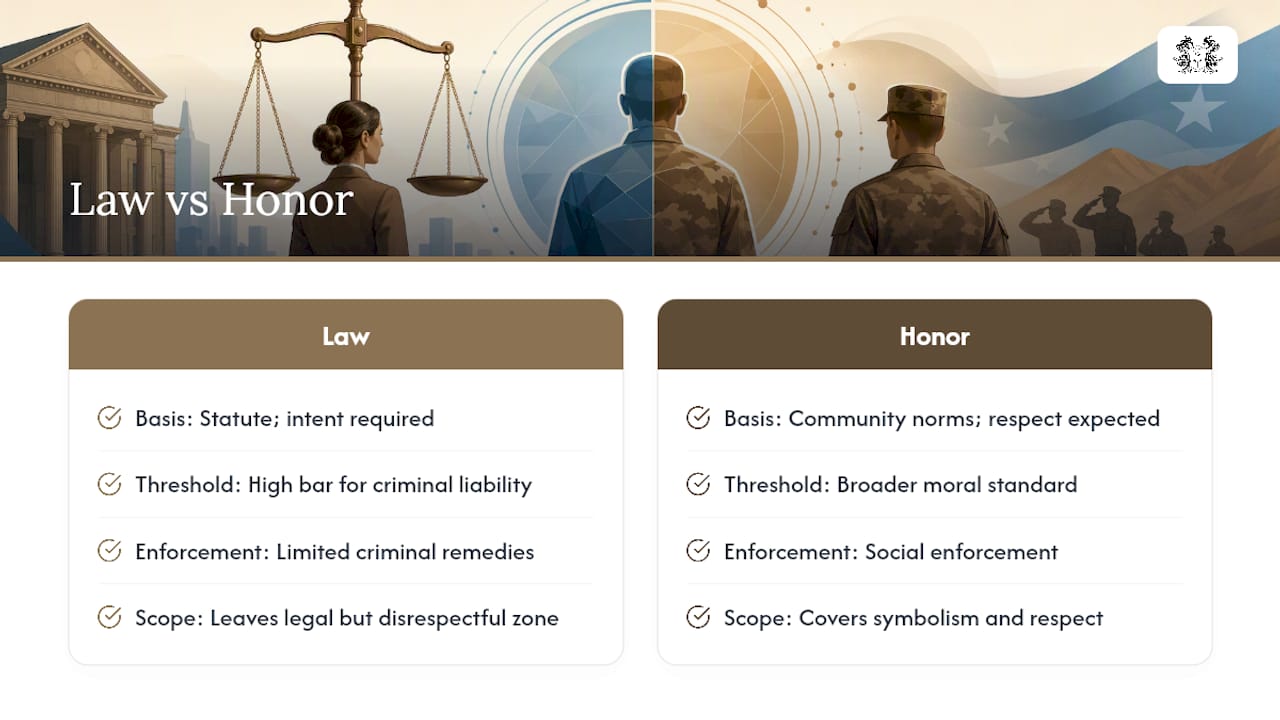
The line between law and honor is not the same line
Most articles on stolen valor laws clothing stop at the statute. That is a mistake. The law tells you the minimum. Honor asks more.
Here is the judgment the research actually supports: the legal bar for criminal liability is deliberately high. Congress and the Supreme Court agreed that false speech, however offensive, cannot be criminalized without proof of intent to gain something concrete. That is a sound constitutional principle. But it means the law leaves a wide zone of conduct that is legal and still deeply disrespectful.
Wearing a Medal of Honor you did not earn to a costume party is not a federal crime if you make no false claims for gain. It is still a profound insult to every person who received that decoration and every family that accepted it posthumously. The law cannot reach that. Community standards can, and should.
The conventional advice on this topic focuses almost entirely on “is it illegal?” That is the wrong first question. The better question is: “Does this honor the people it references, or does it exploit their sacrifice for my own image?” When you answer that honestly, the apparel choices become clear. Military-inspired clothing built around values, not rank or medals, is tribute. Clothing that mimics official decorations or service records, even legally, is something else.
We believe in wearing what you stand for. That means choosing apparel that reflects your actual code, not borrowed credentials. The military values in modern fashion conversation is not just about aesthetics. It is about integrity. Wear it like you mean it.
This article is general information, not a substitute for advice from a qualified lawyer. Consult a qualified legal professional about your own circumstances before acting on anything here.
Sources
- UNITED STATES v. ALVAREZ | Supreme Court | US Law | LII / Legal Information Institute
- H.R.258 - 113th Congress (2013-2014): Stolen Valor Act of 2013


