



If you need Alan Gratz’s most powerful lines right now, here they are. Below are the strongest quotes from Code of Honor, ready to copy for a caption, a speech, or an essay, each with attribution and a suggested use.
- “Be the strongest of the strong. Be the bravest of the brave.” — Alan Gratz, Code of Honor (the opening Code lines; strong for speeches or a bold Instagram caption)
- “Always tell the truth.” — Alan Gratz, Code of Honor (short and direct; ideal for a classroom discussion on honesty or a values-themed caption)
- “Be loyal.” — Alan Gratz, Code of Honor (two words, maximum weight; fits a tattoo-style caption or a toast to a friend)
- “Never give up.” — Alan Gratz, Code of Honor (a resilience line that works for sports captions, graduation speeches, or a gym motivation post)
- “Help the helpless.” — Alan Gratz, Code of Honor (a service-and-duty line, strong for essays on civic responsibility or military family tributes)
- “Kill all monsters.” — Alan Gratz, Code of Honor (the Code’s final, deliberately jarring rule; useful in essays analyzing the book’s moral tension)
- “The Code” (as a whole, seven lines together) — Alan Gratz, Code of Honor (best used in full for a classroom handout or a longer speech opener)
Each of these comes from the seven rules Gratz builds his novel around, a short list his characters recite and wrestle with as they decide what loyalty actually costs. The rest of this guide expands on those lines, groups the fuller collection by theme, breaks down what each Code rule means, and gives you clean citation formats so you never misattribute a line.
Key Takeaways
Alan Gratz’s seven-line Code in Code of Honor works because it turns abstract values like loyalty and courage into short, testable rules a person can actually live by.
| Point | Details |
|---|---|
| Copy the short rules first | “Be loyal,” “Never give up,” and “Always tell the truth” work best for captions and speeches. |
| Verify before quoting longer passages | Cross-check chapter excerpts on Bookey against your own copy. |
| Use MLA or APA for schoolwork | Cite Gratz, Alan. Code of Honor. Scholastic Press, 2015, with a page number. |
| Pair alternatives with clear attribution | Classic lines from Twain, Franklin, or Emerson round out a caption or speech beyond the novel. |
| Wear your code, don’t just post it | Modern Day Knight’s Accountability Tee turns the same principle into a daily, wearable reminder. |
Table of Contents
- Code of Honor Quotes That Readers Remember Most
- The Full Collection, Grouped By Theme
- What the Seven Rules Of the Code Actually Mean
- Honor and Integrity Quotes Beyond the Novel
- How to Cite These Quotes Correctly
- Why These Lines Still Matter Off the Page
- Wear the Code, Don’t Just Quote It
- Where to Verify Every Quote In This List
- Sources
Code of Honor Quotes That Readers Remember Most
The lines readers quote most from Code of Honor aren’t the longest ones. They’re the shortest, sharpest rules, the ones that read like a soldier’s creed because that’s exactly what they’re modeled on. Gratz wrote the novel around a Special Forces sergeant’s personal code, and that military cadence is why these quotes travel so well onto a poster, a caption, or a graduation card.
Here are the standout lines, with context on where each one lands emotionally:
- “Be the strongest of the strong. Be the bravest of the brave.” This opens the Code and sets the tone: honor here isn’t passive, it’s a standard you actively chase.
- “Always tell the truth.” Simple on the page, brutal in practice for a protagonist who spends much of the book keeping secrets.
- “Be loyal.” The shortest rule in the Code and arguably the one the plot tests hardest, since loyalty to family and loyalty to country pull in different directions.
- “Never give up.” A line that reads as generic motivation until you see the physical stakes the characters face when quitting would be the easier, safer choice.
- “Help the helpless.” This rule reframes strength as a responsibility to others, not a personal accomplishment.
- “Kill all monsters.” The most debated line in the book. Readers and reviewers split on whether it means literal danger or the darker instincts a person has to fight within themselves.
- “The Code isn’t just words. It’s who you are.” A paraphrastic theme many reader summaries point to, capturing the novel’s core argument that a code only matters if you live it.
- “A promise is a promise, no matter what it costs you.” A line that echoes across reader discussions of the book’s family loyalty subplot.
Pro Tip: When you’re choosing a quote for a caption, favor the two or three-word rules (“Be loyal,” “Never give up”) over longer passages. Short lines read as intentional, not lifted out of context.
Community-sourced quote pages like Goodreads confirm the wording of the seven Code rules directly from the text, while chapter breakdowns on Bookey verify the surrounding dialogue and context. Treat the seven-rule Code as primary text and treat any paraphrased “theme” quotes as reader interpretation unless you can confirm the exact wording in your own copy of the book.
The Full Collection, Grouped By Theme
Instead of hunting chapter by chapter, it’s more useful to group Code of Honor quotes by the value they represent. Gratz built his plot around loyalty, courage, truth, and resilience, and most memorable lines fall cleanly into one of those four buckets.
Beyond the seven Code lines themselves, Bookey’s chapter-based breakdown pulls additional dialogue tied to the same themes, grouped by where each passage appears in the story. That’s useful if you’re writing an essay and need to show how a theme develops across the book rather than just quoting the Code once and moving on.
A few things to keep in mind when you’re pulling from a fuller collection:
- Chapter numbering can differ slightly between print and digital editions, so treat any chapter reference as approximate unless you’re citing your own copy.
- Community-transcribed quotes (the kind you’ll find on fan pages) sometimes drop a word or punctuation mark, so cross-check anything longer than one sentence.
- The seven-rule Code itself is stable across every source checked here. That’s your safest quote to use without double-checking wording.
What the Seven Rules Of the Code Actually Mean
Gratz doesn’t leave the Code as background flavor. His characters recite it, argue over it, and eventually have to decide which rule matters most when two of them conflict. Here’s each rule, verbatim, with a plain-English read on what it’s actually asking of the reader.
- Be the strongest of the strong. Strength here isn’t about muscle. It’s about being the person others can lean on when things fall apart.
- Be the bravest of the brave. Courage isn’t the absence of fear. It’s acting anyway, especially when the safe choice would be to stay quiet.
- Help the helpless. If you have the power to protect someone who can’t protect themselves, the Code says that’s not optional. It’s the job.
- Always tell the truth. Even when a lie would be easier, even when the truth costs you something you care about.
- Be loyal. Loyalty to people, to family, to a cause bigger than your own comfort. This is the rule the plot pressure-tests the hardest.
- Never give up. Persistence isn’t a personality trait in the Code. It’s a discipline you choose again every time quitting looks reasonable.
- Kill all monsters. The most literal and most symbolic line at once. It reads as a warning against real danger, and as a call to defeat the worst instincts in yourself.
Fictional codes like this one tend to work the same way real warrior traditions do. They start as short rules and grow into a full ethical framework the community holds each other to, the same pattern you see in other warrior code traditions built around group survival and shared duty.
Pro Tip: If you’re writing an essay on the novel, don’t treat the seven rules as equal weight. Rule five (loyalty) and rule four (truth) are the two the plot puts in direct conflict, and that tension is where most of the book’s best analysis comes from.
Honor and Integrity Quotes Beyond the Novel
Sometimes you need a line that isn’t tied to a specific book, something classic, quotable, and instantly recognizable. These honor code sayings pull from writers and thinkers outside the Code of Honor universe but sit comfortably alongside its themes.
- “It is curious that physical courage should be so common in the world and moral courage so rare.” — Mark Twain (speech, essay)
- “Whatever is begun in anger ends in shame.” — Benjamin Franklin (caption, general use)
- “The louder he talked of his honor, the faster we counted our spoons.” — Ralph Waldo Emerson (essay, satire on false honor)
- Integrity is choosing your thoughts and actions based on values rather than on personal gain or fear, an idea Barbara De Angelis puts at the center of what a personal code should look like (caption, personal reflection).
- “Honor is simply the morality of superior men.” — H.L. Mencken (essay, discussion of honor’s history)
- “A man’s true wealth is the good he does in this world.” — often attributed to Muhammad, popular in integrity quote collections (caption, speech)
- “Character is what you do when no one is watching.” — commonly attributed, widely used in leadership contexts (speech, classroom)
- “Trust is built with consistency.” — a line frequently cited in leadership writing, consistent with the view that rebuilding trust depends on changed behavior, not promises (essay, workplace caption)
- “Integrity is doing the right thing, even when no one is watching.” — variant of the Twain-adjacent quote family (caption, speech)
- Short, shareable lines gathered under the “code of honor” topic on AZQuotes offer additional options if you want something outside the Gratz canon entirely (caption, general use).
- BOS’s integrity collection makes the case that integrity shows up in actions and daily choices, not in stated values alone, a useful framing line for a speech opener (speech, essay).
Most of these lines are widely attributed and circulate freely for personal or educational use, but if you’re publishing commercially, verify the original source before reuse. Attribution gets fuzzy fast with quotes this old.
How to Cite These Quotes Correctly
Getting the wording right matters more than most people think, especially for a novel like Code of Honor where reader-transcribed quotes circulate widely online. Before you use any line longer than a sentence, check it against your own copy or a verified source page.
For schoolwork, here’s the format you’ll need:
- MLA style: Gratz, Alan. Code of Honor. Scholastic Press, 2015.
- In-text MLA citation: “Be loyal” (Gratz 112). Replace the page number with the actual page from your edition.
- APA style: Gratz, A. (2015). Code of honor. Scholastic Press.
- In-text APA citation: (Gratz, 2015, p. 112).
- Social caption format: Quote text in quotation marks, followed by “— Alan Gratz, Code of Honor” on the next line.
A few dos and don’ts worth following every time:
- Do confirm exact wording against your physical or digital copy before quoting more than a sentence.
- Do include the author’s full name at least once, even in a casual caption.
- Don’t strip a quote of its context if doing so changes its meaning. “Kill all monsters” reads very differently without knowing it’s rule seven of a defined ethical code.
- Don’t rely solely on fan-transcribed quote pages for anything you plan to cite academically.
- Don’t mix up paraphrased thematic summaries with actual verbatim text from the book.
A clean caption example: “Be the bravest of the brave.” — Alan Gratz, Code of Honor. #CodeOfHonor #IntegrityMatters
That single line, correctly attributed, works for a graduation post, a veteran’s tribute, or a personal values statement, and it holds up whether you’re posting it for fifty followers or handing it in for a grade.
Why These Lines Still Matter Off the Page
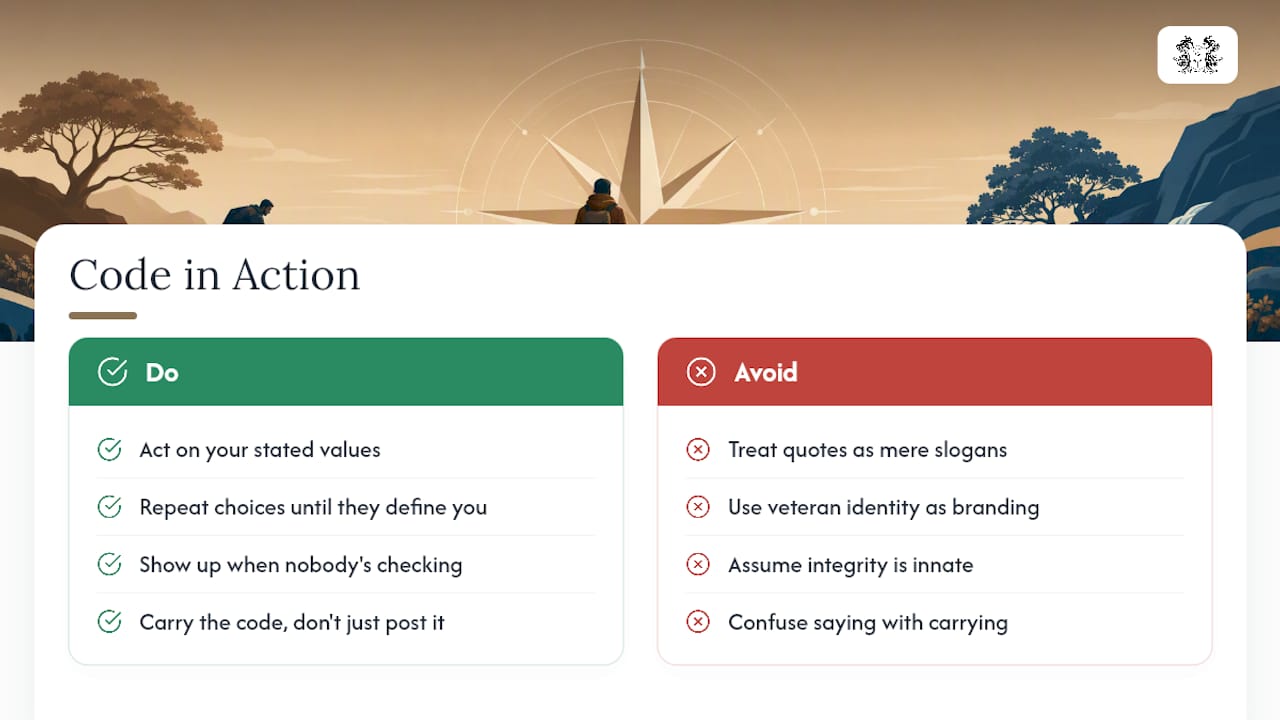
A code only means something when it survives contact with a hard choice. That’s the entire argument Gratz builds into his novel, and it’s the same argument we build our apparel around. Integrity isn’t a personality trait you’re born with. It’s a series of choices repeated until they define you, which is exactly what BOS argues in their own integrity collection: values show up in actions, not in what you say you believe.
We’re a veteran-owned company, and we didn’t pick that identity as branding. It shapes how we think about honor, loyalty, and the quiet discipline of showing up when nobody’s checking. A quote like “never give up” reads as a slogan until you’ve watched someone actually live it under pressure. That’s the difference between a saying and a code: one you post, the other you carry. If you’re drawn to lines like the seven rules in Code of Honor, you already understand why ancient warrior codes still apply today, even in a world that looks nothing like the one they were written for.
Wear the Code, Don’t Just Quote It
A quote on your phone is easy to forget by lunchtime. A quote on your chest is a daily reminder, and that’s the entire idea behind Modern Day Knight’s Accountability Tee.
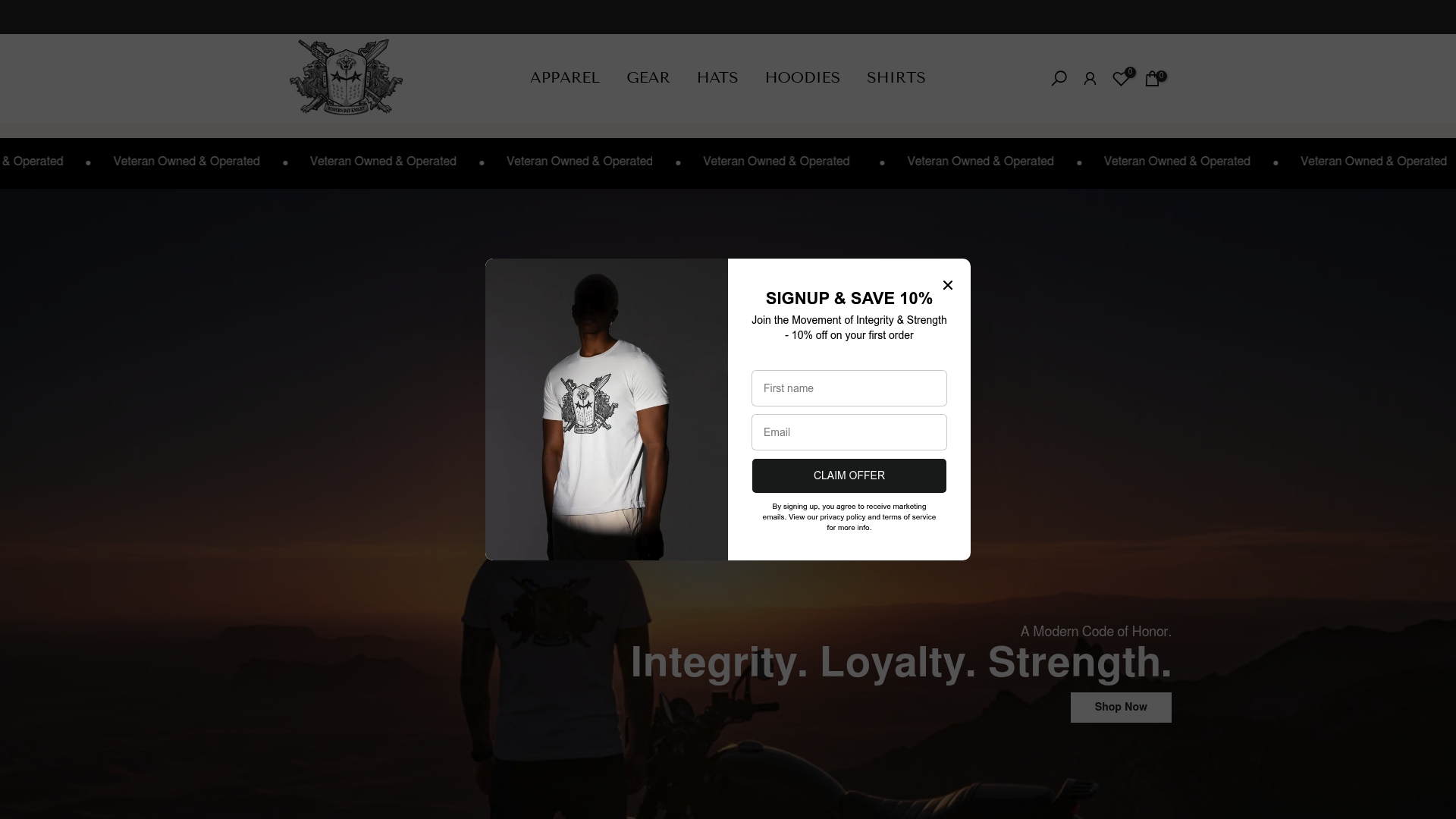
We built our apparel around the same principle Code of Honor puts into seven short rules: values only count when you act on them. Where the novel gives its characters a written Code to live by, we give you something wearable, a way to carry loyalty, integrity, and strength into an ordinary Tuesday without saying a word about it. Every piece in our apparel collection is built the same way, message first, fabric second. If one of the quotes above hit harder than the rest, that’s usually a sign it’s already part of your own code. Pick the piece that matches it, and wear it as your reminder.
Where to Verify Every Quote In This List
Never post or submit a quote you can’t trace back to a real source. Here’s where to double-check anything from this list, and what each site is actually good for.
- Goodreads — the primary source for the seven-rule Code, community-curated but generally reliable for short lines.
- AZQuotes’ code of honor topic page — community-sourced short lines, best for finding alternatives outside the novel.
- AZQuotes’ honor and integrity topic page — a broader pool of attributed authors, useful when you need a recognizable name for a speech.
- Goodreads’ integrity tag — a large community-sourced collection, good for casual caption hunting but always verify attribution.
- BOS’s integrity quote collection — editorial and workplace-focused, strong for essay or speech material.
- LeadershipNow’s integrity quotes — editorial, leadership-focused, useful for framing why a personal code matters practically.
If you’re writing something formal, a class paper or a published piece, treat Goodreads and AZQuotes as starting points, not final answers. Cross-check any line longer than a sentence against your own physical or digital copy of Code of Honor before it goes in front of a teacher, an editor, or an audience.
Sources
- Code of Honor Quotes
- TOP 9 CODE OF HONOR QUOTES | A-Z Quotes
- 75 Quotes on Integrity | Inspiring Workspaces by BOS
- Integrity Quotes | LeadingThoughts - LeadershipNow


