



In fashion, camouflage patterns work as visual shorthand for military heritage, identity, and personal conviction, not concealment. The camouflage fashion market hit $5.3 billion in 2022, and patterns like Woodland and MultiCam now carry distinct cultural signals. What follows breaks down the history, the pattern families, and how to wear camo the right way.
TL;DR:
- Wearing camo today conveys a mix of patriotism, rebellion, aesthetic preference, or activism, depending on the pattern, purpose, and context.
- Recognizing the pattern’s era, like Woodland for late 20th-century service or MultiCam for modern terrains, helps clarify the wearer’s intentions.
- Brand-driven camo reflects fashion identity more than military history, with scale and color affecting the message it communicates.
- The market’s growth stems from its cultural evolution, with patterns rooted in wartime origins and later adopted as symbols of defiance and style.
- When choosing camo pieces, matching the pattern to your message and respecting military symbols ensures authentic representation and appropriate styling.
Table of Contents
- From the Battlefield to the Runway: A Short History
- Understanding Camouflage Patterns: Which Ones You’ll See and What They Say
- What Camouflage Communicates in Civilian Dress
- How to Choose Camouflage Apparel That Reflects Your Values
- Modern Camouflage: Custom Prints, Runway Riffs, and Upcycling
- Why We Treat Camo as a Statement, Not a Costume
- Accessories That Pair With Camo the Right Way
- Sources
From the Battlefield to the Runway: A Short History
Camouflage started as a wartime necessity, but it never stayed there. Artists and soldiers refined disruptive patterns through both World Wars, and by the time surplus stores opened their doors to civilians in the 1960s, camo had already started its second life as a statement piece.
That shift moved fast once it started. Countercultural movements grabbed army-surplus jackets as a rejection of convention, punks and skaters wore camo as rebellion, and by the late 1980s the pattern had walked its first runway. Fashion historians trace camo’s arrival on the catwalk to designers who saw disruptive prints as bold graphic material, stripped of any tactical purpose.
That history explains why the market has grown into a multibillion-dollar category rather than a passing trend:
- WWI and WWII gave camo its visual DNA through military-commissioned pattern design.
- Postwar surplus stores put camo into civilian closets for the first time.
- The 1960s counterculture turned it into a symbol of defiance.
- Designers formalized it as a fashion staple by the 1990s.
For veterans and supporters, that lineage matters. Wearing camo today means tapping into eight decades of shifting meaning, not just picking a print off a rack.
Understanding Camouflage Patterns: Which Ones You’ll See and What They Say
Understanding camouflage patterns starts with recognizing that each family carries its own era and its own message. Four main pattern types show up in apparel today, and each one reads differently to someone who served.
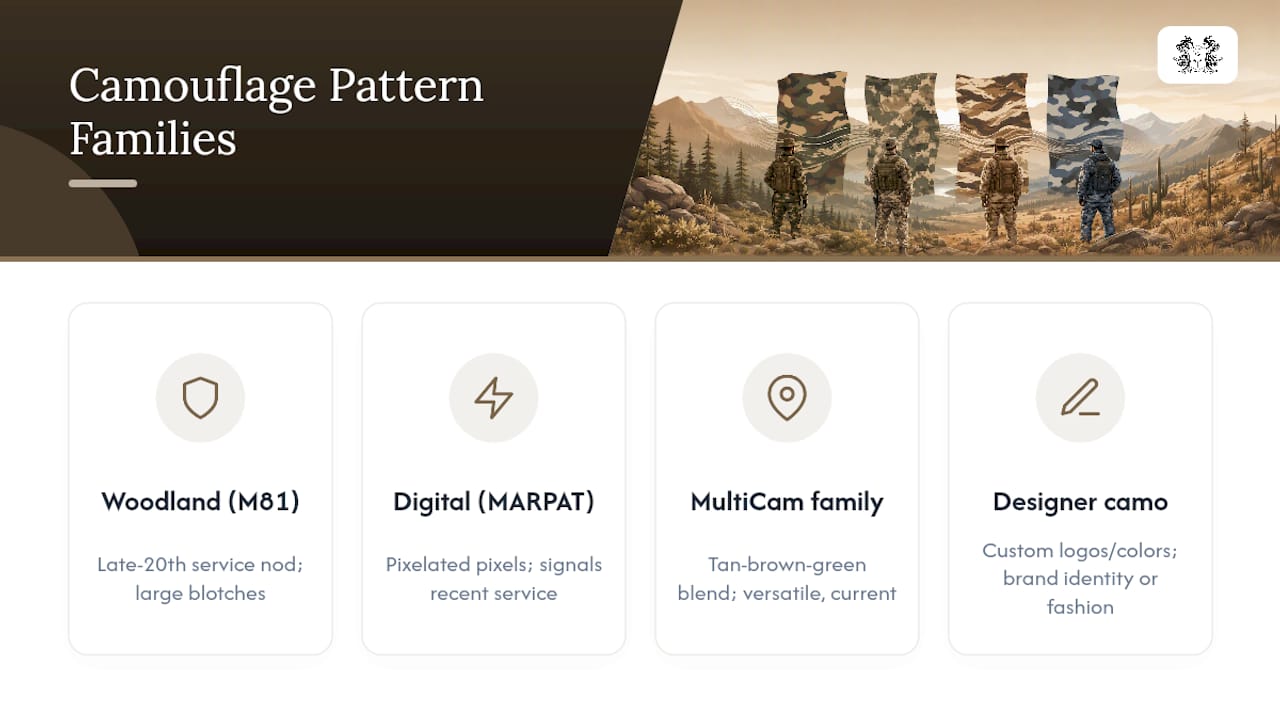
Woodland (M81) is the pattern most Americans picture first: big blotches of green, brown, and black. It dominated U.S. military uniforms from the late 1970s through the early 2000s, and on a civilian jacket or cap, it usually reads as a nod to that era. Practitioners and veterans often treat M81 Woodland as a marker of late-20th-century service, distinct from anything worn today.
Digital patterns, like the pixelated MARPAT family, replaced blotch-style camo in the early 2000s. Small, computer-generated pixels break up outlines more effectively at close range, and on clothing they carry a modern, technical look. Anyone wearing digital camo is usually referencing recent service rather than Vietnam-era or Cold War history.
MultiCam and its Scorpion variants dominate today’s tactical and civilian fashion space alike. MultiCam was developed by Crye Precision and saw broad military adoption starting in the early 2000s, eventually replacing the short-lived Universal Camouflage Pattern, which the Army used from roughly 2005 to 2019 before retiring it as a costly misstep. MultiCam’s tan, brown, and green blend was built to work across multiple terrains at once, and that versatility is exactly why it dominates civilian apparel now. It doesn’t scream one specific war or one specific decade. It just looks current.
Designer and brand-driven camo is a different animal entirely. When a fashion house or apparel brand builds its own camo print, often embedding a logo or symbol into the pattern, it’s signaling brand identity, not military lineage. Scale and color matter here too. A muted, small-scale print reads as understated homage. An oversized, neon-tinted version reads as pure fashion statement, with little connection to service at all.
What Camouflage Communicates in Civilian Dress
Camo carries contradictory meanings at the same time, and that tension is exactly what makes it durable as a fashion motif. It can signal patriotism and support for the armed forces. It can signal rebellion against institutions. It can be pure aesthetic, chosen because a pattern looks sharp with black denim and boots. Fashion critics have long noted this paradox: camo is simultaneously violent and peaceful, conformist and subversive, depending entirely on who wears it and why.
Veterans tend to read camo more literally than the general public does. A pattern isn’t just a graphic to a veteran. It’s tied to unit history, deployment memories, and earned symbols that shouldn’t be treated like costume pieces. That’s part of why commentary on military aesthetics in fashion keeps circling back to one point: brands that strip camo of its context risk turning something meaningful into a novelty print.
There’s also a reclaiming movement worth knowing about. Craftivist groups and independent designers have repurposed surplus camo into protest gear and art installations, deliberately playing with its dual role as both concealment and communication. That reappropriation doesn’t erase camo’s military roots. It adds another layer on top of them.
- Patriotic display: worn to show support for service members and veterans.
- Subversive statement: worn to critique authority or institutional power.
- Pure aesthetic: worn simply because the pattern works with an outfit.
- Reclaimed symbol: repurposed by artists and activists into new visual statements.
Pro Tip: Before buying a camo piece, ask yourself what you want it to say. If the answer is “nothing, it just looks good,” that’s fine, but be aware a veteran standing next to you might read it very differently.
How to Choose Camouflage Apparel That Reflects Your Values
Buying camo with intention starts with matching the pattern to what you actually mean to say. A few habits keep that choice from looking careless.
- Match the era to your intent. If you want to honor a specific period of service, Woodland or a digital pattern from that era says more than a generic “camo-style” print.
- Start small if you’re unsure. A camo-trimmed cap or a single accent piece lets you test the look before committing to a full jacket or pant.
- Check the brand’s provenance. Companies that explain their pattern choices, or that actively engage veteran communities, tend to treat camo with more respect than fast-fashion labels chasing a trend.
- Never replicate earned insignia. Rank, unit patches, and combat badges are earned, not decorative. Keep any patches on your gear legible and honest rather than decorative clutter, a point covered in more depth in this guide to layering tactical casual outfits.
- Care for the garment like it matters. Wash camo pieces inside out to protect the print, and store patched items flat so symbols stay crisp and readable.
| What you want to signal | Pattern to look for | Fit level |
|---|---|---|
| Homage to late-20th-century service | Woodland (M81) | Strong match |
| Modern, technical aesthetic | Digital (MARPAT-style) | Strong match |
| Versatile, contemporary look | MultiCam / Scorpion | Strong match |
| Fashion-forward statement | Designer/brand-driven camo | Casual match |
If you want deeper guidance on wearing military-inspired pieces with the right intent, see this breakdown of military values in modern fashion.
Modern Camouflage: Custom Prints, Runway Riffs, and Upcycling
Camo keeps evolving well past its original pattern families. Custom prints that weave a brand’s logo or a symbolic motif directly into the camo shapes have become common, and that approach signals brand identity first, heritage second.
Runway and streetwear labels take it further, prioritizing color and shape over any military reference at all. Some designers treat camo purely as graphic texture, the same way they’d treat a leopard print or a plaid.
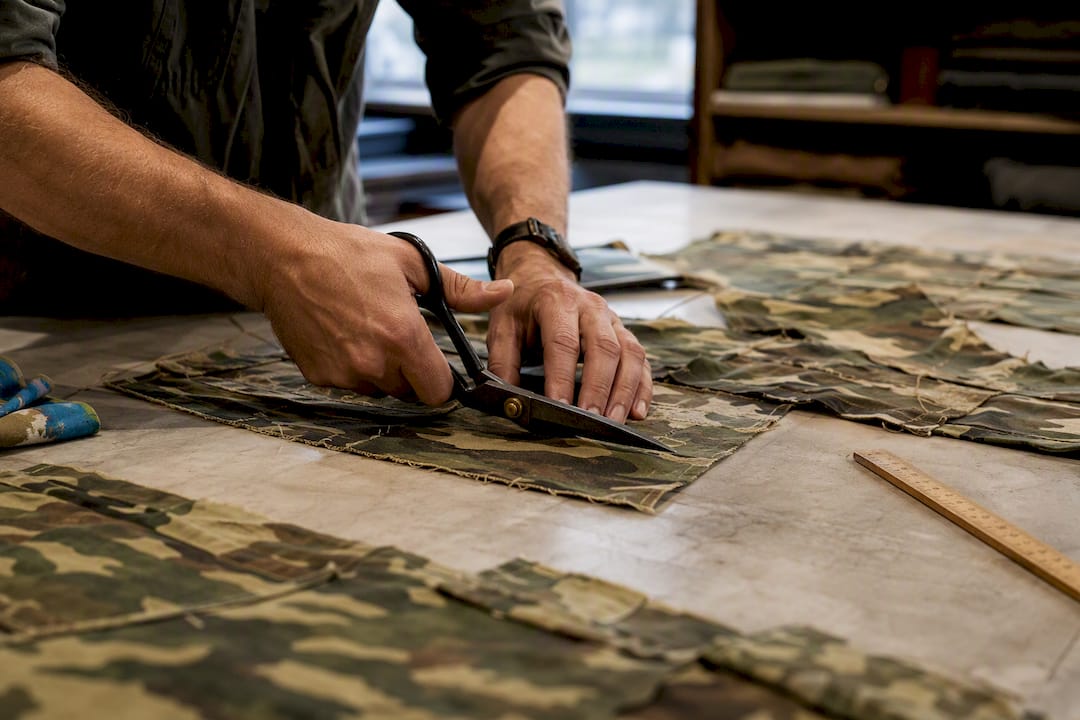
At the other end, sustainability-minded makers are cutting up genuine military surplus and rebuilding it into new garments, preserving the original fabric’s history while giving it a second life. That’s a meaningfully different move than printing a fresh camo pattern onto new cotton. It keeps a physical link to actual service gear rather than just borrowing the look.
Why We Treat Camo as a Statement, Not a Costume
We’re veteran-owned, and that shapes how we look at every camo-adjacent piece we design. Camo isn’t a trend to us. It’s tied to the same code of honor, loyalty, and strength we built this brand around, and we treat every pattern choice with that weight in mind.
That’s why we lean toward pieces that reference the warrior ethos that shapes modern apparel rather than pieces that borrow military looks without any values behind them. Wear it because you mean it. Join a community that expects the same.
— Modern Day Knight
Accessories That Pair With Camo the Right Way
If you’re building out a camo-accented outfit, the right cap finishes the look without competing with it. The Stay Dangerous Hat is built for exactly that. It’s a bold, values-first piece that pairs cleanly with a Woodland jacket or a MultiCam bag, letting the pattern do its work while the hat carries the statement.
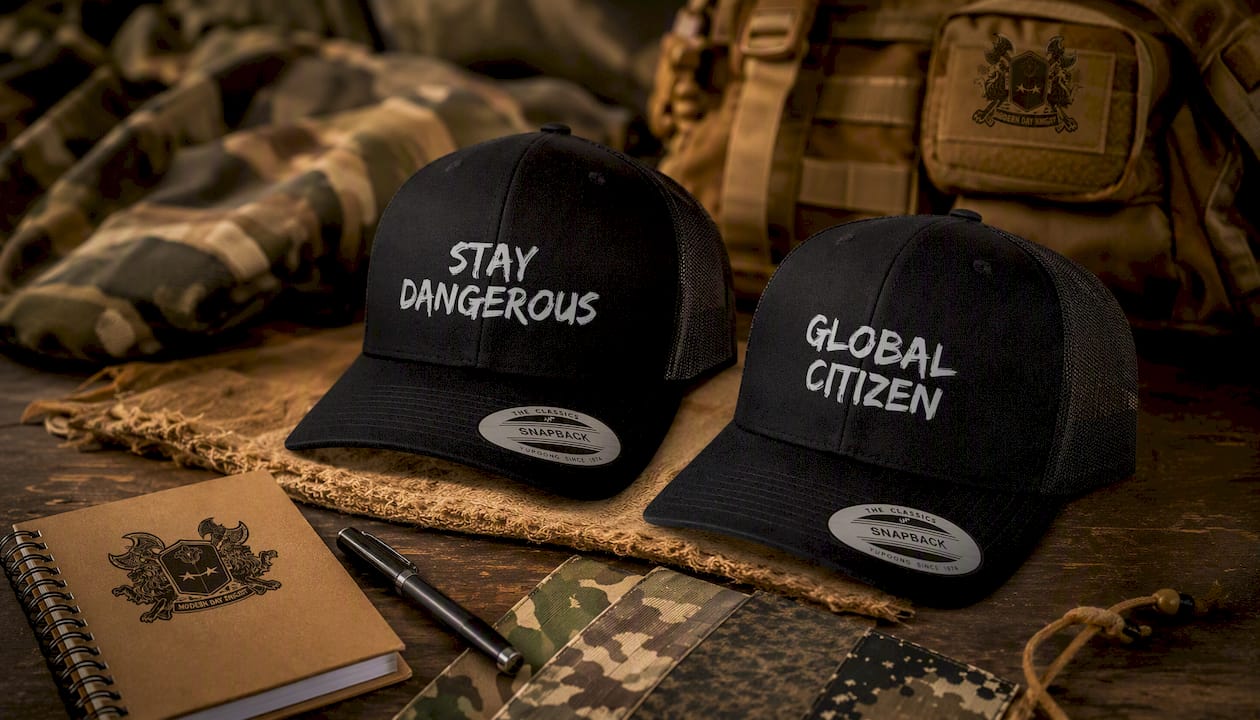
For readers who want something a little more universal, the Global Citizen Hat works across a wider range of camo tones, from muted olive drab to tan-based MultiCam pieces. Both hats are built to hold up next to gear that already means something to you, not to distract from it. Check either product page, see the details, and pick the one that matches the story you’re trying to tell.
Sources
This guide draws on a mix of academic, journalistic, and market research. The Costs of War market analysis supplied the $5.3 billion market figure. The MultiCam Wikipedia entry confirmed pattern development and adoption dates. Fashion history came from Camouflage on the Catwalk, cultural analysis from Camouflage Cultures and Reappropriation, and commentary on respectful use from Navy Times. Together, these sources anchor every claim made above.
- The Militarization of Fashion (market analysis excerpt)
- MultiCam — Wikipedia
- Camouflage on the catwalk (book chapter / fashion history)
- How fashion borrowed military aesthetics and lost the context — Navy Times


